Am I Ready for PMI-RMP? Exam Readiness Checklist (2026)
Tick what you can do today, without notes. The board scores you against the PMI outline and says GO, HOLD or NO-GO before you spend US$520 / US$670 on a booking.
- 115 (100 scored)Questions
- 150 minTime
- Not publishedPass mark
- US$520 / US$670Fee
- Pearson VUEDelivery
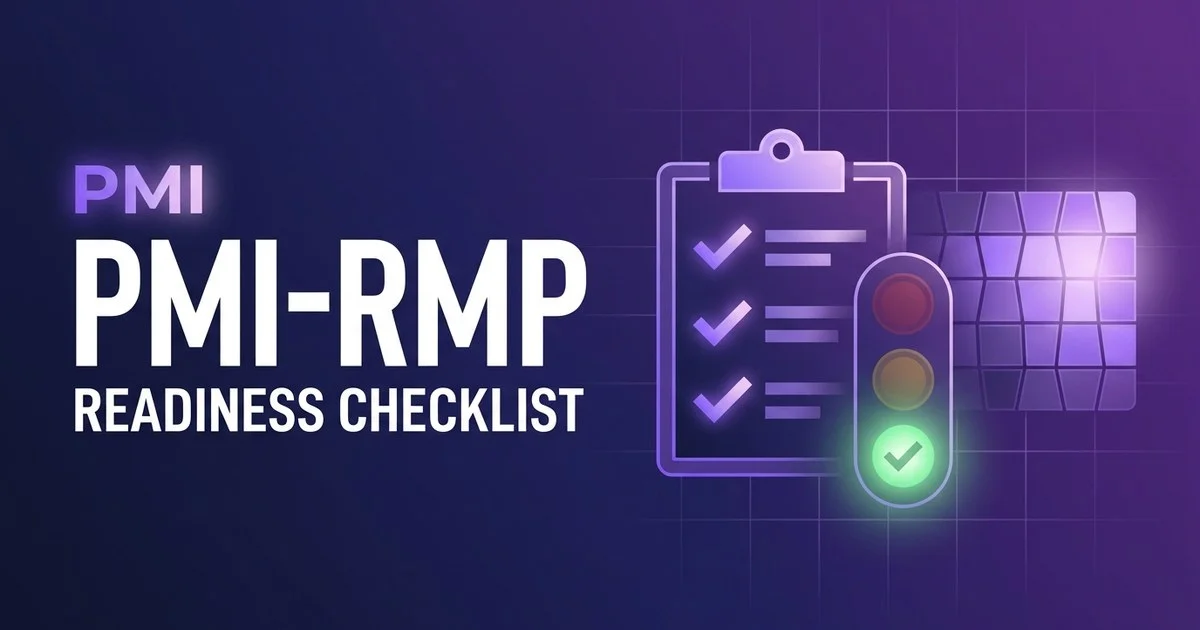
Table of Contents
The PMI-RMP is PMI's specialist credential for people who own risk on projects: risk managers, project and programme managers, PMO analysts and cost or schedule engineers. Before you can book, PMI must accept an application showing one to three years of project risk management experience in the last five years plus 30 or 40 contact hours of risk education, and some applications are audited.
Ready for PMI-RMP means more than reciting tools. The 115 questions are scenarios set in predictive, agile and hybrid projects, and they ask what a risk lead should do next: set thresholds, word a risk properly, pick a response, read a Monte Carlo output or decide what to report. If you can work through the items below from your own experience and explain why the tempting alternative is wrong, book it. If EMV, reserves or secondary risks still send you back to a textbook, wait.
How to use this checklist
Tick only what you can do today, without notes. Each tick is weighted by its domain's share of the official outline, so the score follows the exam, not the number of boxes. A heavy domain (15%+ of the weight) at NO-GO holds the verdict even when the total looks fine. Your ticks are saved in this browser only.
The PMI-RMP readiness checklist
23 items across 5 domains, each one a thing the exam expects you to do rather than recognise.
Your go / no-go board
One lamp per domain, one verdict overall. Amber and red rows are your study plan for the next week or two.
Check your ticks under exam conditions
A tick is a claim; a timed set of questions is the evidence. The PMI-RMP app has 800+ exam-style PMI-RMP questions with an explanation for every option. Do a mixed set and see whether the domains you ticked hold up.
App StoreGoogle PlayFree PMI-RMP practice testRed flags: don't book yet if...
Any one of these on the PMI-RMP is a better predictor of a fail than a low tick count.
Your application would not survive an audit
PMI audits a random share of applications and tells you before you pay. You then have 90 days to supply a copy of your degree, supervisor signatures for every project you listed and certificates for your contact hours. Failing or abandoning the audit brings a one-year suspension.
Fix:Before you submit, confirm each supervisor will sign, collect every course certificate and describe your own risk role on each project, not the project itself.
Your contact hours include self-study
PMI does not accept self-directed learning such as books, videos or mentoring, and the 30 or 40 hours must be project risk content completed before you apply. Only the risk portion of a broader course counts.
Fix:Take a risk course from an Authorized Training Partner, employer programme, training company or university, and record only the hours spent on risk.
Risk maths still takes you several minutes
Risk Analysis is 23% of the exam and covers EMV, decision trees, Monte Carlo and sensitivity analysis. You have about 78 seconds per question, and scenario items mix a calculation with a judgement call.
Fix:Drill EMV, decision trees and reserve calculations from blank paper until each takes under two minutes, then practise reading S-curves and tornado charts.
You only know the predictive playbook
PMI's outline says predictive, agile and hybrid approaches appear across all five domains rather than in one section. A waterfall-only answer is often the distractor.
Fix:For every task in the outline, write how an agile team would handle it: risk-adjusted backlog, spikes, risk reviews in retrospectives and visible burndown.
You see the risk register as the whole job
Risk Strategy and Planning plus Monitor and Close Risks make up 41% of the exam: thresholds, the risk plan, stakeholder engagement, reserves and reporting, not just logging risks.
Fix:Write a one-page risk management plan and a sponsor-level risk report for a real or past project and check both against the outline's task list.
The numbers that say you're ready
Rules of thumb, not official thresholds: PMI does not publish a readiness score. Hit all four before you pay for a booking.
Rule of thumb, not a PMI figure: PMI publishes no pass mark, so aim for a clear margin on two different 115-question mocks sat in 150 minutes.
Rule of thumb. If a decision tree or contingency calculation takes longer than about two minutes, the analysis questions will eat the time you need for scenario reading.
Rule of thumb. Identification and Analysis are 23% each, so a weak spot there costs far more than the same gap in the 13% Risk Response domain.
Rule of thumb. The outline has 19 tasks across five domains; if you can name a real situation where you did each one, scenario questions read like your own job.
Booking and ID checklist
The logistics that trip people up are specific to the PMI-RMP and its delivery provider. Work through them in order.
Submit the PMI-RMP application
Apply online at pmi.org. The draft stays open for 90 days, and you list risk experience project by project and agree to the Code of Ethics. All experience must fall within the last five years.
Clear the audit before paying
PMI notifies you before payment. Upload documents within 90 days; once complete, an audit takes about 5-7 business days and your one-year eligibility period starts when it passes.
Pay the fee and verify identity
US$520 for members, US$670 for non-members. Join PMI before you pay, because PMI will not refund the difference later. PMI may ask for a selfie and photo ID through Persona.
Schedule with Pearson VUE
Use the Eligibility ID from PMI's email to book a test centre (PMI's recommended option) or an online exam. Online testing needs a pre-scheduling identity check and is not open to citizens of China, Macau or Hong Kong.
Make free changes now
Rescheduling or cancelling more than 30 days before the appointment is free. Inside 30 days PMI charges US$70 plus tax for each change.
Changes lock
You cannot reschedule or cancel within 48 hours of the appointment. Missing the exam forfeits the full exam fee.
Check ID and setup
Your government ID must be current and show your photo, signature and Roman characters or an official translation, with the name matching your scheduling notice exactly. Online candidates should run Pearson's system test.
Check in 30 minutes early
Late arrivals are not admitted at test centres. Bring your PMI Eligibility ID and appointment confirmation along with your ID.
Exam-week countdown: T-7 to T-0
Sit one last full mock under real conditions: 115 questions in 150 minutes with a single 10-minute break after question 58. Spend the rest of the week only on your two weakest domains.
Redo EMV, decision tree and reserve calculations from blank paper, then recite the response strategies for threats and for opportunities until you no longer mix them up.
No new material. Confirm your ID matches the scheduling notice, check the route to the centre or rerun the online system test, clear your desk and get a full night's sleep.
Check in 30 minutes early. Finish and review section one before taking the optional break, because once the break starts you cannot go back. Keep to roughly 75 seconds per question and flag sparingly.
Test-day rules
✓ Allowed / expected
- One current government-issued ID with photo, signature and Roman characters, matching your scheduling notice
- Scratch paper and pencils, or erasable boards and markers, supplied by the test centre
- The on-screen calculator, or a handheld calculator on request from the test centre administrator
- One optional 10-minute break after you finish and review the first section
✕ Not allowed
- Personal items at your desk: only your ID and locker key stay on you at a test centre
- Going back to first-section questions once your break has started
- Eating or drinking in the testing room without PMI-approved accommodation
- Leaving the webcam view or your desk outside the scheduled break when testing online; it invalidates your score
- Removing or tearing scratch paper, or sharing exam content
After you pass
Score report at the desk
A computer-based exam ends with a score report showing pass or fail plus diagnostic feedback for each of the five domains. The report is also downloadable from PMI's online certification system. Paper-based candidates in mainland China wait 6-8 weeks.
Listed in the registry
Once you pass, the credential appears in your PMI account and in PMI's online Certification Registry, where employers can verify it. Your three-year certification cycle starts at the same time.
30 PDUs every three years
Keep PMI-RMP active by earning 30 professional development units per three-year cycle: at least 18 in Education, spread across Ways of Working, Power Skills and Business Acumen, and no more than 12 for Giving Back. Then pay the renewal fee.
The PMI-RMP at a glance
| Item | Detail |
|---|---|
| Questions | 115 multiple-choice and multiple-response questions: 100 scored and 15 unscored pretest items |
| Time | 150 minutes, with one optional 10-minute break after the first section (about 58 questions) |
| Passing score | Not published; PMI sets the passing standard by psychometric analysis and reports pass/fail |
| Fee | US$520 for PMI members, US$670 for non-members (US pricing; varies by region) |
| Delivery | Pearson VUE test centre (PMI's recommended option) or online proctored; paper-based only in mainland China |
| Retakes | Up to 3 attempts in the 1-year eligibility period, each retake at a discounted re-exam fee; after 3 fails, wait 1 year to reapply |
| Results | Score report at the end of a computer-based exam with overall pass/fail and diagnostic feedback for each domain |
| Validity and renewal | 3-year CCR cycle: earn 30 PDUs (at least 18 Education, at most 12 Giving Back) and pay the renewal fee |
Turn the amber rows green
Work PMI-RMP questions by domain, starting with whatever the board marked HOLD or NO-GO, then tick again.
App StoreGoogle PlayFree PMI-RMP practice testFAQ
What experience do I need to apply for PMI-RMP?
PMI offers three routes. With a secondary diploma you need 36 months of project risk experience in the last five years plus 40 hours of risk education. With a bachelor's degree it is 24 months and 30 hours. With a degree from a GAC-accredited programme it is 12 months and 30 hours. Self-study does not count toward the education hours.
How many questions are on the PMI-RMP exam and how long is it?
The exam has 115 multiple-choice and multiple-response questions, of which 100 are scored and 15 are unscored pretest items scattered at random. You get 150 minutes, plus an optional 10-minute break after the first section of about 58 questions. Once you start the break you cannot return to that section, so review it first.
What is the PMI-RMP passing score?
PMI does not publish one. Its handbook calls its exams criteria-based: a psychometric standard decides who passes, and only the 100 scored items count. Your report shows pass or fail plus feedback for each domain. Treat any percentage you see online as a guess, and aim for a clear margin on full-length timed mocks instead.
What happens if I fail PMI-RMP?
You can sit the exam up to three times within your one-year eligibility period, paying a discounted re-exam fee for the second and third attempts. If you fail three times, you must wait one year from your last attempt before reapplying for PMI-RMP, although you may apply for other PMI certifications in the meantime. Use the domain feedback to target your study.
Is the PMI-RMP exam content outline changing?
The current Examination Content Outline is the version updated in May 2022, with five domains weighted 22, 23, 23, 13 and 19 percent. As of October 2026 PMI's PMI-RMP page still links that outline and no replacement date has been announced. Check the certification page again before you book, because PMI gives notice before an outline changes.
Sources
Figures on this page come from PMI and the other primary sources below:
- PMI Risk Management Professional (PMI-RMP) certification
- PMI-RMP Examination Content Outline and Specifications
- PMI Certification Handbook
- PMI Continuing Certification Requirements (CCR) Handbook
- PMI Certification FAQs
Checked October 14, 2026. Fees, outlines and eligibility rules change — confirm with PMI before you book.