
PMI-RMP Exam Objectives (2026): Every Domain, Weight and What Gets Asked
The PMI-RMP blueprint has 5 domains and they are nowhere near equal. Here is the exact weighting, roughly how many questions each is worth, and the kind of question each domain actually produces.
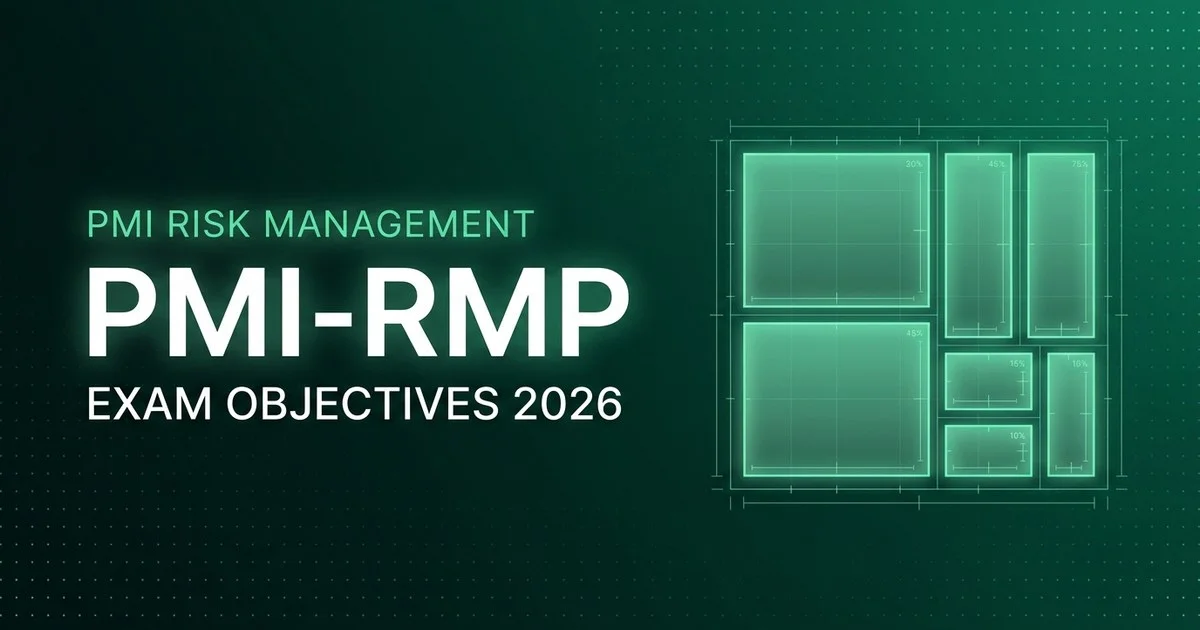
The PMI-RMP blueprint at a glance
Every block below is sized to its share of the exam. The point of drawing it this way is simple: most candidates spread their study time evenly across domains, and the blueprint is not even. Risk Identification alone is 23% of your score.
Block size is proportional to domain weight. PMI publishes these as average weights, so individual exam forms vary slightly.
Domain by domain: what actually gets asked
Weights tell you how much a domain matters. They do not tell you what the questions feel like. This is the part most objective lists leave out.
Risk Identification
23%~26 questionsTechniques over trivia: which elicitation method suits which situation, how to write a risk statement that is not a vague worry, and keeping the register usable.
Risk Analysis
23%~26 questionsThe most quantitative domain. Probability-impact scoring, EMV, decision trees, sensitivity (tornado) diagrams and when simulation is worth the effort.
Risk Strategy & Planning
22%~25 questionsSetting thresholds and appetite with stakeholders, tailoring the risk approach to predictive, agile or hybrid delivery, and defining who owns what.
Monitor & Close Risks
19%~22 questionsKeeping risk live: tracking triggers and residual risk, judging whether a response actually worked, and capturing lessons at closure.
Risk Response
13%~15 questionsSmallest domain, still heavily tested in scenarios. Avoid/transfer/mitigate/accept for threats, exploit/share/enhance/accept for opportunities, plus reserve management.
The study order the weights imply
Sequencing by weight is not the only valid approach — but it is the one that protects your score if you run out of time.
Do first · 46% of the exam
- Risk Identification (23%)
- Risk Analysis (23%)
Then · 41%
- Risk Strategy & Planning (22%)
- Monitor & Close Risks (19%)
Last · 13%
- Risk Response (13%)
One caveat worth stating: a low-weight domain you know nothing about is still a guaranteed loss of those marks. Aim for competence everywhere and depth in the heavy domains, rather than ignoring the tail entirely.
Practise PMI-RMP the way it is actually asked
Exam-style questions weighted to the real blueprint, with an explanation on every answer.
Estimated question counts
Based on a 115-question form. Use it to set a target for how many practice questions per domain you should be getting right.
| Domain | Weight | Approx. questions | Miss all of it and you lose |
|---|---|---|---|
| Risk Identification | 23% | ~26 | 23 points |
| Risk Analysis | 23% | ~26 | 23 points |
| Risk Strategy & Planning | 22% | ~25 | 22 points |
| Monitor & Close Risks | 19% | ~22 | 19 points |
| Risk Response | 13% | ~15 | 13 points |
FAQ
How many domains are on the PMI-RMP exam?
5. The heaviest is Risk Identification at 23% and the lightest is Risk Response at 13%. Weights are averages, so the exact split shifts a little between exam forms.
How many questions come from each PMI-RMP domain?
On a 115-question form, multiply the weight by the total: Risk Identification at 23% is roughly 26 questions. Treat these as planning estimates, not guarantees.
Which PMI-RMP domain should I study first?
Start with Risk Identification and Risk Analysis. Together they are about 46% of the exam, so early progress there moves your score more than anything else.
Do the PMI-RMP objectives change?
Yes. PMI revises the blueprint periodically and weights move with it. Always download the current exam outline from PMI before you build a study plan, and check the version date against any course you buy.
ExamCert Team — we build exam-style practice banks for 90+ certifications. Domain weights here come from the current PMI exam outline; question-count figures are estimates derived from those weights.
Related: PMI-RMP exam guide · Is PMI-RMP worth it in 2026?