Six Sigma Green Belt (CSSGB) Study Plan 2026: 10-Week Calendar
10 weeks at about 9 hours a week, laid out day by day against the ASQ outline, with three checkpoints that tell you when you are ready to book.
- 10 weeksPlan
- ~9 hPer week
- ~88 hTotal
- 110Questions
- 4h 18mExam time
- 550 scaledPass mark
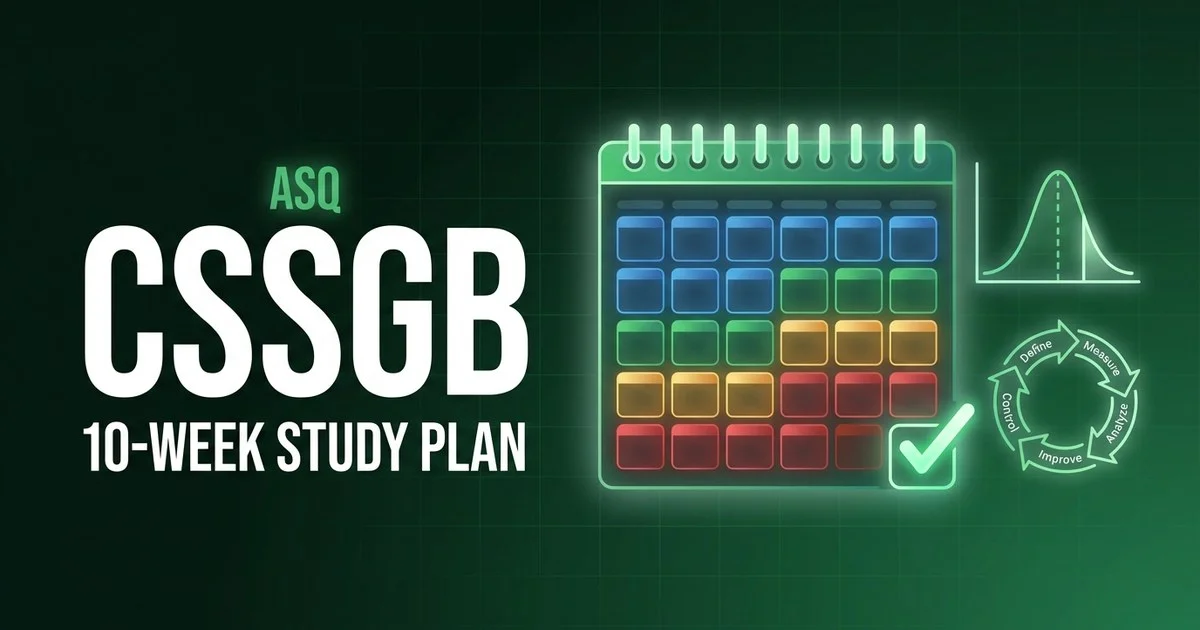
Table of Contents
The CSSGB is usually taken by process engineers, quality analysts, project managers and operations staff who spend part of their time on improvement teams. ASQ requires three years of work experience in at least one area of the Green Belt Body of Knowledge, grants no education waivers, and runs the computer-based exam in even-month Prometric windows.
The exam is open book but not easy. Its 100 scored questions follow the DMAIC sections of the 2022 Body of Knowledge, and Measure and Analyze together account for 38 of them, with probability, capability, regression and hypothesis tests worked on a calculator. At about 2.3 minutes per item, you cannot look everything up. The 10-week plan below teaches the phases in DMAIC order, builds your bound, tabbed reference as you go, and finishes with four timed 258-minute mocks.
The 10-week CSSGB calendar
Who it fits: Someone with some Green Belt project exposure who is comfortable with basic statistics, can study about 9 hours a week, and is aiming at a specific even-month testing window.
Weeks 1-6 teach the six Body of Knowledge sections in DMAIC order, with Measure given two full weeks because it carries the most calculation, and each Sunday review doubles as the time to add tabs and notes to your bound reference. Weeks 7-10 hold four full 258-minute mocks taken open book with the reference you will actually bring, so lookup speed is tested along with knowledge.
- LLearn · New material from the outline
- DDrill · Timed practice questions by domain
- RReview · Error log and spaced recall
- MMock · Full-length timed practice exam
- XRest · Nothing scheduled
- EExam · Test day
| Week | Mon | Tue | Wed | Thu | Fri | Sat | Sun | Hours |
|---|---|---|---|---|---|---|---|---|
| Wk 1 | L1h2022 BoK walkthrough | D1hBaseline diagnostic | L1h15Six Sigma + org goals | L1h15Lean + value streams | XRest | L2hDfSS + FMEA | R1h30Overview recall | 8hours |
| Wk 2 | L1h15Project selection+VoC | D1hDefine phase | L1h15Charter + scope | D1hDefine phase | XRest | L2hPlanning tools + teams | R2hDefine recall + tabs | 8.5hours |
| Wk 3 | L1h15Data types + sampling | L1h15Descriptive statistics | D1hMeasure calculations | L1h15Probability + CLT | XRest | D2h30Distributions drill | R1h30Formula recall | 8.8hours |
| Wk 4 | L1h15MSA + gauge R&R | D1hMSA problems | L1h15Process capability | D1hCp/Cpk vs Pp/Ppk | XRest | D2h30Measure phase mix | R2hWeeks 1-4 recall | 9hours |
| Wk 5 | L1h15Correlation+regression | D1hRegression problems | L1h15Hypothesis testing | D1hMeans/variance tests | XRest | L2hANOVA + chi-square | R2hAnalyze error log | 8.5hours |
| Wk 6 | L1h15DoE basics + plots | D1hDoE + improve | L1hLean tools + kaizen | L1h15SPC + control charts | XRest | D2h30Improve + Control mix | R2hControl plans recall | 9hours |
| Wk 7 | L1hRational subgrouping | D1hControl phase | D1hMixed DMAIC set | R45mFormula + tab check | XRest | M4h18Full mock 1 | R1h30Mock 1 review | 9.6hours |
| Wk 8 | D1hMeasure phase | L1hWeakest stats topic | D1hAnalyze phase | R45mError log recall | XRest | M4h18Full mock 2 | R1h30Mock 2 review | 9.6hours |
| Wk 9 | D1hDefine + Overview | D1hImprove + Control | R1hMissed-item rework | D45mLookup speed drill | XRest | M4h18Full mock 3 | R1h30Mock 3 review | 9.6hours |
| Wk 10 | M4h18Full mock 4 | R1h15Mock 4 review | D1h15Weakest phase | R45mFormula + tab check | R30mLight recall | XRest | EExamExam day | 8.1hours |
Each cell is one day: the session type, the planned minutes and what to cover. The bar along the bottom of a cell is that day's load against the heaviest day in the plan.
What each week has to deliver
A week is done when its exit check passes, not when the calendar says so. If a check fails, repeat that week's drill days before moving on.
| Week | Focus | Exit check |
|---|---|---|
| 1 | Baseline and Six Sigma overview | Finish a baseline diagnostic and tab the handbook by the six Body of Knowledge sections. |
| 2 | Define: projects, VoC, teams | Score 65%+ on a 30-question Define set using no more than five lookups. |
| 3 | Measure: probability and statistics | Compute mean, standard deviation and basic probabilities by hand and score 60%+ on a 30-item statistics set. |
| 4 | Measure: MSA and capability | Get Cp, Cpk, Pp and Ppk right on 10 of 12 problems and reach 65% on the gate 1 mixed set. |
| 5 | Analyze: regression and tests | Pick the right test (z, t, F, chi-square or ANOVA) in 15 of 18 written scenarios. |
| 6 | Improve and Control phases | Choose the correct control chart in 12 of 15 data scenarios and explain a two-level factorial result. |
| 7 | Control wrap-up and first mock | Finish full mock 1 inside 258 minutes and log every miss and slow lookup by phase; pass gate 2 at 70%. |
| 8 | Repair Measure and Analyze, mock 2 | Score 72%+ on mock 2 with Measure and Analyze both higher than on mock 1. |
| 9 | Mock 3 and lookup speed | Score 75%+ on mock 3 with no phase below 65%; pass gate 3. |
| 10 | Final mock, review, taper | Score 75%+ on mock 4, re-pack the bound reference, and stop new material by Thursday. |
Where the hours go
Weights are the question counts per section in ASQ's 2022 CSSGB Body of Knowledge; with 100 scored questions, each count equals its percentage.
Measure gets the largest share of learn-and-drill time, about double its 20% weight, because probability, distributions, MSA and capability are where most calculation errors happen, and Analyze is also boosted for hypothesis testing and regression. Overview and Define get about their weight or less since they are mostly terminology and tools that an open-book reference covers well. Improve and Control share a full week plus drill time, with extra practice on DoE interpretation and control-chart selection.
Study time is the share of the plan's learn and drill hours, set from the published weight and nudged up for heavier domains and down for lighter ones.
Overview: Six Sigma and the OrganizationLighter
≈ 4 hSix Sigma goals, lean concepts, value stream maps and DfSS/FMEA basics are mostly definitions that a tabbed handbook supports well.
Define PhaseLighter
≈ 8 hCharters, voice of the customer, planning tools and team stages are intuitive, but the long tool list creates many near-miss distractors.
Measure PhaseHeavy
≈ 13 hProbability, distributions, descriptive statistics, gauge R&R and Cp/Cpk versus Pp/Ppk all require calculation and careful formula choice.
Analyze PhaseHeavy
≈ 11 hChoosing the right hypothesis test and reading regression and multi-vari results only sticks with practice on real numbers.
Improve PhaseStandard
≈ 8 hDesign of experiments terms and plots take practice to interpret, while the lean tools (waste, cycle time, kaizen) are mostly recall.
Control PhaseStandard
≈ 7 hSPC, rational subgrouping and control-chart selection need hands-on practice; control plans, audits and PDCA are lighter.
Three checkpoints before you book
The calendar is a forecast. These checkpoints are the measurement: each one has a target and a fallback if you miss it.
- End of week 465%
Timed mixed set of about 40 items on Overview, Define and Measure at 2.3 minutes per item, open book with your tabbed reference.
If you miss it: Add one more Measure week (probability and capability) before starting Analyze, and move to the next even-month window if your eligibility allows.
- End of week 770% on mock 1
Full 110-item mock in 258 minutes, scored overall and by phase, with a count of lookups that took over two minutes.
If you miss it: Spend week 8 only on the two lowest phases and rebuild the tabs for every tool you looked up slowly.
- End of week 975% on 2 mocks
Mocks 2 and 3 both at 75% or better with no phase below 65%. ASQ's 550 passing scaled score has no published percentage, so 75% is a buffered working target.
If you miss it: Reschedule into a later window within your three-window eligibility ($130 fee) and repeat the week 8-9 pattern on your two weakest phases.
Run the drill and mock days on ExamCert AI
The D and M cells in the calendar need exam-style questions with explanations. ExamCert AI has CSSGB questions organised by the same outline, so the drill days stay on the domain the calendar names and your checkpoint scores mean something.
Practise CSSGB on ExamCert AIFree CSSGB practice testWhat one study session looks like
Most weekday cells in the calendar are one session of about 75 minutes. Split it like this so every session ends with questions, not just reading:
- Recall (10 min). Write the formulas from the last two sessions from memory (for example standard deviation, Cpk, a t statistic) and check them.
- Learn (30 min). Study one Body of Knowledge subtopic in the Green Belt handbook and work its examples by hand.
- Tab (10 min). Add or fix tabs and margin notes in your bound reference for the tools covered today.
- Drill (20 min). Answer about eight timed questions at 2.3 minutes each, using the reference only when stuck.
- Log (5 min). Record each miss and each slow lookup with its BoK section and the fix.
Pick your pace
Prep providers commonly cite 80 to 120 hours of study for the CSSGB. Ten weeks at about 9 hours lands near 90 hours, inside that range, and fits within ASQ's three-window eligibility period.
Fast track
Engineers or analysts who already run capability studies, hypothesis tests and control charts at work and need the credential for a near window.
Trade-off: Only two full mocks and little time to build a well-tabbed reference, so open-book lookups stay slow.
Standard
Most candidates with some project exposure and basic statistics who can study about 9 hours a week.
Trade-off: Exam week starts with a 258-minute mock, which usually means a day off or a long evening block.
Steady
Candidates new to statistics or returning to study after years away.
Trade-off: The plan spans more than one testing window, so the date must be fixed early and early Measure topics need spaced review to stay fresh.
The CSSGB you are planning for
| Questions | 110 multiple-choice on computer (100 scored, 10 unscored); the paper-based Mandarin version has 100 |
| Time | 4 hours 18 minutes of exam time within a 4.5-hour appointment |
| Passing standard | Scaled score of 550; ASQ does not publish the raw-score percentage, and passing points are pre-equated across exam forms |
| Fee | $483 nonmember, $383 ASQ member; $283 retake for everyone; $130 to reschedule |
| Delivery | Prometric test center or live remote proctoring in even-month testing windows; open book with bound references; on-screen calculator or a silent handheld without an alphabetic keyboard |
| If you fail | $283 per retake, no attempt limit; not in the same testing window as the failed attempt, and within two years of your last attempt |
Materials the plan uses
| Resource | Type | Cost | How the plan uses it |
|---|---|---|---|
| ASQ CSSGB Body of Knowledge (2022) | Official | Free | Week 1 checklist; its question counts per section drive the hour allocation, and its section numbers become your reference tabs. |
| ASQ Certification Candidate Handbook | Official | Free | Read the reference-material, calculator and remote-proctoring rules before you assemble your bound reference. |
| The Certified Six Sigma Green Belt Handbook (ASQ Quality Press) | Textbook | Varies | Primary reading for every learn block and the core of the bound reference you bring into the exam. |
| The ASQ Certified Six Sigma Green Belt Study Guide, Second Edition (ASQ Quality Press) | Question bank | Varies | Practice questions by BoK section for drill blocks and mocks; do not bring it into the exam unless the questions are removed, because ASQ bans question-and-answer collections. |
| ASQ Certified Six Sigma Green Belt Certification Preparation course | Course | Varies | Optional structured lessons if you want guided coverage of weeks 1-6. |
| NIST/SEMATECH e-Handbook of Statistical Methods | Free | Free | Plain explanations of capability, MSA, regression and control charts when the Green Belt handbook is too brief; study use only, since electronic references are not allowed in the exam. |
CSSGB study-plan mistakes
- Treating open book as a safety net. At about 2.3 minutes per question you can afford a handful of lookups, not one per item, so know the formulas and use the book to confirm table values.
- Bringing a reference that is rejected at check-in. Hand-stapled notes, loose pages, electronic copies, and study guides whose practice questions have not been removed are not allowed; Post-it tabs must be attached before you arrive.
- Underweighting Measure and Analyze. They are 38 of the 100 scored questions and hold most of the calculations, including capability, MSA, hypothesis tests and regression.
- Learning control charts by name only. Control-phase questions ask which chart fits the data type and subgroup size, so practise chart selection and rational subgrouping with actual data.
- Booking without checking the windows. The CSSGB runs only in even months, eligibility covers three consecutive windows, and a retake cannot fall in the same window as the failed attempt.
The final week, day by day
- T-7
Confirm your Prometric appointment (test center or live remote) inside your even-month window and that the name matches your government ID. If testing remotely, run the system check on the exam computer now. - T-5
Lock the bound reference: handbook and notes in a spiral or ring binder, tabs attached, no hand-stapled pages or e-copies, and any practice-question collections removed or left at home. Prometric desks are about 48 by 24 inches. - T-3
Pack a silent, battery-operated calculator without an alphabetic keyboard (no TI-89), clear its memory, and add a backup. Use the on-screen calculator once in your last timed set. - T-1
Light formula review only. Set out an unexpired government-issued ID and your references, and plan to arrive 30 minutes early; late arrivals forfeit the fee. Remote candidates use the on-screen Scratchpad, not paper. - T-0
Budget about 2.3 minutes per item across 258 minutes, flag long lookups and return to them, and remember the clock does not stop for breaks at a test center. Prometric shows a result on screen; ASQ's official email follows in about seven days.
Book it when the third checkpoint passes
Two full mocks above your target is the signal. Run them on ExamCert AI, review every miss, and book the CSSGB while the material is fresh.
Practise CSSGB on ExamCert AIFree CSSGB practice testFAQ
Is the CSSGB exam open book?
Yes. ASQ's candidate handbook says all ASQ exams are open book. References and notes must be permanently bound, for example in a spiral or ring binder, Post-it tabs must be attached before you arrive, and electronic copies, hand-stapled notes and collections of practice questions and answers are not allowed. Prometric desks are about 48 by 24 inches, so bring only what you will use.
How many questions are on the CSSGB and what is the passing score?
The computer-based exam has 110 multiple-choice questions, 100 scored and 10 unscored, with 4 hours 18 minutes of exam time inside a 4.5-hour appointment. ASQ reports a passing scaled score of 550 but does not publish the raw percentage, and passing points are pre-equated across forms, so aim for 75% or better on timed mocks.
How much does the CSSGB exam cost?
The first attempt costs $483 for nonmembers and $383 for ASQ members. Retakes are $283 for members and nonmembers alike, and rescheduling costs $130. Weigh the $100 member discount against the cost of membership, and budget for the Green Belt handbook you will bring as your bound reference.
What calculator can I use on the CSSGB exam?
The computer-based exam includes an on-screen basic scientific calculator. You may also bring any silent, hand-held, battery-operated calculator without an alphabetic keyboard, with programmable memory cleared before you enter; models like the TI-89 are banned. A backup calculator is allowed, and ASQ says a simple calculator is enough for every calculation.
Can I take the CSSGB online, and what happens if I fail?
Yes. ASQ offers live remote proctoring through Prometric as well as test centers; remote candidates use the on-screen Scratchpad instead of paper. If you fail, you can retake for $283 in a later testing window, not the same one, within two years of your last attempt, with no limit on attempts. The CSSGB does not require recertification once earned.
Sources
Figures on this page come from ASQ and the other primary sources below:
- ASQ: Six Sigma Green Belt Certification (CSSGB)
- ASQ CSSGB Body of Knowledge (2022)
- ASQ Certification Candidate Handbook
- ASQ CSSGB Certification Fact Sheet
Checked October 7, 2026. Fees, outlines and eligibility rules change — confirm with ASQ before you book.