Am I Ready for PCEP? Exam Readiness Checklist (2026)
Tick what you can do today, without notes. The board scores you against the Python Institute outline and says GO, HOLD or NO-GO before you spend from US$69 on a booking.
- 30Questions
- 40 + 5 minTime
- 70%Pass mark
- From US$69Fee
- TestNow / onlineDelivery
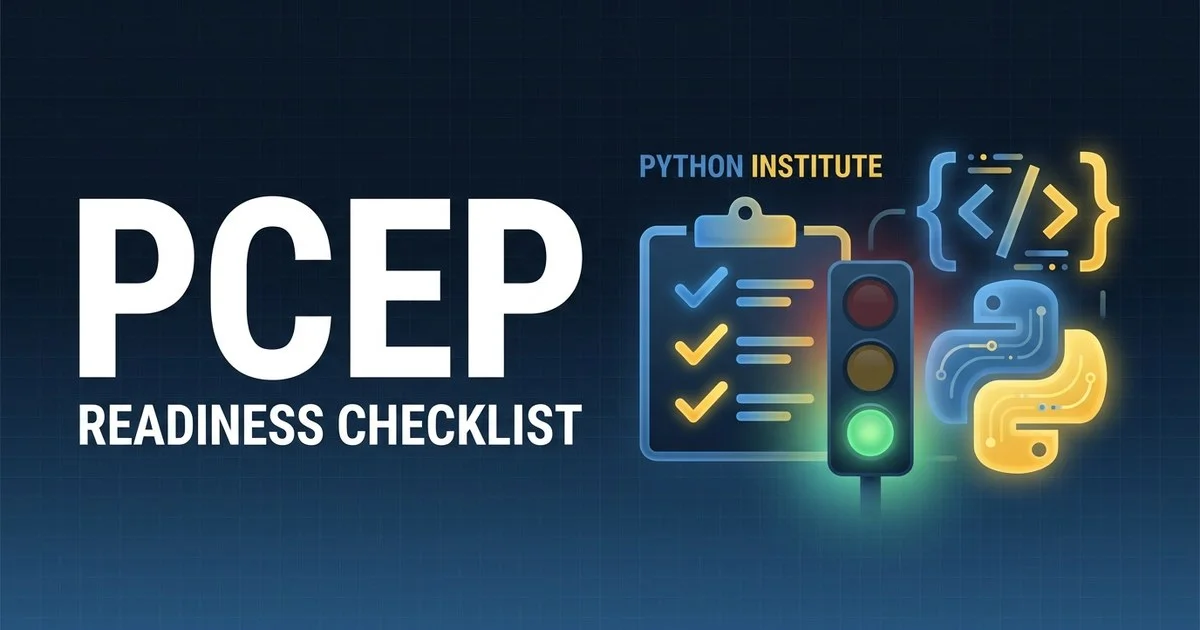
Table of Contents
PCEP is the Python Institute's entry-level credential for people who are new to programming or new to Python: students, testers, analysts and career-changers. The exam gives you 30 items in 40 minutes, and many are not simple recall. You fill gaps in code, insert missing lines, order statements and predict what a short program prints, so you need to read Python precisely and quickly.
Ready means you can trace short programs in your head without an interpreter: loops with break and else, slices with negative steps, functions with default arguments and exceptions that travel up the call stack. The pass mark is 70%, and control flow plus functions and exceptions carry well over half the weight. A new exam version, PCEP-30-03, is due on 31 October 2026, so check which version you will sit. Tick only what you can do today without running code.
How to use this checklist
Tick only what you can do today, without notes. Each tick is weighted by its domain's share of the official outline, so the score follows the exam, not the number of boxes. A heavy domain (15%+ of the weight) at NO-GO holds the verdict even when the total looks fine. Your ticks are saved in this browser only.
The PCEP readiness checklist
20 items across 4 domains, each one a thing the exam expects you to do rather than recognise.
Your go / no-go board
One lamp per domain, one verdict overall. Amber and red rows are your study plan for the next week or two.
Check your ticks under exam conditions
A tick is a claim; a timed set of questions is the evidence. ExamCert AI has exam-style PCEP questions with an explanation for every option. Do a mixed set and see whether the domains you ticked hold up.
Practise on ExamCert AIPCEP practice questionsRed flags: don't book yet if...
Any one of these on the PCEP is a better predictor of a fail than a low tick count.
You have watched Python videos but rarely written code
PCEP includes code fill, code insertion, gap fill and sorting items. Recognising correct syntax is easier than producing it under a 40-minute clock.
Fix:Work through the free Python Essentials 1 course and type every example yourself, then change it and predict the new output before running it.
You guess at operator precedence and integer division
The fundamentals block leans on operator priority, //, %, ** and bitwise operators, and one wrong rule can cost several items.
Fix:Predict twenty one-line expressions a day, including negative operands and mixed int and float, then check each in the interpreter.
Loop else and nested break still trip you up
Control flow is the heaviest block at 29%, and loop-else behaviour is the kind of detail that short code-tracing items test.
Fix:Write ten small nested loops with break, continue and else, predict each output on paper, then run them and explain any miss.
You are buying a voucher without checking the exam version
PCEP-30-03 is due on 31 October 2026. The current store vouchers are labelled PCEP-30-02, and the official site had not said how vouchers carry over when we checked.
Fix:If you will not sit before the switch, read the exam page and voucher terms first, and match your study material to the version you will take.
Your computer or room will not pass TestNow's rules
TestNow needs a desktop or laptop (no tablets or phones), a webcam and microphone on throughout, one screen and an empty room. Leaving the camera view can end the session.
Fix:Run the diagnostics check on the same machine and network days ahead, and allow *.edube.org and *.openedg.org on any managed network.
The numbers that say you're ready
Rules of thumb, not official thresholds: Python Institute does not publish a readiness score. Hit all four before you pay for a booking.
A rule of thumb, not an official figure: the pass mark is 70%, and a margin protects you from unfamiliar item types and wording.
Rule of thumb: 40 minutes is 80 seconds per item. Finishing with ten minutes spare leaves time to re-trace the code items you flagged.
Rule of thumb: most items ask what code does or which line completes it. If your predictions are right 90% of the time, the format will not surprise you.
Rule of thumb: if you can explain why except Exception catches ValueError but not KeyboardInterrupt, the functions and exceptions block is in good shape.
Booking and ID checklist
The logistics that trip people up are specific to the PCEP and its delivery provider. Work through them in order.
Create a Test Candidate account
Register a TestNow test candidate account with OpenEDG. Use your real name as you want it on the certificate, since you may be asked to show ID at check-in.
Buy a voucher from the OpenEDG store
The exam starts from US$69, US$86 with a retake and US$95 with a retake and practice test. Exam vouchers are valid for 12 months from purchase and must be redeemed before they expire.
Know that online exams have no appointment
TestNow online exams do not need booking or rescheduling. You start whenever you redeem the voucher, as long as it has not expired.
Check your equipment
Use a desktop or laptop with keyboard and mouse or touchpad, the latest browser (Chrome preferred), a webcam, a microphone and a stable, ideally wired, connection of at least 1 Mbps down.
Prepare your room and ID
Choose a quiet, well-lit room with a neutral background where you will be alone. You may be asked to photograph your face and your ID during check-in.
Book through a testing partner
At an OpenEDG Testing Service Partner such as a school, arrive 15 minutes early with a valid government photo ID, and reschedule with the facility at least 24 hours ahead.
Get consent first
Candidates aged 13 to 17 can test and be certified with parental or legal guardian consent. Children under 13 cannot test, even with consent.
Exam-week countdown: T-7 to T-0
Take a full timed 30-item practice test in 40 minutes. Sort your misses by block and spend the week on the two weakest, coding small examples rather than rereading notes.
Run the TestNow diagnostics check on your exam computer and network. Turn off automatic updates and notifications, and reread the PCEP testing policies so nothing on the day surprises you.
Light review only: the operator precedence order, slicing rules and the built-in exception hierarchy. Check your voucher code and its expiry date, and clear the desk and room.
Close every other app, plug in the laptop and make sure you will be alone. Log in, enter the voucher, finish check-in and allow 5 minutes for the NDA and tutorial before the 40-minute clock.
Test-day rules
✓ Allowed / expected
- A desktop or laptop with a keyboard and a mouse or touchpad, and one screen
- A current browser such as Chrome, Firefox, Edge, Safari or Opera, with JavaScript enabled
- Webcam and microphone on for the whole session, with your face and shoulders in view
- Extra time of 25%, 50% or 100% if an accommodation request is approved before the exam
✕ Not allowed
- Breaks: the PCEP has none scheduled, and leaving the camera view can end the session
- Notes, books, phones, smart watches, headsets, smart glasses or a second monitor
- Leaving full-screen mode, opening new tabs or moving the pointer outside the exam window
- Writing, copying, photographing or recording any part of the exam
- Anyone else in the room, or help from messaging apps or voice assistants
After you pass
Preliminary score, then verification
The score at the end of the exam is preliminary. Sessions are reviewed and only become final once they pass verification. Your score report, with a breakdown, sits in Exam History in your account.
Certificate and badge
Within 24 hours you get an email with a link to your digital certificate, a verification code and a PCEP badge issued through Credly, ready to share on LinkedIn.
Five-year validity and next steps
The Python Institute lists PCEP as valid for five years. The PCEP page does not describe a renewal route, so check it before your five years are up. The next step on the path is PCAP.
The PCEP at a glance
| Item | Detail |
|---|---|
| Questions | 30 items: single- and multiple-select, drag and drop, gap fill, sort, code fill, code insertion and scenario-based items |
| Time | 40 minutes for the exam plus 5 minutes for the NDA and tutorial |
| Passing score | 70%, as a cumulative score across all four blocks |
| Fee | From US$69 for the exam; from US$86 with a retake; from US$95 with a retake and practice test |
| Delivery | Online through OpenEDG TestNow with OpenEDG online proctoring, or at an OpenEDG Testing Service Partner. English, Spanish, Portuguese, Polish or Japanese |
| Retakes | Wait 7 days after a fail; no limit on retakes. A new voucher is needed unless you bought the retake bundle, whose retake must be used within 90 days |
| Results | Score shown at the end is preliminary until the session is verified; certificate, verification code and Credly badge emailed within 24 hours |
| Validity and renewal | 5 years |
Turn the amber rows green
Work PCEP questions by domain, starting with whatever the board marked HOLD or NO-GO, then tick again.
Practise on ExamCert AIPCEP practice questionsFAQ
Does the PCEP certification expire?
Yes. The Python Institute's exam page lists PCEP's validity as five years, and its notice about the new exam version refers to the five-year validity of credentials already earned. Older guides, including some prep sites, still call PCEP a lifetime certification, but that is not what the official page says now. The page does not describe a renewal process, so check it before your five years are up.
How long is the PCEP exam and how many questions does it have?
There are 30 items in 40 minutes, plus 5 minutes for the non-disclosure agreement and tutorial. Items include single- and multiple-select questions, drag and drop, gap fill, sorting, code fill, code insertion and scenario-based tasks. That works out at 80 seconds per item, so fast, accurate tracing of short snippets matters more than wide but shallow knowledge.
What is the PCEP passing score and how are the blocks weighted?
You need 70%, worked out as a cumulative score across all four blocks, so a strong block can make up for a weaker one. The blocks are Computer Programming and Python Fundamentals (7 items, 18%), Control Flow (8 items, 29%), Data Collections (7 items, 25%) and Functions and Exceptions (8 items, 28%). Each item is worth up to 40 points before normalising.
Should I wait for PCEP-30-03?
PCEP-30-03 is scheduled for release on 31 October 2026, and PCEP-30-02 is the active version until then. If you are ready now, sitting 30-02 earns the same PCEP credential, and the Python Institute says the update does not affect credentials already earned. If you will start after the switch, check the exam page for the 30-03 syllabus before buying study material or a voucher.
Do I need to book a time slot or go to a test centre?
Usually not. The PCEP page lists OpenEDG's TestNow as the delivery channel, not Pearson VUE. With online proctoring you log in, enter your voucher code, run the diagnostics check and start when you are ready; there is no appointment to reschedule. Schools and training organisations that are OpenEDG Testing Service Partners can run proctored sessions on site, and those do have appointments.
Sources
Figures on this page come from Python Institute and the other primary sources below:
- Python Institute: PCEP - Certified Entry-Level Python Programmer
- Python Institute: PCEP-30-0x exam syllabus
- Python Institute: TestNow PCEP testing policies
- OpenEDG store: PCEP-30-02 exam + retake + practice test voucher
Checked October 14, 2026. Fees, outlines and eligibility rules change — confirm with Python Institute before you book.