NBCOT COTA Exam Content Outline 2026: Domains and Weights
Every NBCOT COTA domain, how much of the paper it is, what its questions ask you to do and the order to study it in, straight from the NBCOT outline.
- 3Domains
- 190Questions
- 240 minTime
- 55%Heaviest area
- $540Exam fee
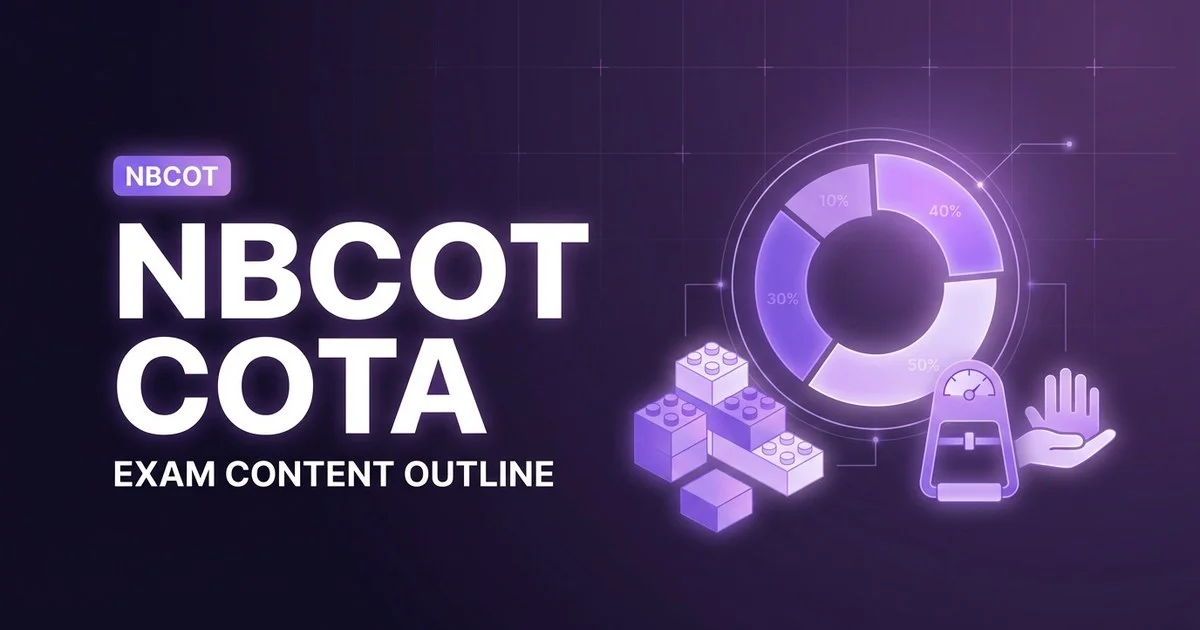
Table of Contents
The outline at a glance
National Board for Certification in Occupational Therapy publishes the COTA outline that every NBCOT COTA question is written against (2022 COTA Examination Content Outline, based on the 2022 practice analysis; in effect for all COTA exams since January 2, 2024). This page turns that document into what you actually need before you study: how big each area is, what the questions in it ask you to do, and the order to learn it in.
- Domain 2: Select and Implement Interventions~104 questions55%
- Domain 1: Collaborate and Gather Information~51 questions27%
- Domain 3: Uphold Professional Standards and Responsibilities~34 questions18%
What each domain actually asks
The official outline describes what each area covers. Below is what the questions in it ask you to do, which is what decides how you should study it.
Domain 2: Select and Implement Interventions
55%~104 itemsIt asks you to: Carry out the OTR's intervention plan: choose how to grade an activity, position a client, train a transfer, adapt a task or use a device safely for the client in the vignette.
- Preparatory methods and physical agent modalities; wound and skin integrity
- Occupation-based ADL/IADL, play, leisure, work and social participation; grading activities; group dynamics
- Cognitive, perceptual, visual and sensory strategies; compensatory and remedial approaches
- Feeding, eating and swallowing; functional transfers; wellness and mental health
- Therapeutic exercise, edema and scar management, balance and body mechanics
- Orthotic fabrication and prosthetic training
- Assistive technology, seating, mobility aids and community mobility
- Implementing environmental modifications and accessibility
Domain 1: Collaborate and Gather Information
27%~51 itemsIt asks you to: Recognize what a condition or life history means for function, gather and report the right information to the supervising OTR, and spot when a client's response means the plan needs to change.
- Influence of development, lived experience, body functions/structures and identity on occupational performance
- Gathering information for the occupational profile (referrals, records, IEPs)
- Purpose, limits and service-competency needs for standardized and nonstandardized assessments
- Activity analysis: task demands, performance skills, context
- Interprofessional collaboration, client-centered approach, therapeutic use of self, health literacy
- Monitoring the plan with the OTR: response to intervention, precautions, vital signs
Domain 3: Uphold Professional Standards and Responsibilities
18%~34 itemsIt asks you to: Decide what a COTA is allowed and expected to do: respond to an adverse event, stay within supervision rules and scope, document correctly, and handle ethical dilemmas.
- Using evidence and quality improvement to support safe, effective services
- Infection control, emergency response, safety and risk management
- Laws, state practice acts, supervision requirements, reimbursement and documentation
- Professional development, service competency and burnout prevention
- Ethical decision-making under the NBCOT Code of Conduct
Study it in this order
Weight is the only honest guide to where your hours go. The areas that make up the first half of the paper are core; the next third is support; whatever is left is a quick win you review last, not skip.
| Domain | Weight | Items | Priority |
|---|---|---|---|
| Domain 2: Select and Implement Interventions | 55% | ~104 | Core |
| Domain 1: Collaborate and Gather Information | 27% | ~51 | Support |
| Domain 3: Uphold Professional Standards and Responsibilities | 18% | ~34 | Quick win |
Item counts are the weight applied to 190 scored questions and rounded, so treat them as approximate.
How the exam is built
| Item | Detail |
|---|---|
| Questions | 190 |
| Time | 240 minutes |
| Question types | Three-option single-response multiple choice, Four-option single-response multiple choice, Six-option multi-select (select 3 of 6) |
| Delivery | Computer-based, in person at Pearson VUE test centers (Pearson Professional Centers and PTC Selects); Pearson replaced Prometric on January 2, 2024. No remote/online-proctored option; the handbook describes the standard exam as taken in person at a test center. |
| Passing standard | Criterion-referenced; scores reported on a 300-600 scale and a total scaled score of at least 450 is required to pass. Passing standard set by a modified Angoff method. |
| Fee | $540 — Same fee schedule as OTR: online initial application $540, paper $595; retake $430 online / $485 paper; ATT reissue $115; extra score transfers or eligibility notices $35 each (one of each free with the application). |
| Retakes | New application required for each retest. Waiting periods: 2nd-3rd attempt 30 days after last exam; 4th-6th attempt 60 days; 7th attempt or more six months. Each approved application gives a 90-day ATT testing window. |
| Published pass rate | 67% (First-time new graduates (tested within one year of graduation), first attempt; 2,806 candidates, 2025) |
Where candidates lose marks
These are the places the outline and the real exam part ways, the parts of the outline candidates misjudge most often:
- Answering like an OTR: the COTA exam frames tasks as under the supervision of or in collaboration with the OTR. Options where the COTA independently evaluates, interprets standardized results or rewrites the plan are usually wrong.
- Underestimating Domain 2: implementing interventions is 55% of the exam, so grading activities, transfers, positioning, orthotics, AT and modalities should take most of your study time.
- Mis-studying the item format: COTA multi-select items are standalone (pick 3 of 6), not the OTR scenario sets. OTR-focused scenario-set prep is not a direct match.
- Skipping safety and precautions: post-surgical precautions, vital signs, infection control and emergency response appear in both Domain 1 and Domain 3.
- Assuming it is easy to pass: only 67% of first-time new graduates passed in 2025, down from 74% in 2023.
Turn the outline into practice
ExamCert AI has 800 NBCOT COTA practice questions with explanations, built around the same outline this page walks through. Work them by domain, find the weak area, and fix it before test day.
Practise NBCOT COTA on ExamCert AIHow to Become an Occupational Therapy Assistant in 2026FAQ
What are the domains on the NBCOT COTA exam?
There are three: Collaborate and Gather Information (27%), Select and Implement Interventions (55%), and Uphold Professional Standards and Responsibilities (18%). They come from the 2022 COTA Examination Content Outline, which has applied since January 2, 2024.
How many questions are on the COTA exam?
The COTA exam has 190 items to answer in four hours. They are three- and four-option single-answer multiple-choice items plus six-option multi-select items where you choose three answers. Some items are unscored field-test questions, but NBCOT does not publish how many.
Does the COTA exam have scenario sets or clinical simulations?
No. Scenario sets, which replaced CSTs in January 2024, appear only on the OTR exam. The COTA exam uses standalone multiple-choice and six-option multi-select items, and NBCOT did not change its item types in 2024.
What is the passing score for the COTA exam?
You need a scaled score of at least 450 on NBCOT's 300-600 scale. The cut score is criterion-referenced and set with a modified Angoff method, so your result does not depend on how other candidates perform.
Sources
Figures on this page come from NBCOT and the other primary sources below:
- NBCOT 2022 COTA Examination Content Outline
- NBCOT Certification Exam Handbook (ID 40 rev121625)
- NBCOT Foundations of the Certification Examinations
- NBCOT 2024 Exam Frequently Asked Questions
- NBCOT Fees
- NBCOT Certification Renewal
- NBCOT Certification Activities: New Graduate Testing
- BLS Occupational Outlook Handbook: Occupational Therapy Assistants and Aides
- ACOTE Accreditation Standards (2023, effective July 31, 2025)
- AOTA: OT Licensure Compact Begins Issuing Privileges to Practice
Checked September 25, 2026. Fees, outlines and eligibility rules change — confirm with NBCOT before you book.