SHRM-CP Exam Content Outline 2026: New BASK, New Weightings
SHRM rewrote the BASK for 2026 and moved the weights: Leadership up to 19%, Interpersonal down to 13.5%. And 40% of the paper is situational judgment, where recall alone will not carry you.
- 134 (110 scored)Questions
- 3h 40mTime
- 6Sections
- YesWeights published
- 200 on 120-200Pass mark
- $350-$499Fee
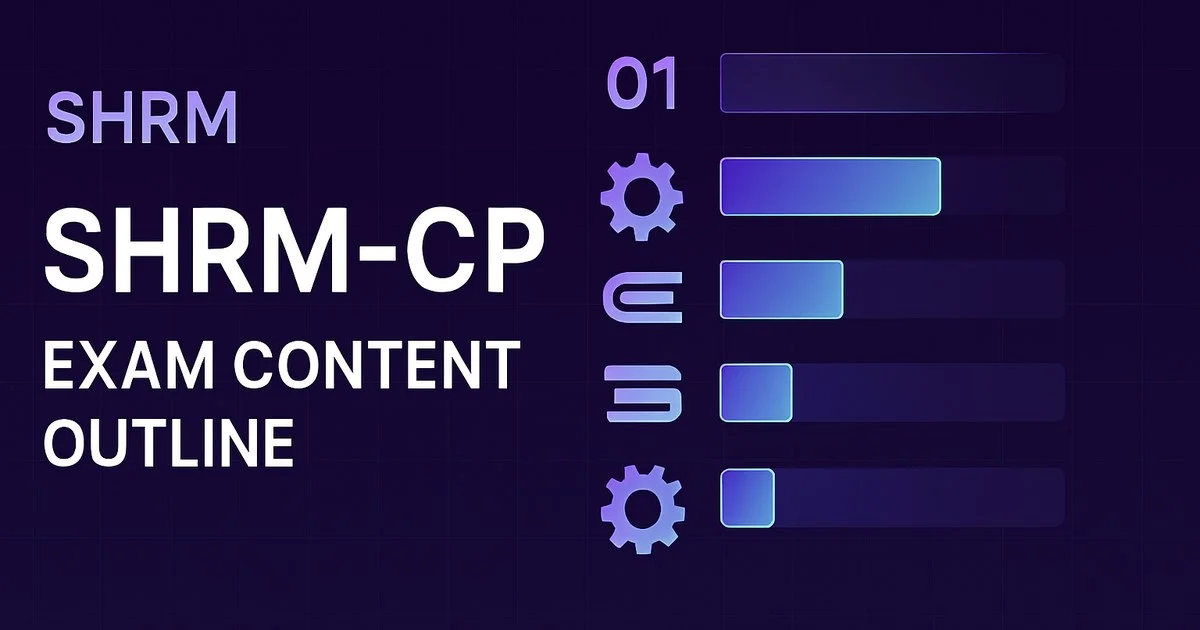
Table of Contents
The whole paper in one bar
The 2026 SHRM Body of Applied Skills and Knowledge (SHRM BASK) is the exam guide SHRM publishes for SHRM Certified Professional (SHRM-CP), restated so you can see the shape of the paper before you read a word of the detail. The bar below is the entire syllabus: 6 sections, in the order the certifying body lists them.
- §1 Leadership Cluster — 19%
- §2 Interpersonal Cluster — 13.5%
- §3 Business Cluster — 17.5%
- §4 People Domain — 19%
- §5 Organization Domain — 18%
- §6 Workplace Domain — 13%
Those percentages are SHRM’s own, not an estimate. That matters more than it sounds: most pages ranking for this query quote weightings the certifying body never published.
The syllabus, section by section
Each block below is one section of the official outline. The bullets are the sub-objectives SHRM publishes underneath it — the actual scope statement, not a summary of it.
Leadership Cluster
- Leadership & Navigation: navigating the organisation, vision, managing HR initiatives, influence
- Leadership and motivation theories: situational, transformational, servant leadership; expectancy, equity, Herzberg
- Ethical Practice: personal integrity, professional integrity, acting as an ethical agent
- Ethics concepts: conflicts of interest, confidentiality and privacy, standards for employee investigations
- Inclusive Mindset (new for 2026): connecting I&D to performance, inclusive infrastructure, impartiality and fairness
- Operating in a global environment: cultural dimensions (Hall, Hofstede, Schein, Trompenaars), globally diverse workforces
- Measuring inclusion and equity: pay audits, pay equity reports, retention of diverse employees
Interpersonal Cluster
- Relationship Management: networking, relationship building, teamwork
- Negotiation: interest-based versus position-based bargaining, principled bargaining, perspective taking
- Conflict management: relationship versus task conflict; accommodate, collaborate, compromise, compete, avoid
- Trust-building: emotional intelligence, transparency, recognising individual strengths
- Communication: delivering messages, exchanging organisational information, listening
- Specialised situations: giving feedback, facilitating focus groups, translating jargon, communication plans
Business Cluster
- Business Acumen: competitive awareness, business analysis, strategic alignment
- Financial basics: P&L, balance sheet, cash flow, budgets, ROI, SWOT, KPIs, business cases
- Consultation: evaluating business challenges, designing and advising on HR solutions, service excellence
- Change management models: Lewin, Kotter's eight steps, McKinsey 7S, Kubler-Ross change curve
- Analytical Aptitude: data advocacy, data gathering, data analysis, evidence-based decision-making
- Statistics and measurement: descriptive statistics, correlation, reliability, validity, reading charts
People Domain
- HR Strategy: strategic planning frameworks (PESTLE, SWOT), project management approaches, systems thinking
- Talent Acquisition: employee value proposition, job analysis, sourcing, selection methods, onboarding
- AI in hiring: AI-supported resume screening, AI-based skills matching, AI-generated interview guides
- Employee Engagement & Retention: culture, workplace flexibility, engagement surveys, performance management
- Learning & Development: needs analysis, ADDIE, adult learning, developmental assessments, career development
- Total Rewards: compensation philosophy (lead, lag, match), market data, pay equity and transparency, leave and benefits
- People metrics: cost per hire, time to fill, quality of hire, voluntary turnover
Organization Domain
- Structure of the HR Function: centralised and decentralised models, centres of excellence, shared services, outsourcing
- Organizational Effectiveness & Development: group dynamics, organisational design structures, organisational analysis
- Workforce Management: workforce planning (build, buy, borrow, bridge), gap analysis, succession planning
- Restructuring: mergers and acquisitions, reductions in force, layoffs, furloughs
- Employee & Labor Relations: ILO standards, ADR, retaliation prevention, investigations, progressive discipline
- Grievances and labour action: complaint resolution, strikes, lockouts, boycotts
- Technology Management: HRIS, ATS, LMS, generative AI tools, data protection, AI-use and social media policies
Workplace Domain
- Managing a Global Workforce: immigration and mobility, international assignments, repatriation, offshoring and nearshoring
- Risk Management: enterprise risk processes and treatments, compliance audits, business continuity, emergency planning
- Safety and security: workplace violence, insider threat, data breach, injury and illness prevention
- Corporate Social Responsibility: sustainability-related HR activity, CSR strategy, community engagement
- U.S. employment law, part 1: IRCA and I-9, FLSA, Equal Pay Act, ERISA, NLRA, Taft-Hartley, WARN
- U.S. employment law, part 2: OSHA, HIPAA, Title VII, ADEA, ADA, FMLA, COBRA, USERRA
The SHRM BASK - renamed from the SHRM BoCK - weights the exam on two axes at once. The three behavioural competency clusters are half the score and the three HR knowledge domains are the other half. Item type cuts across both: 40% situational judgment and 10% foundational knowledge items test the competencies, and 50% HR-specific knowledge items test the domains. So the behavioural half is four-fifths scenarios. Of the 134 items, 80 are stand-alone knowledge questions and 54 are scenario-based, and 24 are unscored field-test items you cannot spot. The SHRM-SCP uses the same BASK, weights and item mix; the CP is judged against the proficiency indicators for all HR professionals only.
What the weightings really mean
A percentage in an exam guide is a promise about how many questions get drawn from a section, not about how hard those questions are. On a paper of roughly 110 items, Leadership Cluster at 19% is worth about 21 questions and Workplace Domain at 13% is worth about 14. No single section decides the result on its own here - the largest is 19% of the paper - so the result is decided by how few sections you leave weak, not by how well you master one.
The trap is treating that arithmetic as permission to skip. Weightings are the floor of what a section costs you, because the low-weight sections on almost every blueprint are the ones that supply context for questions filed under a different heading. You lose those marks in the heavy section and never find out why.
Reading the verbs in the objectives
The verb at the front of each sub-objective is the part candidates skim and examiners take literally. It sets the depth you are tested at, and it is the difference between recognising a term and being asked to choose between two answers that both look right.
| Verb | What a question at that depth looks like |
|---|---|
| Know / Define (knowledge items) | Half the score. Stand-alone questions on the 14 functional areas - what FMLA covers, what a lag pay policy is, which workforce-planning option fits a skills gap - with one correct answer and no scenario around it. |
| Recognise (foundational knowledge items) | 10% of the paper tests the concepts behind the competencies directly: Kotter against Lewin, interest-based against position-based bargaining, correlation against validity. Short and definitional, and lost by candidates who skipped the competency pages of the BASK. |
| Choose the best action (situational judgment) | 40% of the paper. A realistic workplace scenario, several workable responses, and credit only for the one a panel of experienced HR professionals rated best. Expect two defensible options; the better one usually acts at the right level and involves the right stakeholder. |
SHRM pitches the SHRM-CP at operational HR work: implementing policy, supporting day-to-day HR and acting as the HR point of contact. Situational judgment items are scored against what experienced practitioners would do, not against the letter of a policy, so read each scenario for whose decision it is before you read the options.
Study it in this order, not the syllabus order
Exam guides are written to describe what a candidate must know, not to teach it. The published order is almost never the order that builds knowledge fastest. This is the sequence that front-loads the material everything else depends on.
| Order | Why here |
|---|---|
| 1. People Domain | 19%, tied for the largest weight. Talent acquisition, engagement, L&D and total rewards are the settings most scenarios are written in, so learn them first. |
| 2. Organization Domain | 18%. HR structure, workforce planning, employee and labour relations and technology, including the new AI-use policy content. It builds directly on People. |
| 3. Workplace Domain | 13%. US employment law, risk, global mobility and CSR. The statute list is long but finite: memorise it once, early, and review it weekly. |
| 4. Business Cluster | 17.5%. Business acumen, consultation and analytical aptitude. Finance, change models and basic statistics feed the foundational knowledge items. |
| 5. Leadership Cluster | 19%. Leadership & Navigation, Ethical Practice and the new Inclusive Mindset. Read the 2026 Inclusive Mindset pages fresh even if you studied an older BASK. |
| 6. Interpersonal Cluster | 13.5%, now only Relationship Management and Communication. Almost all of it reaches you through situational judgment, so practise it as scenarios rather than reading. |
Knowledge first, judgment second: a total-rewards scenario cannot be judged before you know total rewards. But start timed scenario sets in week one, because the behavioural half of the score is 80% situational judgment and that skill improves with volume, not with re-reading.
What changed, and how to spot the next change
The 2026 SHRM BASK merged Inclusion & Diversity and Global Mindset into one Leadership-cluster competency, Inclusive Mindset, leaving eight behavioural competencies instead of nine, and added AI examples across competencies and functional areas. The weights moved with it. SHRM's 2026 handbook puts Leadership at 19% (was 17%), Business 17.5% (16.5%), Interpersonal 13.5% (16.5%), People 19% (18%), Organization 18% (unchanged) and Workplace 13% (14%). SHRM's own BASK web page still says nine competencies, last updated 2021; the PDF and the May 2026 handbook say eight. The 134-item, 3h 40m format is unchanged. The 2025 handbook offered US remote proctoring; the exam is now Prometric test centres only. From 3 June 2026 fees fell to $350 member / $450 non-member early-bird and $399 / $499 standard. Recertify every three years with 60 PDCs or by retesting.
Two habits keep you from studying a retired outline. First, open the official exam guide and look for its revision date before you buy anything — courses and question banks lag a syllabus change by months, and the cheapest ones never catch up. Second, re-check it the week you book. A revision announced after you started studying is still a revision you sit.
Turn the syllabus into questions
Reading an outline tells you the shape of the paper. Answering questions tells you which sections you would actually lose marks on. Start free, then $5.99 unlocks the full SHRM-CP bank.
App StoreGoogle PlayFree practice testSHRM-CP exam pageFAQ
What are the SHRM-CP clusters and domains and their weightings?
Six, on two axes. Behavioural competency clusters: Leadership 19%, Interpersonal 13.5% and Business 17.5%. HR knowledge domains: People 19%, Organization 18% and Workplace 13%. These are SHRM's 2026 figures, and each axis is half the score. By item type the same exam is 40% situational judgment, 10% foundational knowledge and 50% HR-specific knowledge. On the 110 scored items that is roughly 21, 15, 19, 21, 20 and 14 questions.
What is the passing score for the SHRM-CP?
200 on a scaled range of 120 to 200, and every candidate who passes is reported at 200, so there is no such thing as a high pass. Only the 110 scored items count; the 24 field-test items do not. SHRM pre-equates forms and publishes no raw cut. Its latest published global pass rate is 68% for the May-July 2025 window, against 50% for the SHRM-SCP.
Do I need HR experience or a degree to take the SHRM-CP?
No. SHRM requires no degree, no HR job title and no prior HR experience, and membership is optional; a basic working knowledge of HR is recommended. The gotchas are logistical. You can only test in two windows, 1 May to 15 July and 1 December to 15 February, at a Prometric test centre. The two 110-minute sections are timed separately and you cannot go back once you leave Section 1.
How much does the SHRM-CP cost in total?
For the 1 December 2026 to 15 February 2027 window: $350 for SHRM members and $450 for non-members at the early-bird rate, which closed on 31 August, or $399 and $499 at the standard rate, open until 24 December. Every rate includes a $50 non-refundable application fee, and the standard rate adds a $49 deadline fee. A fail means applying again in a later window at the full fee. Moving to the next window costs $150.
Sources
Every section title, sub-objective and number on this page comes from the certifying body:
- https://www.shrm.org/content/dam/en/shrm/credentials/shrm-certification/bask/shrm-bask.pdf
- https://www.shrm.org/content/dam/en/shrm/credentials/shrm-certification/2026_shrm_certification-handbook.pdf
- https://www.shrm.org/content/dam/en/shrm/credentials/shrm-certification/2025-shrm-certification-handbook.pdf
- https://www.shrm.org/credentials/certification/exam-options-fees
- https://www.shrm.org/credentials/certification/shrm-cp
- https://www.shrm.org/credentials/certification/eligibility-criteria
Checked October 9, 2026. Exam guides are revised without notice — confirm against SHRM before you build a study plan around this page.