PTCE Exam Content Outline 2026: Domains, Weights, Traps
Every PTCB PTCE domain, how much of the paper it is, what its questions ask you to do and the order to study it in, straight from the PTCB outline.
- 4Domains
- 90Questions
- 110 minTime
- 35%Heaviest area
- $129Exam fee
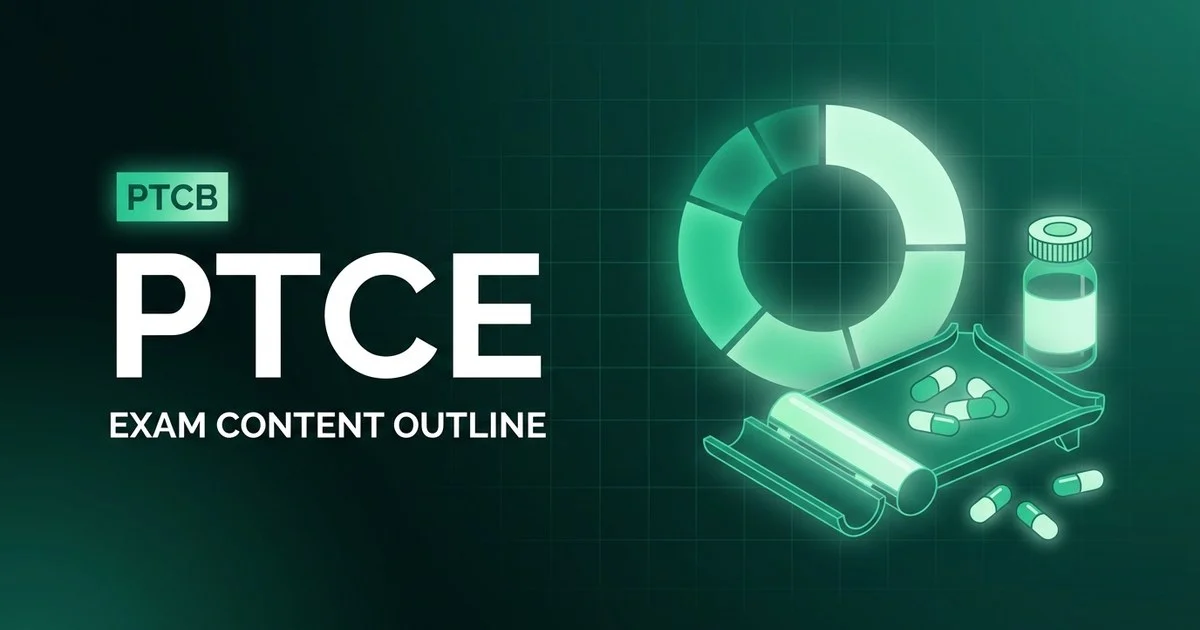
Table of Contents
The outline at a glance
Pharmacy Technician Certification Board publishes the PTCE outline that every PTCB PTCE question is written against (PTCE Content Outline v1.4, effective January 6, 2026). This page turns that document into what you actually need before you study: how big each area is, what the questions in it ask you to do, and the order to learn it in.
- Medications~28 questions35%
- Patient Safety and Quality Assurance~19 questions23.8%
- Order Entry and Processing~18 questions22.5%
- Federal Requirements~15 questions18.8%
What each domain actually asks
The official outline describes what each area covers. Below is what the questions in it ask you to do, which is what decides how you should study it.
Medications
35%~28 itemsIt asks you to: Expect to match a brand name to its generic and drug class, spot a duplicate therapy on a patient profile, flag a dangerous interaction or allergy for the pharmacist, and work out how long a reconstituted suspension or opened insulin vial stays good and how it must be stored.
- Generic names, brand names, and classifications of medications
- Therapeutic duplications
- Common or life-threatening drug interactions and contraindications (drug-drug, drug-dietary supplement, drug-laboratory, drug-nutrient, drug-disease)
- Strengths/doses, dosage forms, routes of administration, special handling and administration instructions, duration of therapy (calculation-based)
- Common or severe side effects, adverse effects, and allergies
- Indications of medications
- Drug stability, e.g. oral suspensions, insulins, reconstitutables, injectables, vaccines (calculation-based)
- Proper storage: temperature ranges, light sensitivity, restricted access
Patient Safety and Quality Assurance
23.8%~19 itemsIt asks you to: Scenario items ask you to catch the error before it leaves the pharmacy: a dose written as .5 or 5.0 mg, a LASA pair shelved side by side, a patient asking which OTC product to take, or a vaccine reaction. You must decide whether to fix it, report it (and to which system), or escalate to the pharmacist.
- High-alert/high-risk and look-alike/sound-alike (LASA) medications
- Error prevention strategies: Tall Man lettering, separating inventory, leading and trailing zeros, bar code use, error-prone abbreviations
- Issues that require pharmacist intervention: DUR, adverse drug events, OTC recommendations, therapeutic substitution, misuse, adherence, post-immunization care, allergies, interactions (calculation-based)
- Event reporting: medication errors, MedWatch, VAERS, near misses, root-cause analysis, continuous quality improvement
- Types of prescription errors: wrong dose, quantity, patient, drug, or route (calculation-based)
- Infection prevention and cleaning standards: hand hygiene, PPE, cleaning counting trays and equipment
Order Entry and Processing
22.5%~18 itemsIt asks you to: Mostly math and translation: turn a sig like 1 tab PO BID x 10d into a quantity and days supply, calculate a dilution or concentration, read the parts of an NDC, pick the right syringe or supply for a prescription, and decide whether an expired or returned item goes back to stock or to reverse distribution.
- Formulas, calculations, ratios, proportions, conversions, Sig codes, abbreviations, and medical terminology for days supply, quantity, dose, concentration, and dilutions (calculation-based)
- Equipment and supplies for drug administration: diabetic supplies, spacers, oral and injectable syringes, filters, nebulizers, immunization supplies (calculation-based)
- Lot numbers, expiration dates, and National Drug Code (NDC) numbers (calculation-based)
- Identifying and returning dispensable, non-dispensable, and expired medications (credit return, return to stock, reverse distribution)
Federal Requirements
18.8%~15 itemsIt asks you to: Questions put you in a federal-law situation: how many refills or transfers a Schedule III-V prescription allows, which DEA form covers ordering C-II drugs or reporting a theft, how much pseudoephedrine a customer may buy, what a Class I recall requires, or what to do with a product that fails DSCSA verification.
- Federal rules for storage, handling, and disposal of non-hazardous, hazardous (e.g. P-list) and pharmacological wastes
- Controlled substance prescriptions (new, refill, transfer) and DEA schedules (calculation-based)
- Receiving, storing, ordering, labeling, dispensing, returning, take-back, loss/theft reporting, and destruction of controlled substances
- Restricted drug programs, e.g. pseudoephedrine limits and REMS (calculation-based)
- FDA medication recall requirements
- DSCSA product serialization, tracking, tracing, handling, and quarantine
Study it in this order
Weight is the only honest guide to where your hours go. The areas that make up the first half of the paper are core; the next third is support; whatever is left is a quick win you review last, not skip.
| Domain | Weight | Items | Priority |
|---|---|---|---|
| Medications | 35% | ~28 | Core |
| Patient Safety and Quality Assurance | 23.8% | ~19 | Core |
| Order Entry and Processing | 22.5% | ~18 | Support |
| Federal Requirements | 18.8% | ~15 | Support |
Item counts are the weight applied to 80 scored questions and rounded, so treat them as approximate.
How the exam is built
| Item | Detail |
|---|---|
| Questions | 90 |
| Scored questions | 80 |
| Unscored pretest items | 10 |
| Time | 110 minutes |
| Question types | M, u, l, t, i, p, l, e, -, c, h, o, i, c, e |
| Delivery | In person at Pearson VUE test centers (1,400+ in the US). PTCB states online testing is available for all its credential exams except the PTCE, so online proctoring of the PTCE is currently paused (reported as effective December 12, 2025, with no announced return date). |
| Passing standard | Scaled score of 1,400 or higher on a 1,000-1,600 scale; PTCB uses IRT pre-equating across exam forms. Official score reports are typically available within 3 weeks. |
| Fee | $129 — $129 covers the CPhT application and one PTCE attempt; the current fee is due again for every retake. After approval you get a 90-day authorization window to schedule, which can be extended by 90 days for $20 (up to two extensions). Total appointment time is 2 hours: 5-minute tutorial, 1 hour 50 minutes of exam time, and a 5-minute survey. |
| Retakes | No set limit on attempts. For a 2nd or 3rd attempt you can reapply as soon as you receive the official score report from the previous attempt. Before a 4th attempt you must wait 6 months. After 4 attempts you must submit evidence of an acceptable preparation activity (e.g. 6+ months of tutoring by a pharmacist or CPhT, a formal review course, an ASHP/ACPE-accredited program, or a pharmacy technician associate degree) started and completed after your last attempt. |
| Published pass rate | 69% (All CPhT/PTCE candidates in 2025 (49,253 PTCEs administered); PTCB does not specify first-time vs repeat, 2025) |
Where candidates lose marks
These are the places the outline and the real exam part ways, the parts of the outline candidates misjudge most often:
- Studying from a pre-2026 outline. Federal Requirements jumped from 12.5% to 18.75% on January 6, 2026, and now includes DSCSA serialization, FDA recalls, and REMS. Older prep books that treat law as a small slice will leave you short.
- Treating math as a single topic. Nine outline statements across all four domains are flagged as calculation-based, so days supply, dilutions, reconstitution stability, and pseudoephedrine limits can show up anywhere, not just in Order Entry.
- Confusing federal and state law. The PTCE tests federal rules only (DEA schedules, C-II refill and transfer limits, DEA forms for ordering, loss and destruction). Answering with your own state's stricter rule is a common way to miss an easy item.
- Memorizing the top 200 drugs by name only. Medications (35%) also asks classes, indications, major interactions, and storage and stability, e.g. which products need refrigeration or protection from light and how long an opened insulin is good.
- Missing the pharmacist-intervention line. Patient Safety scenarios often end with a question the technician should not answer (an OTC recommendation, a DUR alert, a possible adverse event); the right choice is to refer to the pharmacist, not to counsel.
Turn the outline into practice
ExamCert AI has 2,264 PTCE practice questions with explanations, built around the same outline this page walks through. Work them by domain, find the weak area, and fix it before test day.
Practise PTCE on ExamCert AIHow to Become a Pharmacy Technician in 2026FAQ
How many questions are on the PTCE in 2026?
The PTCE has 90 multiple-choice questions: 80 scored and 10 unscored pretest items. You get 1 hour 50 minutes of exam time inside a 2-hour appointment that also includes a short tutorial and survey.
What changed on the PTCE content outline in 2026?
A new outline took effect on January 6, 2026. Medications dropped from 40% to 35%, Federal Requirements rose from 12.5% to 18.75%, Patient Safety and Quality Assurance fell from 26.25% to 23.75%, and Order Entry and Processing rose from 21.25% to 22.5%. The federal law domain now explicitly covers DSCSA, FDA recalls, and REMS.
What score do you need to pass the PTCE?
You need a scaled score of 1,400 on a scale of 1,000 to 1,600. PTCB uses multiple exam forms and IRT pre-equating, so the scaled score is not a fixed percentage of questions correct.
Can you take the PTCE online?
Not currently. PTCB states that online testing is available for all of its exams except the PTCE, which is delivered in person at Pearson VUE test centers. The online proctored option was paused in December 2025 with no announced return date.
Sources
Figures on this page come from PTCB and the other primary sources below:
- PTCB - PTCE Content Outline (effective January 6, 2026)
- PTCB - Certified Pharmacy Technician (CPhT) credential page
- PTCB Help Center - At-a-Glance: CPhT Exam
- PTCB Help Center - Can I retake the PTCE?
- PTCB Help Center - Where and when can I take my PTCB Exam?
- PTCB Help Center - Recertification Policy
- PTCB - Renewal Requirements and fees
- PTCB - Credentials by the Numbers (2025 pass rate)
- BLS Occupational Outlook Handbook - Pharmacy Technicians
- Texas State Board of Pharmacy - Pharmacy Technician Application
- Oregon Board of Pharmacy - Certified Oregon Pharmacy Technician License
- California State Board of Pharmacy - Pharmacy Technician License
- Illinois IDFPR - Pharmacy Technician application checklist
Checked September 25, 2026. Fees, outlines and eligibility rules change — confirm with PTCB before you book.