NHA CPT Phlebotomy Exam Content Outline 2026
Every NHA CPT domain, how much of the paper it is, what its questions ask you to do and the order to study it in, straight from the NHA outline.
- 5Domains
- 120Questions
- 120 minTime
- 28%Heaviest area
- $134Exam fee
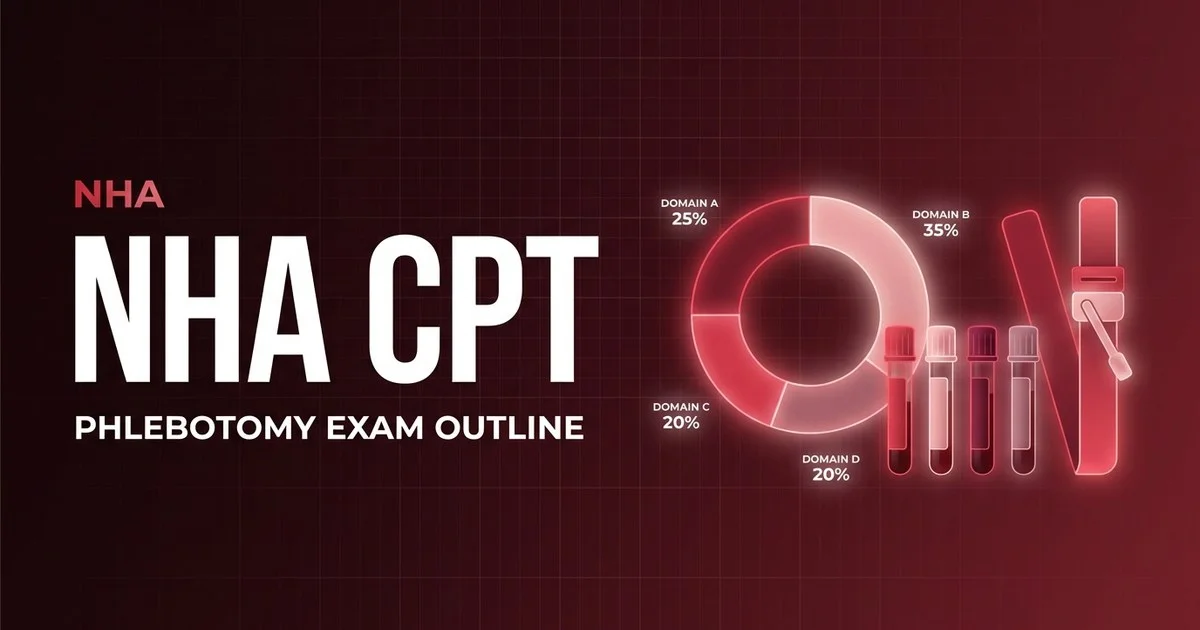
Table of Contents
The outline at a glance
National Healthcareer Association publishes the CPT outline that every NHA CPT question is written against (2025 CPT test plan, based on a job analysis completed in 2024; new exam version launched January 7, 2026 (new study materials released October 8, 2025)). This page turns that document into what you actually need before you study: how big each area is, what the questions in it ask you to do, and the order to learn it in.
- Routine Blood Collections~28 questions28%
- Safety and Compliance~26 questions26%
- Patient Preparation~20 questions20%
- Processing~14 questions14%
- Special Collections~12 questions12%
What each domain actually asks
The official outline describes what each area covers. Below is what the questions in it ask you to do, which is what decides how you should study it.
Routine Blood Collections
28%~28 itemsIt asks you to: The largest domain: you sequence the draw, pick the correct tube and order of draw for a set of ordered tests, troubleshoot a draw that stops flowing (redirect, change angle, change tube), and respond when a patient shows signs of syncope or nerve involvement.
- Select and assemble equipment (evacuated tube system, syringe, winged set) and needle gauge
- Equipment quality checks (sterility, expiration, defects)
- Tourniquet application/removal, palpation, antisepsis, anchoring the vein, angle of insertion
- Order of draw for venipuncture and for capillary collection
- Tube additives, fill level/ratios and number of inversions
- Recognize and respond to complications (hematoma, no blood flow, nerve pain, syncope)
- Dermal (capillary) puncture procedure
- Post-procedure care and specimen labeling
Safety and Compliance
26%~26 itemsIt asks you to: Scenario questions where you pick the correct next step after something goes wrong (a needlestick, a blood spill, a fainting patient, an out-of-range fridge log) or choose the right PPE and precaution level for a given patient.
- Workplace safety regulations (OSHA, NIOSH) and operational standards (The Joint Commission, CLSI, CDC)
- HIPAA and Protected Health Information
- Scope of practice and ethical standards (NHA code of ethics)
- Quality control for lab equipment, POC and CLIA-waived tests (logs, calibration, refrigerator/freezer temps)
- Sharps/biohazard disposal and the Bloodborne Pathogens Standard
- Exposure control plans (needlesticks, blood spills, eye contamination)
- Transmission-based and standard precautions, PPE, hand hygiene
- Emergency response, CPR and first aid; incident documentation and reporting
Patient Preparation
20%~20 itemsIt asks you to: Questions test what you must confirm before the needle comes out: whether the ID is sufficient, whether a non-fasting patient can proceed, who can consent for a minor or a patient with dementia, and which arm or site you may not use (e.g. a fistula side).
- Obtain, review and verify orders/requisitions (STAT, routine, timed draws)
- Positive patient identification using required identifiers
- Implied, informed and expressed consent; guardian permission
- Insurance, copays, registration and billing documentation (incl. ICD-10-CM coding)
- Verify patient compliance with fasting, medication, basal-state requirements
- Interview for allergies, fainting history and other special considerations
- Patient positioning and venipuncture site selection per CLSI
- Instruct patients on non-blood specimen collection (urine, stool, semen, sputum)
Processing
14%~14 itemsIt asks you to: Questions ask how to keep a specimen valid after collection: which samples go on ice or are protected from light, when to spin and separate, what breaks chain of custody, and what to do when a POC result comes back critical.
- Centrifuging and aliquoting specimens
- Handling requirements for temperature, light and time
- Chain of custody (forensic, blood alcohol)
- Clinical research lab protocols and shipping (specimen bags, air waybills)
- Entering and retrieving data in the laboratory information system
- Recognize and report critical values for POC/CLIA-waived tests
- Result distribution and patient re-collection
Special Collections
12%~12 itemsIt asks you to: Expect procedure-specific details: which bottle fills first in a blood culture, why alcohol is avoided for blood alcohol site prep, how timing works for a glucose tolerance test, and how much blood can safely be drawn from a small child.
- Blood culture collection (skin prep, bottle order, volumes)
- Newborn/metabolic screening on filter paper (PKU, galactosemia)
- Pediatric/geriatric volume limits and assisting with line draws
- Blood donation phlebotomy and donor screening
- Point-of-care testing (H&H, glucose, urine pregnancy, urinalysis)
- Tolerance tests (gestational glucose, lactose, 2-hour post-prandial)
- Blood alcohol site prep and drug-screen collection
Study it in this order
Weight is the only honest guide to where your hours go. The areas that make up the first half of the paper are core; the next third is support; whatever is left is a quick win you review last, not skip.
| Domain | Weight | Items | Priority |
|---|---|---|---|
| Routine Blood Collections | 28% | ~28 | Core |
| Safety and Compliance | 26% | ~26 | Core |
| Patient Preparation | 20% | ~20 | Support |
| Processing | 14% | ~14 | Support |
| Special Collections | 12% | ~12 | Quick win |
Item counts are the weight applied to 100 scored questions and rounded, so treat them as approximate.
How the exam is built
| Item | Detail |
|---|---|
| Questions | 120 |
| Scored questions | 100 |
| Unscored pretest items | 20 |
| Time | 120 minutes |
| Delivery | At your school/training institution, at a PSI testing center, or via live remote proctoring (LRP) |
| Passing standard | Scaled score method; scaled scores range from 200 to 500 and a scaled score of 390 or higher is required to pass (NHA Candidate Handbook, updated 06/01/2026) |
| Fee | $134 — $134 is the list price of the CPT Exam Application in the NHA online store (checked September 2026). Candidates testing through a partner school may pay a different/institution price. A full fee is due for every attempt, including retakes. |
| Retakes | After a failed first attempt you may retake after a 30-day waiting period. Up to three attempts are allowed with at least 30 days between each; after each failure beyond the third you must wait one year. Each retake requires re-registration and the full exam price. |
Where candidates lose marks
These are the places the outline and the real exam part ways, the parts of the outline candidates misjudge most often:
- Order of draw is tested twice: once for venipuncture and separately for capillary collection, and the two sequences differ. Memorizing only the venipuncture order costs points in two domains.
- Blood culture and blood alcohol collections break the routine rules. Culture bottles have their own order and skin prep, and alcohol-based antiseptic must not be used for a blood alcohol draw.
- Processing questions are 14% of the exam and often under-studied. You need to know which specimens need chilling, light protection or prompt centrifugation, and what breaks chain of custody.
- Safety and Compliance (26%) is heavier than many candidates expect. It includes QC logs, CLIA-waived test controls and exposure-control steps, not just PPE.
- Patient-prep scenarios, such as a non-fasting patient, a fistula arm, an allergy, or consent for a minor, reward stopping and verifying before drawing, not rushing to the draw.
Turn the outline into practice
ExamCert AI has 1,000 NHA CPT practice questions with explanations, built around the same outline this page walks through. Work them by domain, find the weak area, and fix it before test day.
Practise NHA CPT on ExamCert AIHow to Become a Phlebotomist in 2026FAQ
How many questions are on the NHA CPT exam in 2026?
The exam has 120 questions: 100 scored items and 20 unscored pretest items, with a 2-hour limit. The scored items are split across five domains: Safety and Compliance (26), Patient Preparation (20), Routine Blood Collections (28), Special Collections (12), and Processing (14).
Did the CPT test plan change for 2026?
Yes. After a job analysis completed in 2024, NHA released new CPT study materials on October 8, 2025 and launched a new exam version on January 7, 2026. NHA says the update has minimal impact on exam topics, but learners testing on or after that date should use the latest materials.
What score do you need to pass the CPT?
NHA reports scaled scores from 200 to 500, and you need 390 or higher to pass. Scaling adjusts for small difficulty differences between exam forms, so 390 is not the same as a fixed percentage correct.
Which CPT domain carries the most weight?
Routine Blood Collections is the largest domain, with 28 of 100 scored items. It covers equipment selection, tourniquet use, site selection, order of draw, tube inversions, complications, capillary puncture, and labeling. Safety and Compliance is second, with 26 items.
Sources
Figures on this page come from NHA and the other primary sources below:
- NHA CPT Test Plan (2025, based on 2024 job analysis)
- NHA - Phlebotomy Technician certification page
- NHA - New CPT Certification Exam & Study Materials (Jan 7, 2026 launch)
- NHA - CPT Eligibility Update (finger sticks, Sept 2022)
- NHA Candidate Handbook (updated 06/01/2026)
- NHA Store - CPT Exam Application ($134)
- NHA - Renew/Reinstate Certification
- BLS Occupational Outlook Handbook - Phlebotomists
- California CDPH Laboratory Field Services - Phlebotomist
- California CDPH LFS - Personnel License Renewal
- Nevada DPBH - Medical Lab FAQ
- Louisiana LSBME - Initial Licensure, Clinical Laboratory Personnel
- Washington DOH - Medical Assistant credentialing requirements
Checked September 25, 2026. Fees, outlines and eligibility rules change — confirm with NHA before you book.