NAVLE Content Outline 2026: Species, Competencies, Weights
Every NAVLE domain, how much of the paper it is, what its questions ask you to do and the order to study it in, straight from the ICVA outline.
- 4Domains
- 360Questions
- 396 minTime
- 70%Heaviest area
- $825Exam fee
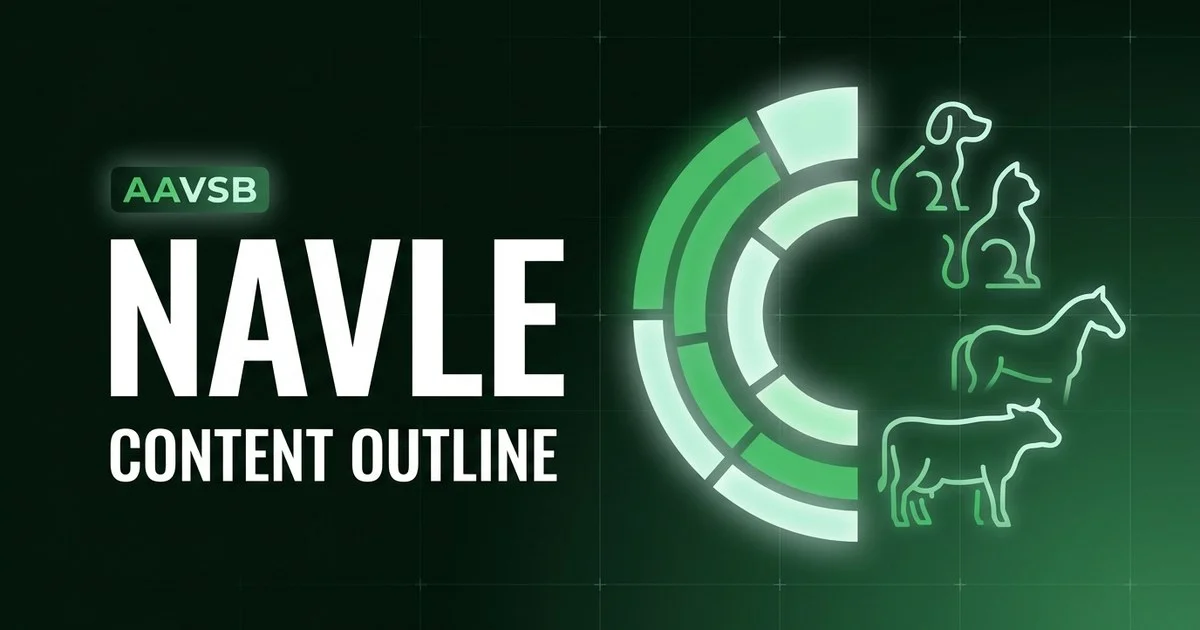
Table of Contents
The outline at a glance
International Council for Veterinary Assessment publishes the NAVLE outline that every NAVLE question is written against (NAVLE Candidate Handbook, 2026-2027 Testing Cycle (released May 26, 2026); target blueprint weights on p.25, detailed tasks in the NAVLE Competency Domains outline (copyright 2026)). This page turns that document into what you actually need before you study: how big each area is, what the questions in it ask you to do, and the order to learn it in.
- Clinical Practice~252 questions70%
- Preventive Medicine and Animal Welfare~54 questions15%
- Communication~29 questions8%
- Professionalism, Practice Management, and Wellness~25 questions7%
What each domain actually asks
The official outline describes what each area covers. Below is what the questions in it ask you to do, which is what decides how you should study it.
Clinical Practice
70%~252 itemsIt asks you to: Most questions give a clinical vignette for a specific species and ask for the most likely diagnosis, the next best diagnostic test, or the correct treatment, drug or dose. Many items make you interpret a lab panel, radiograph, cytology photo or ECG before you can answer.
- Data Gathering and Interpretation (35%)
- Health Maintenance and Problem Management (35%)
- Develop differential diagnoses and a diagnostic plan
- Interpret lab tests, cytology, diagnostic images (ECG, endoscopy, ultrasound, x-ray)
- Investigate toxin exposure in companion and food animals
- Administer anesthesia, drugs and vaccines; perform surgical procedures
- Establish treatment, herd-management and rehabilitation plans; determine prognosis
Preventive Medicine and Animal Welfare
15%~54 itemsIt asks you to: You decide how to contain a disease outbreak on a farm or in a clinic, what a regulatory or reportable-disease situation requires, and how to protect people from zoonoses or residues. Expect herd-health and population-level reasoning, not just single-patient care.
- Animal Welfare Issues and Concerns (6%)
- Environmental Health and Safety (5%)
- Veterinary Public Health (4%)
- Veterinary Epidemiology Statistics
- Isolation, quarantine and disinfection for disease control
- Zoonoses, food safety and biomedical waste disposal
Communication
8%~29 itemsIt asks you to: Questions ask what you should tell or ask a client or colleague in a given situation, such as explaining withdrawal times to a producer, obtaining consent, or when to refer. The best answer is usually the one that is legally sound and client-centred.
- Communication with Clients (5%)
- Communication with Veterinary and Other Professionals (3%)
- Informed consent, euthanasia and bad-news conversations
- Extra-label drug use limits, withdrawal times and antimicrobial stewardship
- Referral, case summaries and delegation to staff
Professionalism, Practice Management, and Wellness
7%~25 itemsIt asks you to: You handle ethics, legal and practice-operations scenarios: responding to unprofessional behaviour, supervising technicians, choosing evidence sources, and running the business side of a practice.
- Veterinary Practice Management (4%)
- Professional Development and Life-Long Learning (3%)
- Conduct oneself in a professional, ethical and legal manner
- Supervise paraprofessional staff; develop SOPs
- Evaluate new products and equipment for the practice
Study it in this order
Weight is the only honest guide to where your hours go. The areas that make up the first half of the paper are core; the next third is support; whatever is left is a quick win you review last, not skip.
| Domain | Weight | Items | Priority |
|---|---|---|---|
| Clinical Practice | 70% | ~252 | Core |
| Preventive Medicine and Animal Welfare | 15% | ~54 | Support |
| Communication | 8% | ~29 | Quick win |
| Professionalism, Practice Management, and Wellness | 7% | ~25 | Quick win |
Item counts are the weight applied to 360 scored questions and rounded, so treat them as approximate.
How the exam is built
| Item | Detail |
|---|---|
| Questions | 360 |
| Time | 396 minutes |
| Question types | Single-best-answer multiple choice built on a clinical scenario or vignette, About 15-20% of items include graphics (photos, radiographs) with zoom, contrast and pan tools |
| Delivery | Computer-based at Prometric test centers in the U.S., Canada and internationally, during fixed testing windows (no remote option published). |
| Passing standard | Criterion-referenced, not curved. Scores are reported as a three-digit scaled score on a 200-800 scale; the minimum passing score corresponds to a scaled score of 425 (standard last set in 2022). Score report gives pass/fail, scaled score and content-area diagnostics. |
| Fee | $825 — 2026-2027 cycle: $825 standard fee for testing in the U.S., U.S. territories and Canada; $1,220 for testing elsewhere ($825 + $395 international fee). Nonrefundable and nontransferable; missing your window means a new application and full fee. $100 testing-region change fee. Timing from Oct-Nov 2026: 10-min tutorial, 12 blocks x 33 min (396 min of testing), 50 min total break time; about 7.5 hours at the center. |
| Retakes | Lifetime limit of five NAVLE attempts. Starting with the March 2026 window, ICVA granted all candidates five new opportunities regardless of prior testing history. Students at AVMA COE-accredited schools may take it up to two times before graduation. Each retake needs a new application and fee in a later window; there are no rescores, appeals or test reviews. |
| Published pass rate | 81.6% (Criterion group: senior students at AVMA COE-accredited schools testing for the first time under standard conditions (Nov-Dec 2024 + April 2025 windows combined; 914 of 4,977 failed = 18.4%). Nov-Dec 2024 alone: 82.4%. Non-accredited (international) group failed at 62.5% across the cycle., 2024-2025 testing cycle) |
Where candidates lose marks
These are the places the outline and the real exam part ways, the parts of the outline candidates misjudge most often:
- Studying only small animals: dogs and cats are about 50% of the blueprint, but equine, bovine and porcine together are about 33%, and food-animal herd questions trip up companion-animal-focused students.
- Ignoring the 30% outside Clinical Practice: public health, reportable disease, withdrawal times, extra-label drug rules and client communication are scored alongside diagnosis.
- Pacing for the old format: from Oct-Nov 2026 the exam runs as 12 blocks of 30 questions at 33 minutes each (about 66 seconds per question), and leaving a block mid-way is an unauthorized break that costs clock time.
- Not practising image interpretation: 15-20% of items carry radiographs or photos, and you need to be comfortable reading them with the zoom, contrast and pan tools.
- Missing the application period: windows are fixed (Oct-Nov, March, July-Aug), there are no extensions, and a missed window means a new application and full fee.
Turn the outline into practice
ExamCert AI has 800 NAVLE practice questions with explanations, built around the same outline this page walks through. Work them by domain, find the weak area, and fix it before test day.
Practise NAVLE on ExamCert AIHow to Become a Veterinarian in 2026FAQ
How is the NAVLE weighted?
The NAVLE uses two weightings at once. By competency it is 70% Clinical Practice, 15% Preventive Medicine and Animal Welfare, 8% Communication and 7% Professionalism, Practice Management and Wellness. By species it is led by canine (25.6%), feline (24.3%), equine (14.7%) and bovine (13.3%).
How many questions are on the NAVLE and how long is it?
There are 360 multiple-choice questions. From October 2026 they come in 12 blocks of 30, with 33 minutes per block, a 10-minute tutorial and 50 minutes of total break time, about 7.5 hours in all.
What score do you need to pass the NAVLE?
NAVLE scores are scaled from 200 to 800, and the minimum passing score is 425. The standard is criterion-referenced, so you are measured against a fixed standard rather than graded on a curve.
Are there pictures or radiographs on the NAVLE?
Yes. ICVA says about 15-20% of questions include graphics such as photos or radiographs, and the testing software gives you zoom, contrast and pan tools to examine them.
Sources
Figures on this page come from ICVA and the other primary sources below:
- ICVA - NAVLE overview (testing windows 2026-2027, retake policy)
- ICVA - NAVLE Candidate Handbook, 2026-2027 Testing Cycle
- ICVA - NAVLE Competency Domains
- ICVA - NAVLE Species and Diagnoses
- ICVA - 2024-2025 NAVLE Technical Report
- ICVA - News and Updates
- BLS Occupational Outlook Handbook - Veterinarians
Checked September 25, 2026. Fees, outlines and eligibility rules change — confirm with ICVA before you book.