How to Become a Pediatric Nurse Practitioner in 2026: RN to CPNP
The full route to working as a pediatric nurse practitioner, in order: program, PNCB CPNP-PC exam, state licence and renewal, with timings and what each step costs you.
- $132,300Median pay
- +41%Job growth
- A master's degree is the typical entry-level education for nurse practitioners (BLS); length varies by program and full- or part-time studyTraining
- PNCB CPNP-PCExam
- $407Exam fee
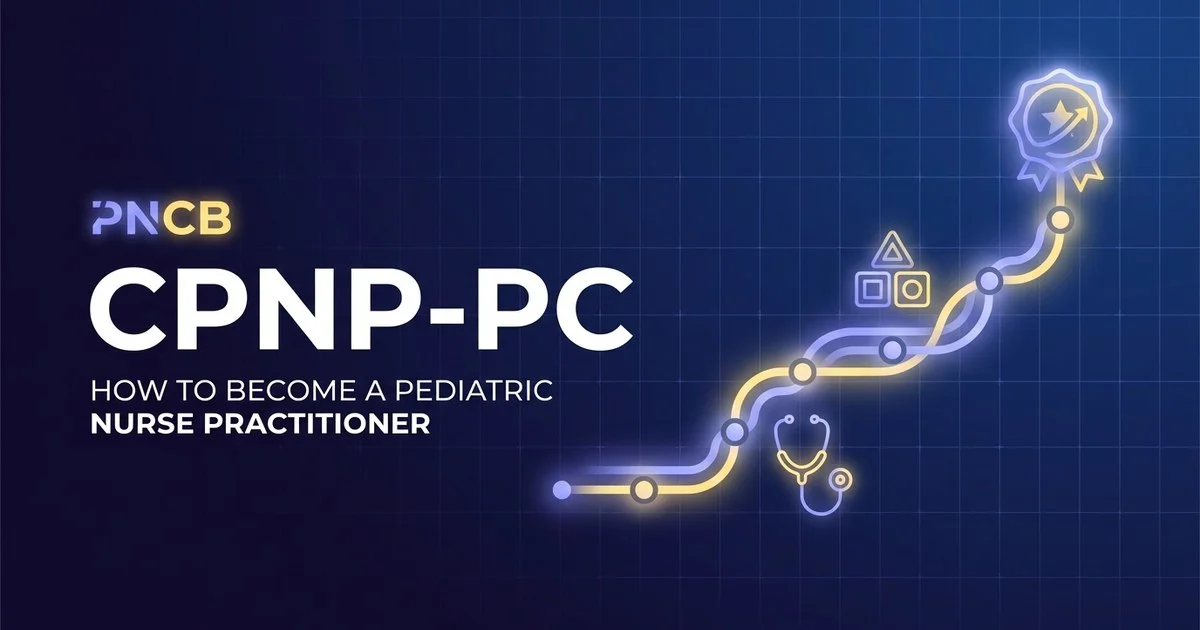
Table of Contents
The route, start to finish
Becoming a pediatric nurse practitioner is a fixed sequence: an approved program, the PNCB CPNP-PC exam, then whatever your state requires on top. Here is every stop in order, with realistic timings.
- 1
Become a registered nurse
About 4 years for a BSNEarn a nursing degree, usually a BSN, and pass the NCLEX-RN. Pediatric RN experience helps with admission and clinical judgment but is not a PNCB requirement.
- 2
Complete a primary care PNP program
Program-dependentFinish an accredited MSN, DNP or post-master's certificate with a pediatric primary care focus and at least 500 supervised direct-care hours in primary care pediatrics.
- 3
Apply to PNCB
Complete the free Ethics in Testing module, apply online ($407), and have final official transcripts sent directly to PNCB. PNCB then emails an approval notice with a 90-day testing window.
- 4
Pass the CPNP-PC exam
3-hour examAnswer 175 multiple-choice questions (150 scored) in 3 hours at a PSI testing center. You need a scaled score of 400 on the 200-800 scale. Official results arrive by email in about 2-3 weeks.
- 5
Get your state APRN license
Apply to your state board of nursing for APRN/NP licensure with the pediatric primary care population focus, plus prescriptive authority and a DEA registration if needed.
- 6
Start practice and recertify every year
AnnuallyWork in pediatric primary care (private practice, clinics, school-based health, FQHCs). Recertify annually between November 1 and January 31 and complete the 7-year Pediatric Updates and pharmacology requirements.
Step one: the right program
The program is the one step you cannot shortcut. The exam body checks where you trained before it lets you sit, so an unaccredited course can cost you the whole route.
Accreditation: ACEN, CCNE or NLN CNEA
Typical length: A master's degree is the typical entry-level education for nurse practitioners (BLS); length varies by program and full- or part-time study
Who is eligible to sit the exam
| Route | What you need |
|---|---|
| Licensure | Current, active, unencumbered RN license issued by a US state, US territory or Canada. |
| Graduate PNP program | Graduation from an ACEN-, CCNE- or NLN CNEA-accredited master's or doctoral nursing program with a pediatric primary care nurse practitioner concentration, or a formal dual primary/acute care PNP program, including at least 500 supervised direct-care clinical hours in primary care pediatrics (simulation does not count toward the 500) and separate graduate courses in advanced physiology/pathophysiology, advanced health assessment and advanced pharmacology. |
| Post-master's certificate | Graduation from a post-master's pediatric primary care NP certificate program at an accredited college or university, meeting the same clinical-hour and course requirements. FNP and acute care PNP graduates are not eligible without additional formal primary care PNP education. |
| Documents | Official final transcripts sent directly to PNCB by the school or a transcript service, and completion of PNCB's free Ethics in Testing module before applying. |
The exam itself
This is the checkpoint the whole route builds towards. The essentials:
Questions: 175 (150 scored)
Time: 180 minutes
Where you test: Computer-based at PSI testing centers only (PNCB's live remote proctoring is offered for the CPN and PMHS exams, not the CPNP-PC); 90-day testing window
Passing standard: Criterion-referenced (Angoff) and equated across forms. Scaled scores run from 200 (0 correct) to 800 (all correct); a scaled score of 400 is the pass point on every form.
Fee: $407
Eligibility in detail is in CPNP-PC requirements, and how the score works in the CPNP-PC passing score explained.
Licensure: what your state adds
CPNP-PC is a national certification, not a license. Pediatric nurse practitioners are licensed by each state's board of nursing as APRNs with a pediatric primary care population focus, and in most states the license depends on holding and maintaining national certification (PNCB notes CPNP certification is linked to licensure in most states). Practice authority and prescribing rules, including any collaborative agreement with a physician, are set by state law. Controlled-substance prescribing requires a DEA registration and, in some states, a state registration.
Pay and job outlook
The US Bureau of Labor Statistics files pediatric nurse practitioners under “Nurse Practitioners (SOC 29-1171), within the BLS group 'Nurse Anesthetists, Nurse Midwives, and Nurse Practitioners'; BLS does not report pediatric nurse practitioners separately”. Median means half earn more and half less; pay moves a long way with state, setting and experience, so read this as a benchmark, not an offer.
Keeping the credential
Requirement: Each year: current, active, unencumbered RN license plus 15 contact hours (or equivalent PNCB-accepted activities such as Pediatric Updates modules). Over each 7-year cycle: 4 PNCB Pediatric Updates modules (2 primary care, 2 of your choice) and 15 contact hours of pediatric pharmacology. One record-review year is allowed per 7-year cycle.
Fee: With 15 contact hours: $90 early bird (Nov 1 - Dec 1), $111 standard (Dec 2 - Jan 31), $231 late (Feb). With 2 Pediatric Updates modules: $0 / $21 / $141.
The exam is the step most people underprepare for
The CPNP-PC app has 500 exam-style questions with explanations, organised by the same domains the exam uses. Work them by domain, find the weak area, and fix it before test day.
App StoreGoogle PlayFree CPNP-PC practice testFAQ
How do you become a pediatric nurse practitioner?
Become an RN, complete an accredited MSN, DNP or post-master's program with a primary care pediatric NP focus and at least 500 supervised direct-care hours in primary care pediatrics, pass the PNCB CPNP-PC exam, then apply to your state board of nursing for an APRN license.
Can a family nurse practitioner take the CPNP-PC exam?
Not on FNP education alone. PNCB requires formal pediatric primary care NP education, such as a post-master's PNP certificate, before an FNP can sit for the CPNP-PC.
What is the CPNP-PC pass rate?
PNCB reports a 79.10% first-time pass rate for the CPNP-PC in 2025, from 1,263 candidates. The pass point is a scaled score of 400 on a 200-800 scale.
How much do pediatric nurse practitioners make?
BLS does not report pediatric NPs separately. Nurse practitioners overall earned a median of $132,300 in May 2025, and NP employment is projected to grow 41% from 2025 to 2035.
How often do you recertify the CPNP-PC?
Every year, between November 1 and January 31, with 15 contact hours or equivalent activities and a fee ($90-$111 in the normal window). Over each 7-year cycle you also complete 4 Pediatric Updates modules and 15 hours of pediatric pharmacology.
Sources
Figures on this page come from PNCB and the other primary sources below:
- PNCB - Steps to CPNP-PC Certification (fees, timeline, PSI)
- PNCB - CPNP-PC Exam Eligibility
- PNCB - 2023 CPNP-PC Detailed Content Outline
- PNCB - CPNP-PC Exam Scoring
- PNCB - CPNP-PC Exam FAQs
- PNCB - CPNP-PC Retesting Policies
- PNCB - Exam Candidate Handbook
- PNCB - Recertification Guide (2026)
- PNCB - 2025 Exam Statistics
- BLS Occupational Outlook Handbook - Nurse Anesthetists, Nurse Midwives, and Nurse Practitioners
Checked October 3, 2026. Fees, outlines and eligibility rules change — confirm with PNCB before you book.