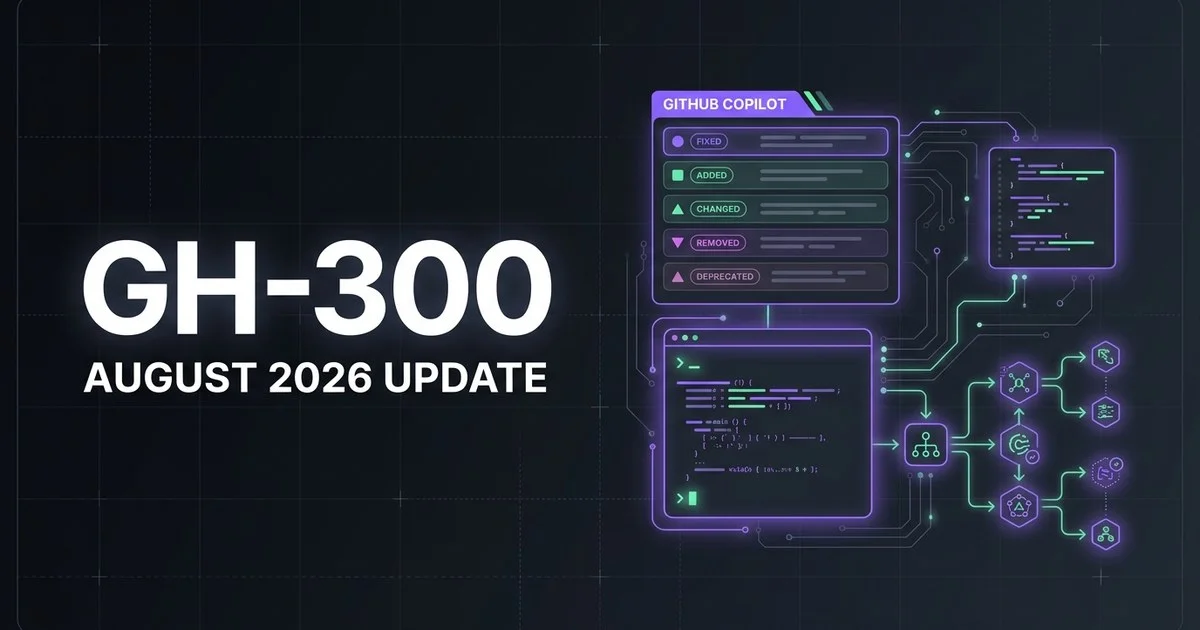
GH-300 August 2026 Update: What Changed in the GitHub Copilot Exam
If you prepared for GH-300 before August, part of your material is now out of date. Here is the official change log, translated into a restudy list.
On this page
Microsoft updated the GH-300 skills-measured document on 7 August 2026. The stated purpose was to ensure the exam accurately measures competence in the latest editor settings, command-line tooling and enterprise privacy features.
The headline for anyone mid-preparation: the domains and their weights did not change. What changed is what sits underneath three of them. That is a smaller update than it first appears — but the specific features added are recent enough that a lot of prep material has not caught up.
You do not need to restart. You need to add Copilot CLI, Agent Mode and Sub-Agents, MCP and content-exclusion troubleshooting to whatever you already know.
What changed, in one screen
| Area | Status | What it means for you |
|---|---|---|
| Audience profile | No change | Same expected background: GitHub fundamentals plus one language |
| Domain structure | No change | Still six domains |
| Domain weights | No change | Features still 25–30%, responsible AI still 15–20% |
| Use Copilot in the IDE | Minor revision | Triggering now explicitly includes CLI and agent mode |
| Copilot features and capabilities | Minor revision | Agent Mode, Copilot Edits, MCP, Agent Sessions, Sub-Agents, Spaces, Spark, instructions files |
| Apply safeguards and troubleshoot | Minor revision | Content-exclusion troubleshooting sharpened |
The official change log
Microsoft publishes a change table comparing the previous and current objective sets. For 7 August 2026 it records:
Microsoft's change log grades structural changes, not conceptual ones. A bullet-level revision that introduces an entire command-line tool and a multi-agent delegation model is still logged as “minor”. Read the objectives themselves, not just the change column.
Copilot CLI became its own objective
The most concrete addition. Use GitHub Copilot CLI now carries five bullets:
- Define what Copilot CLI is and how it benefits developers
- Identify the steps for installing it
- Describe key features and commands
- Use it interactively and in sessions
- Generate scripts and manage files with it
Alongside this, the IDE objective was revised so that triggering Copilot explicitly includes CLI and agent mode, not just inline suggestions and chat.
If you have never used Copilot CLI, install it and spend an hour with it. The distinction between a one-shot interactive invocation and a session is exactly the kind of detail this exam turns a question on.
Agent Mode, Sub-Agents and MCP
The biggest conceptual expansion. The revised objective now reads, in Microsoft's own phrasing, as using Agent Mode, Copilot Edits and MCP for enhanced development and workflows, and managing Agent Sessions and delegating tasks to Sub-Agents for optimised context usage.
Also newly explicit in the same objective: Spaces, Spark, pull request summaries, customisable review standards via instructions files, and prompt file reuse for consistent responses. Instructions files and prompt files are easy to confuse — instructions shape how Copilot behaves in a repository, prompt files are reusable prompts.
Organisation policy, audit logs and the REST API
Sitting in the same domain, and worth separating out because it is administrator rather than developer content: organisation-wide policy management, enabling Copilot Code Review policies, managing feature availability across IDEs and github.com, using audit log events, and managing subscriptions through the REST API.
Developers preparing alone tend to skip this entirely. It sits inside the exam's largest domain.
Safeguards and troubleshooting
The third revised sub-objective. Apply safeguards and troubleshoot covers enabling the filter for suggestions matching public code, and resolving issues with suggestions and content exclusions.
The troubleshooting framing is the tell. You are not only being asked what a content exclusion is — you are being asked what to do when someone reports that an exclusion is not working. Know the scope of exclusions, what they do not cover, and that changes are not always instantaneous.
Your restudy list
If you prepared before August 2026, work through this list and leave the rest of your notes alone.
Localised exam versions are updated roughly eight weeks after the English version. If you are sitting GH-300 in a language other than English before early October 2026, you may be tested against the previous objective set. Check the exam details page for your language before assuming this update applies to your sitting.
Which version will you actually sit?
With an update this recent, this is a real question rather than a pedantic one.
| Your situation | Which objectives apply |
|---|---|
| Sitting in English, on or after 7 Aug 2026 | The new objectives, including CLI and Sub-Agents |
| Sitting in another language before roughly early Oct 2026 | Probably the previous objectives — localisation lags about eight weeks |
| Sitting in another language after that window | The new objectives |
| Not sure | Check the exam details page for your language, and prepare for the new set either way |
Preparing for the newer set is never the wrong call. Everything added is genuine Copilot capability, so it costs you nothing on an older paper and rescues you on a newer one.
New features, mapped to where they are tested
The added features are not spread evenly. Almost all of them land in one domain, which makes triage easy.
| Feature | Domain it sits in | Depth expected |
|---|---|---|
| Copilot CLI | Use GitHub Copilot features (25–30%) | Installation, commands, interactive vs session, script and file work |
| Agent Mode | Use GitHub Copilot features | What it is and how it differs from chat and inline suggestions |
| Copilot Edits | Use GitHub Copilot features | Multi-file edits from one instruction |
| MCP | Use GitHub Copilot features | Conceptual — what it connects and why |
| Agent Sessions | Use GitHub Copilot features | Managing them; expect lifecycle framing |
| Sub-Agents | Use GitHub Copilot features | Delegation, and the stated rationale of context optimisation |
| Spaces, Spark | Use GitHub Copilot features | Recognition-level |
| Instructions and prompt files | Use GitHub Copilot features | Be able to tell the two apart |
| Content-exclusion troubleshooting | Privacy, exclusions and safeguards (10–15%) | Diagnosis, not just definition |
If the exam is within a week, spend your remaining time on Copilot CLI and the Agent Mode / Sub-Agents / MCP cluster. Those are concentrated in the exam's largest domain and are the least likely to be covered by anything you already studied. Spaces and Spark are recognition-level and can wait.
For the full objective-by-objective breakdown including domain weights, see the GH-300 exam guide.
Frequently Asked Questions
When did GH-300 change?
The English version of the exam reflects skills measured as of 7 August 2026. Localised versions are typically updated around eight weeks later, so a non-English sitting before early October may still use the previous objectives.
Do I need to restudy if I prepared in July 2026?
Partly. The domain structure and weights did not change. Three sub-objectives were revised, all within Copilot features and safeguards, so focus your restudy on Copilot CLI, Agent Mode, Sub-Agents, MCP and content-exclusion troubleshooting.
Is Copilot CLI now on the GH-300 exam?
Yes. Copilot CLI has its own sub-objective covering what it is, installation, key commands, interactive and session use, and generating scripts or managing files.
Did the GH-300 domain weights change in August 2026?
No. The change log records the domain groups as unchanged. What changed were bullet-level revisions inside three sub-objectives, all marked minor.
Test Yourself on the New Objectives
Practice questions updated against the current skills-measured document, with worked explanations.
Browse All Exams
Practice Before You Book
500–1,000+ practice questions per exam with detailed explanations, across Azure, AWS, GCP, security, and AI certifications.