CSWA Practice Questions: 14 Questions, 240 Points, and Where the Marks Really Are
Fourteen questions, 180 minutes, and 165 of 240 points to pass. The questions are not worth the same, so losing one big modelling task hurts far more than missing three theory questions.
- 14Questions
- 180 minTime
- $99Cost
- Does not expireValid
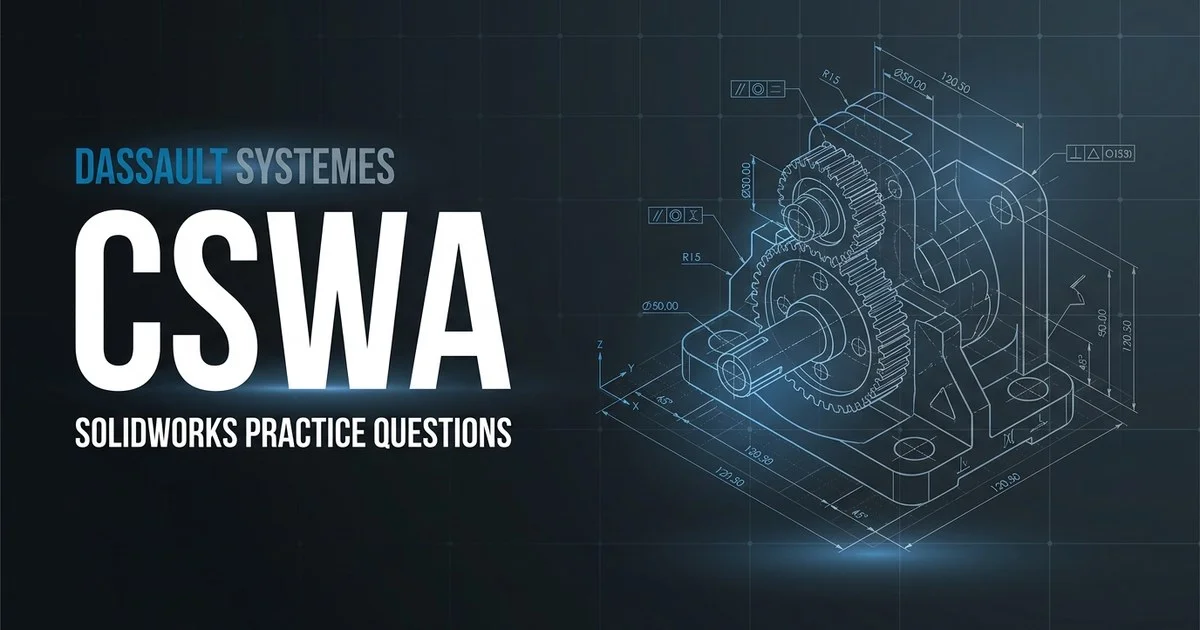
Table of Contents
The Certified SOLIDWORKS Associate paper is 14 questions in 180 minutes and costs $99. This is the unusual one: 14 questions worth 240 points in total, so the questions carry very different weights. The hands-on modelling tasks are worth far more than the multiple-choice theory items.
What follows is the question split by domain, then five practice questions written to Dassault Systemes’s published objectives, each with the reasoning for the right answer and for every wrong one. These are original practice items, not real exam content – the point is to show you how the questions are shaped and where the traps sit.
How the 14 questions split
Dassault Systemes lists the exam sections but does not publish percentage weights for this exam, so nobody can tell you an exact question count per domain. The honest version is below: the sections, and what an even split across a 14-question paper would look like.
| Domain | Weight | If even | |
|---|---|---|---|
| Sketching and sketch relations | not published | ~3 | |
| Part modelling features | not published | ~3 | |
| Mass properties and material assignment | not published | ~3 | |
| Assembly modelling and mates | not published | ~3 | |
| Drawing views and theory | not published | ~3 |
Be sceptical of precise weightings. Sites quoting exact percentages for this exam are inventing them. Dassault Systemes has not published them, so revise the sections evenly and spend your extra time on whichever one you can least explain out loud.
Five practice questions
Answer each one before reading the key underneath it.
A modelling question gives a part's dimensions and a material, then asks for the mass to two decimal places. Your answer does not match any option. What is the most likely cause?
- A SOLIDWORKS rounds mass differently from the exam
- B The material was not assigned, or the document units differ from the ones in the question
- C The part must be saved before mass can be calculated
- D Mass properties only work on assemblies
Answer: B
Mass depends on density and units. Leaving the default material or working in millimetres when the question expects inches produces a confidently wrong number - the single most common CSWA mistake.
Why the others fail
A Rounding differences do not move an answer far enough to miss every option.
C Mass properties compute from the model in memory without saving.
D Mass properties work on parts and assemblies alike.
A sketch shows as under-defined. What does that mean for the exam task?
- A The sketch cannot be extruded until it is fully defined
- B Geometry can still move, so a later dimension change may not update the model as intended
- C SOLIDWORKS will refuse to save the part
- D The sketch is invalid and must be redrawn
Answer: B
An under-defined sketch has unconstrained degrees of freedom, so geometry can shift when something changes. On a timed exam that turns a small edit into a wrong mass value.
Why the others fail
A Under-defined sketches extrude perfectly well, which is why the risk is easy to miss.
C The part saves normally.
D It is valid, merely unconstrained - fully defining it is a discipline, not a repair.
Two parts must stay in contact face to face while remaining free to slide along that face. Which mate expresses this?
- A Concentric
- B Coincident between the two faces
- C Fixed
- D Distance of zero between the faces
Answer: B
A coincident mate between two planar faces removes the degree of freedom normal to the faces and leaves the sliding degrees of freedom, which is exactly the described behaviour.
Why the others fail
A Concentric aligns cylindrical axes and says nothing about planar contact.
C Fixing a component removes all movement, contradicting the sliding requirement.
D A zero distance mate can achieve contact but is the awkward route where a coincident mate is intended.
A part needs a constant-width channel that follows a curved path. Which feature is intended?
- A Extruded cut along the sketch plane
- B Swept cut using the path and a profile
- C Revolved cut about an axis
- D Loft between two profiles
Answer: B
A swept cut moves a profile along a path, which is the definition of a constant-section channel following a curve.
Why the others fail
A An extruded cut goes in a straight direction and cannot follow a curved path.
C A revolved cut sweeps around an axis, producing a circular form rather than an arbitrary path.
D A loft blends between differing profiles and does not maintain a constant section along a path.
With 180 minutes for 14 questions but unequal marks, what is the best time strategy?
- A Spend equal time on every question
- B Secure the high-value modelling tasks first, then spend what remains on the theory items
- C Answer all theory questions first because they are quicker
- D Attempt questions strictly in the order presented
Answer: B
With 240 points spread unevenly across 14 questions, the modelling tasks carry most of the marks. Protecting them is what gets you past 165.
Why the others fail
A Equal time on unequal marks systematically underspends on what matters.
C Clearing quick theory first feels productive but can leave too little time for the tasks that actually carry the paper.
D Fixed order ignores the mark distribution entirely.
What catches people out
- 165 of 240 points is roughly 69%, but points are not evenly spread across the 14 questions. One abandoned modelling task can cost more than several theory questions.
- Set the document units and assign the material before calculating anything. Wrong units is the classic way to produce a precise, confident, wrong answer.
- You need a working SOLIDWORKS installation for the exam - this is a hands-on paper, not a multiple-choice one.
- Fully define your sketches. Under-defined geometry survives the first extrude and then quietly moves when you edit a dimension.
What it really costs to pass
The sticker price is $99, but that is the cost of passing first time. The number worth budgeting is different.
- First attempt: $99.
- Resit: Dassault Systemes does not publish a discounted resit alongside the headline fee, so budget a second full fee unless the official page says otherwise when you book.
- Renewal: none. The credential does not expire, which makes the one-off fee the whole story.
- Your time: 180 minutes in the chair, and realistically several weeks of preparation before it. That is the largest cost on this list and the only one you cannot pay to avoid.
The margin you are playing with. A 69% pass mark on 14 scored questions means about 10 correct answers, so you can afford in the region of 4 mistakes. Going in at exactly that level is how people fail on a bad day.
Who should sit it: there are no formal prerequisites. Going in well under that bar is usually how people end up paying the fee twice.
How to prepare
A workable sequence for this exam, assuming you already work near the material:
- Read the official guide first. Everything on this page is secondary to what Dassault Systemes publishes at the link in the sidebar, and guides get revised.
- Work the heaviest domain until you can teach it. Use the table above to decide which one that is.
- Practise under the clock. 180 minutes for 14 questions is roughly 771 seconds each. Knowing the material and being able to apply it at that pace are different skills.
- Review every wrong answer to the level of the distractor. Being able to say why the other three options fail is what turns a 60% into a pass.
Frequently asked questions
How many questions are on the CSWA exam?
Fourteen questions worth 240 points in total, with 180 minutes allowed. The questions carry different point values.
What is the CSWA passing score?
165 out of 240 points, which is approximately 69%.
How much does the CSWA exam cost?
$99 USD. It is often available at no cost to holders of an active SOLIDWORKS subscription and through academic programmes.
Is CSWA a hands-on exam?
Yes. It combines multiple-choice theory with hands-on modelling tasks performed in SOLIDWORKS, so you need a working installation to sit it.
Sources
Every figure on this page comes from the certifying body rather than a third-party summary:
- https://www.solidworks.com/sw/support/cswa-academic.htm
- https://www.solidworks.com/certifications/mechanical-design-cswa-mechanical-design
Checked September 2, 2026. Formats and fees change – confirm against Dassault Systemes before you pay for anything.