CSP Exam Study Plan 2026: 12-Week Calendar, Day by Day
12 weeks at about 10 hours a week, laid out day by day against the BCSP outline, with three checkpoints that tell you when you are ready to book.
- 12 weeksPlan
- ~10 hPer week
- ~120 hTotal
- 5h 30mExam time
- Cut scorePass mark
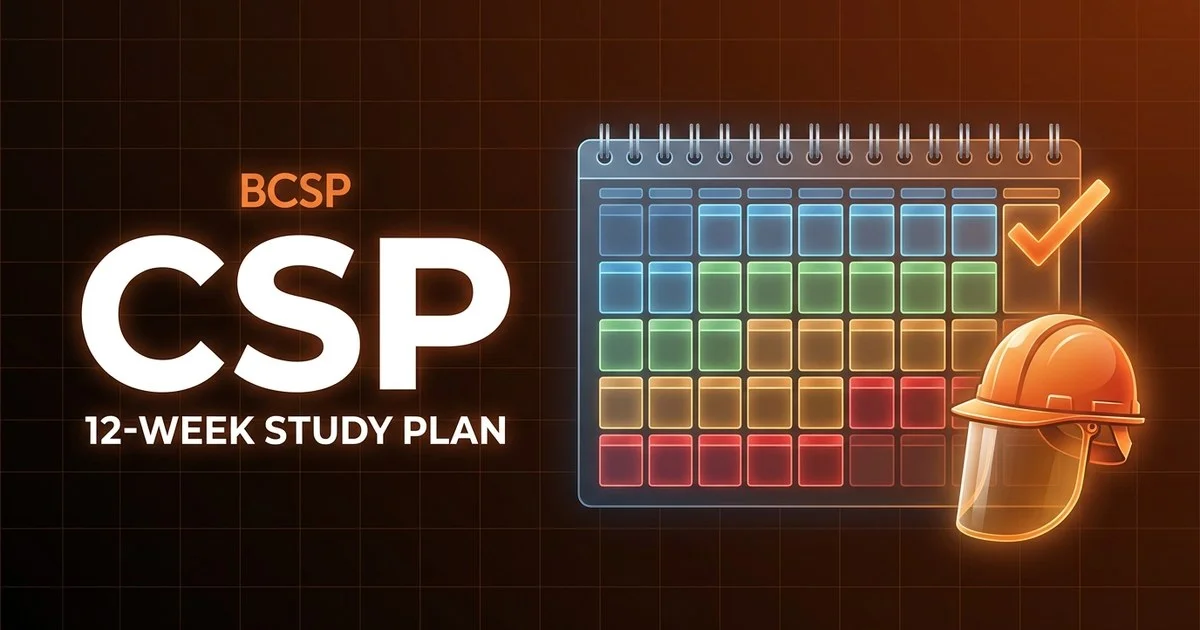
Table of Contents
Most CSP candidates are working safety professionals who already hold the ASP or another BCSP-qualified credential, have a bachelor's degree and at least four years of professional safety experience, and are studying around a full-time job. The exam covers seven blueprint domains in 5.5 hours, from process safety and fleet programs to budgeting, toxicology and adult learning.
Planning for the CSP is different because breadth and math arrive together. Program Management alone is 25% and includes statistics, cost-benefit and ROI work, while Occupational Health and Applied Science leans on industrial hygiene, ventilation, chemistry and physics calculations. BCSP hands out no formula sheet and allows only its on-screen calculator. The 12-week plan below puts the calculation-heavy domains early, then switches to full 5.5-hour mocks for the last six weeks.
The 12-week CSP calendar
Who it fits: A working safety professional who passed the ASP (or holds another qualified credential) in the last few years, can reliably give about 10 hours a week, and is comfortable but rusty on the math.
Weeks 1-6 cover all seven domains, with the math-heavy ones (Occupational Health and Applied Science, and the statistics and finance tasks in Program Management) placed early so every later review block revisits them. Weeks 7-12 add five full 5.5-hour mocks, mostly on Saturdays; the last one falls on the Monday of exam week, which usually means taking a day off work.
- LLearn · New material from the outline
- DDrill · Timed practice questions by domain
- RReview · Error log and spaced recall
- MMock · Full-length timed practice exam
- XRest · Nothing scheduled
- EExam · Test day
| Week | Mon | Tue | Wed | Thu | Fri | Sat | Sun | Hours |
|---|---|---|---|---|---|---|---|---|
| Wk 1 | L1h15CSP11 blueprint | L1h30Safety principles | D1hSafety principles | L1h30Process safety | XRest | D2h45BCSP self-assessment | R1h30Error log setup | 9.5hours |
| Wk 2 | L1h30Workplace hazards | D1h15Safety principles | L1h30Materials handling | D1h15Safety principles | XRest | L2hFleet + life safety | R2hWeek 1-2 error log | 9.5hours |
| Wk 3 | L1h30Toxicology + IH | D1h15IH calculations | L1h30Ventilation + noise | D1h15Occ health & science | XRest | L2hChemistry + physics | R2hFormula recall | 9.5hours |
| Wk 4 | L1h30Mgmt systems 45001/Z10 | D1h15Program management | L1h30Stats + data analysis | D1h15Statistics problems | XRest | L2hFinance + ROI calcs | R2hWeeks 1-4 recall | 9.5hours |
| Wk 5 | L1h30Leadership + MOC | D1h15Program management | L1h30Incident investigation | D1h15Program management | XRest | L2hSystem safety + FTA | R2hMixed recall D1-D2 | 9.5hours |
| Wk 6 | L1h30Risk management | D1h15Risk management | L1h30Risk financing | L1h15Emergency mgmt | XRest | D2h30Risk + emergency mix | R1h30Weeks 4-6 recall | 9.5hours |
| Wk 7 | L1h15Environmental mgmt | L1h15Training + adult learn | D45mEnv + training drill | R45mFormula recall | XRest | M5h30Full mock 1 | R1h30Mock 1 review | 11hours |
| Wk 8 | L1h15Occ health & science | D1h15IH + ventilation math | L1h15Safety principles | D1h15Safety principles | XRest | D2h45BCSP self-assessment | R2hError log by domain | 9.8hours |
| Wk 9 | D1hProgram management | D1hStatistics problems | L1hRisk management | R1hFormula recall | XRest | M5h30Full mock 2 | R1h30Mock 2 review | 11hours |
| Wk 10 | D1hOcc health & science | D1hSafety principles | R1hMissed-item rework | D45mTimed math sets | XRest | M5h30Full mock 3 | R1h30Mock 3 review | 10.8hours |
| Wk 11 | D1hWeakest domain | D1hProgram management | R1hError log recall | D45mEmergency + environ. | XRest | M5h30Full mock 4 | R1h30Mock 4 review | 10.8hours |
| Wk 12 | M5h30Full mock 5 | R1h15Mock 5 review | D1hWeakest domain | R1hFormula recall | R30mLight recall | XRest | EExamExam day | 9.2hours |
Each cell is one day: the session type, the planned minutes and what to cover. The bar along the bottom of a cell is that day's load against the heaviest day in the plan.
What each week has to deliver
A week is done when its exit check passes, not when the calendar says so. If a check fails, repeat that week's drill days before moving on.
| Week | Focus | Exit check |
|---|---|---|
| 1 | Blueprint, baseline, safety principles | Finish the BCSP self-assessment and record a score for each of the 7 domains in your error log. |
| 2 | Safety principles: hazards, equipment | Score 60%+ on a 40-question Safety Principles set without notes. |
| 3 | Occupational health and applied math | Write the core IH, noise and ventilation formulas from memory and score 60%+ on 15 calculation items. |
| 4 | Program management: systems and data | Score 60%+ on a 40-question Program Management set, including every statistics and ROI item. |
| 5 | Program management: investigation, FTA | Explain FTA, FMEA and MOC steps in your own words and score 65%+ on a mixed Program Management set. |
| 6 | Risk and emergency management | Score 65%+ on a 50-question Risk Management and Emergency Management set. |
| 7 | Environment, training, first mock | Complete full mock 1 in 5.5 hours and log every miss by domain; pass gate 2 at 65%. |
| 8 | Repair the weakest domains | Raise your self-assessment score in your two weakest domains by 10 points over week 1. |
| 9 | Mock 2 and program management depth | Score 70%+ on full mock 2 with Program Management at 70%+. |
| 10 | Mock 3 and calculation speed | Score 75%+ on full mock 3 and finish with at least 15 minutes to spare. |
| 11 | Mock 4 and final gap closing | Score 75%+ on full mock 4 with no domain below 65%; pass gate 3. |
| 12 | Final mock, review, taper | Score 75%+ on the final mock, then taper with no new material after Wednesday. |
Where the hours go
Weights come from BCSP's CSP11 Examination Blueprint, version V.2024.04.24.
Hours roughly follow the CSP11 weights, so Advanced Application of Safety Principles and Program Management each get about a quarter of learn-and-drill time. Occupational Health and Applied Science gets more than its 10% weight because its toxicology, ventilation, noise and chemistry calculations take the longest to build. Emergency Management, Environmental Management and Training are compressed into about a week and a half because most experienced candidates already know much of that material.
Study time is the share of the plan's learn and drill hours, set from the published weight and nudged up for heavier domains and down for lighter ones.
Advanced Application of Safety PrinciplesStandard
≈ 17 hFamiliar ground for most candidates, but seven task areas from process safety and life safety to fleet, cranes and robotics make breadth, not depth, the challenge.
Program ManagementStandard
≈ 17 hMixes management-system standards and leadership theory with statistics, budgeting and ROI calculations that are easy to underestimate.
Risk ManagementStandard
≈ 10 hRisk matrices and hazard analysis feel intuitive, but financial risk treatment (retention, sharing, transfer) is new to many field-focused safety professionals.
Emergency ManagementLighter
≈ 5 hConcrete, plan-based content such as emergency response plans, incident command and fire protection that most candidates know from practice.
Environmental ManagementLighter
≈ 3 hA small domain on waste, GHS classification and sustainability that a short, focused review usually covers.
Occupational Health and Applied ScienceHeavy
≈ 9 hToxicology, sampling, ventilation, noise, chemistry and physics calculations make this the most math-dense domain per question.
TrainingLighter
≈ 5 hNeeds assessment, training effectiveness and adult-learning concepts are straightforward once the terminology is learned.
Three checkpoints before you book
The calendar is a forecast. These checkpoints are the measurement: each one has a target and a fallback if you miss it.
- End of week 360%
Untimed domain sets on Safety Principles and Occupational Health and Applied Science, plus writing the core IH, noise and ventilation formulas from memory.
If you miss it: Add two hours a week of calculation drills before starting Program Management and push the whole calendar back one week.
- End of week 765% on mock 1
Full-length timed mock taken in one 5.5-hour sitting, scored overall and by domain.
If you miss it: Spend week 8 only on the two lowest domains, weighted by blueprint percentage, and retake the BCSP self-assessment to confirm the gain.
- End of week 1175% on 2 mocks
Mocks 3 and 4 both at 75% or better with no domain below 65%. BCSP publishes no fixed passing percentage, so 75% is a buffered working target.
If you miss it: Move the exam date back three to four weeks (staying inside your 1-year eligibility period) and repeat the week 10-11 pattern on your weakest two domains.
Run the drill and mock days on ExamCert AI
The D and M cells in the calendar need exam-style questions with explanations. ExamCert AI has CSP questions organised by the same outline, so the drill days stay on the domain the calendar names and your checkpoint scores mean something.
Practise CSP on ExamCert AIFree CSP practice testWhat one study session looks like
Most weekday cells in the calendar are one session of about 75 minutes. Split it like this so every session ends with questions, not just reading:
- Recall (10 min). Write five formulas from memory (for example TWA, noise dose, ventilation, ROI, confidence interval) and check them against your notes.
- Learn (30 min). Work through one or two task statements from the CSP11 blueprint using your main reference.
- Calculate (15 min). Solve three to five numeric problems on a basic scientific calculator, keying full expressions as you would on screen.
- Drill (15 min). Answer 10 timed practice questions from the same domain.
- Log (5 min). Add each miss to the error log with its domain and the reason it was wrong.
Pick your pace
Prep providers commonly suggest three to six months of study for the CSP. Twelve weeks at about 10 hours (roughly 120 hours) sits at the shorter end of that range, which suits candidates whose ASP-level fundamentals are still fresh.
Fast track
Candidates who passed the ASP within the past year or are using a structured prep course, with time to study most evenings and long weekend blocks.
Trade-off: Only about four weeks for mocks and repair, and 15 hours a week next to a full-time job leaves little slack if a gate is missed.
Standard
Most working candidates with a recent ASP or other qualified credential and moderate confidence in the math.
Trade-off: Needs a day off or a long split session in exam week for the final 5.5-hour mock.
Steady
Candidates who qualified through a CIH, CMIOSH or other credential rather than the ASP, or who last studied the math years ago.
Trade-off: More weeks mean more forgetting, so formulas need spaced recall every week and the exam date must be booked early so the 1-year eligibility period does not run short.
The CSP you are planning for
| Time | 5.5 hours |
| Passing standard | Pass/fail against a cut score set by BCSP; no fixed percentage is published, and the official result is available as soon as you submit |
| Fee | $160 application + $350 exam ($494 if paid together); $600 exam bundle covers two attempts plus one self-assessment ($744 with application); $180 annual renewal once certified |
| Delivery | Computer-based at Pearson test centers worldwide; on-screen calculator provided, personal calculators, notes and formula sheets not allowed |
| If you fail | At least 6 weeks after your last attempt, within the 1-year eligibility period; $350 per attempt unless you bought the bundle; one-time $100 eligibility extension available within 60 days of the deadline |
Materials the plan uses
| Resource | Type | Cost | How the plan uses it |
|---|---|---|---|
| BCSP CSP11 Examination Blueprint (V.2024.04.24) | Official | Free | Week 1: map the seven domains and their task statements; every learn block in the calendar ties back to a blueprint task. |
| BCSP CSP Exam References list | Official | Free | Choose one or two references per weak domain instead of buying the whole list. |
| BCSP CSP Self-Assessment | Official | Varies | Weeks 1 and 8: half-length diagnostic with domain scores; one is included in BCSP's $600 exam bundle and access lasts six months. |
| BCSP CSP examCORE | Course | Varies | Optional self-paced BCSP course with pre- and post-assessments for structured lessons in weeks 2-7. |
| Safety Professional's Reference and Study Guide (W. David Yates, CRC Press) | Textbook | Varies | Worked math for Occupational Health and Applied Science and Program Management; use it for the weekend calculation blocks. |
| Pocket Prep BCSP CSP question bank | Question bank | Varies | Daily drill blocks; confirm it offers enough items for timed full-length runs before relying on it for the five mocks in weeks 7-12. |
CSP study-plan mistakes
- Splitting time evenly across the seven domains. Advanced Application of Safety Principles and Program Management are 25% each, so half the exam sits in two domains, while Emergency (9%) and Environmental (6%) together are smaller than Risk Management alone.
- Treating Program Management as the soft domain. Its task list includes confidence intervals, probabilities, Pareto analysis, budgeting and cost-benefit work, so it needs calculation drills, not just reading.
- Studying from a personal formula sheet. BCSP provides no formula sheet and bans notes; formulas appear inside questions when needed, but you still have to know which one applies and how to rearrange it.
- Practising only on a graphing calculator or phone. The test center gives you an on-screen calculator and personal calculators are not allowed, so drill with a basic scientific calculator and get used to keying long expressions.
- Skipping full-length mocks. A 5.5-hour sitting is a stamina test, and candidates who only do short sets often lose accuracy late in the exam; the plan includes five full mocks for that reason.
The final week, day by day
- T-7
Confirm your Pearson appointment, test center address and arrival time, and check that the name on your BCSP account matches your government ID exactly. Make sure the date sits inside your 1-year eligibility period. - T-5
After the final full mock, rework every miss in Safety Principles and Program Management and redo wrong calculation items from scratch. No new topics from here on. - T-3
Run a 45-minute formula recall: write the IH, ventilation, noise, statistics and finance equations from memory and work one problem for each on a basic scientific calculator. - T-1
Set out an unexpired, government-issued ID with photo and signature. Plan to leave phones, smart glasses, earbuds and notes in the test center storage, and stop studying by early evening. - T-0
Arrive early for check-in and security screening. Split the 5.5 hours into checkpoints, flag long calculations and come back to them, and expect your official result as soon as you submit.
Book it when the third checkpoint passes
Two full mocks above your target is the signal. Run them on ExamCert AI, review every miss, and book the CSP while the material is fresh.
Practise CSP on ExamCert AIFree CSP practice testFAQ
How long is the CSP exam and how many questions does it have?
BCSP allows 5.5 hours for the CSP. Its current CSP page and Credentials At-A-Glance sheet list the time but not an item count, and BCSP places unscored developmental items on its exams that you cannot tell apart from scored ones. Treat every item as scored and set your pacing from full-length timed mocks.
How much does the CSP exam cost in 2026?
BCSP lists a $160 application fee and a $350 exam fee, or $494 if you pay both together. A $600 exam bundle covers two attempts plus one self-assessment ($744 with the application). After you pass, the annual renewal fee is $180, and recertification requires 25 points every five years.
Can I bring a calculator or formula sheet to the CSP exam?
No. BCSP provides an on-screen calculator at the Pearson test center, and personal calculators, notes and formula sheets are not allowed. BCSP embeds needed formulas inside the questions, but you still have to know which formula applies and how to rearrange it, so practise calculations under time pressure.
How long should I study for the CSP?
Prep providers commonly suggest three to six months. This plan uses 12 weeks at about 10 hours a week, roughly 120 hours, for candidates with a recent ASP. If you qualified through another credential or your math is rusty, the 18-week steady variant at 7 hours a week gives more room for spaced review.
What happens if I fail the CSP exam?
You can schedule another attempt once at least six weeks have passed since your last one, as long as you are still inside the 1-year eligibility period that starts when BCSP approves your application. Each attempt costs $350 unless you bought the two-attempt bundle, and a one-time $100 extension is available within 60 days of the deadline.
Sources
Figures on this page come from BCSP and the other primary sources below:
- BCSP: Certified Safety Professional (CSP)
- BCSP CSP11 Examination Blueprint (V.2024.04.24)
- BCSP Credentials At-A-Glance
- BCSP: Exam security, what candidates should know before their exam
- BCSP: Formulas now embedded in BCSP examinations
- BCSP Self-Assessments
Checked October 7, 2026. Fees, outlines and eligibility rules change — confirm with BCSP before you book.