CSCP Study Plan 2026: 12-Week Calendar, Day by Day
12 weeks at about 9 hours a week, laid out day by day against the ASCM outline, with three checkpoints that tell you when you are ready to book.
- 12 weeksPlan
- ~9 hPer week
- ~107 hTotal
- 150Questions
- 3h 30mExam time
- 300 scaledPass mark
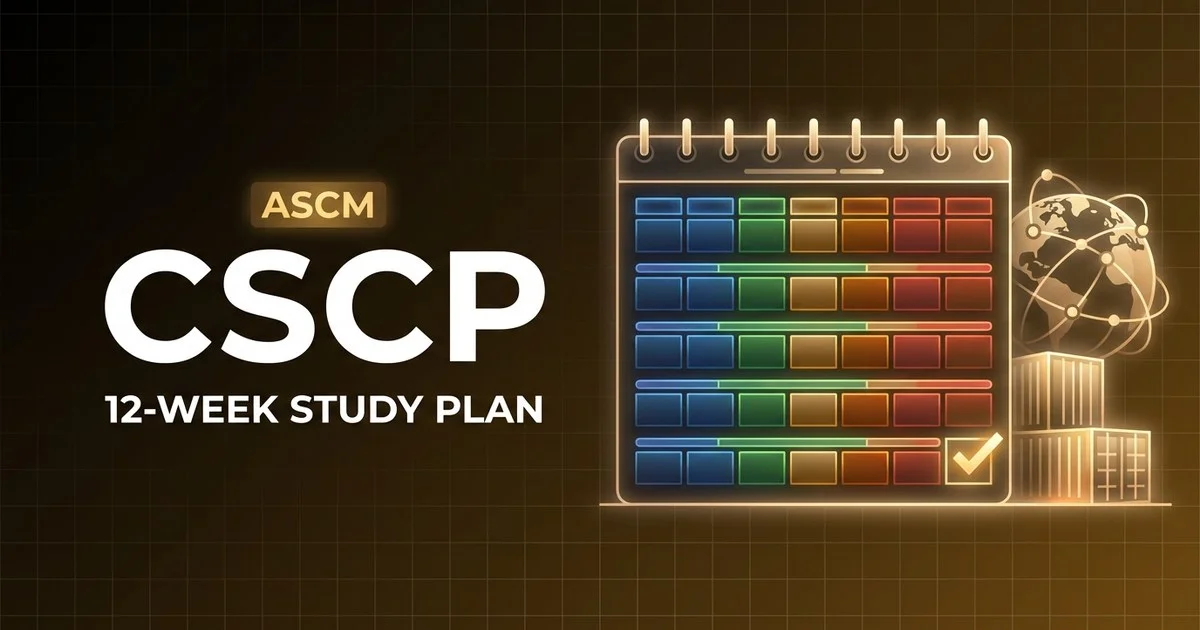
Table of Contents
CSCP candidates are usually planners, buyers, logistics analysts and supply chain managers who want one credential that spans the whole chain, from forecasting to returns. ASCM dropped the eligibility requirement in December 2022, so the only gate is a 150-question, 3.5-hour exam scored on a 200-350 scale, with 300 to pass.
What makes planning different here is the reading load, not the format. The 2026 Learning System spans eight modules in two books, and the exam weights them unevenly: internal operations and inventory, sourcing, and supply chain relationships make up 53% of the test. The 12-week plan below reads and drills each module in the same week, spends extra time on the calculation-heavy modules, and finishes with three timed mocks inside the six-month exam authorization.
The 12-week CSCP calendar
Who it fits: Someone working full time in planning, purchasing or logistics who can give 75 minutes on four weekday evenings and two hours on each weekend day.
Weeks 1-10 work through the eight Learning System modules in book order, reading and quizzing each section in the same week, with Sundays kept for the error log and APICS dictionary terms. Mocks start once all eight modules are read: 210-minute sittings on the Saturdays of weeks 10 and 11 and the Tuesday of exam week, each followed by a review session before any new drilling.
- LLearn · New material from the outline
- DDrill · Timed practice questions by domain
- RReview · Error log and spaced recall
- MMock · Full-length timed practice exam
- XRest · Nothing scheduled
- EExam · Test day
| Week | Mon | Tue | Wed | Thu | Fri | Sat | Sun | Hours |
|---|---|---|---|---|---|---|---|---|
| Wk 1 | D1h15LS pretest (baseline) | L1h15M1 Supply chain basics | L1h15M1 Demand management | D1h15M1 chapter quizzes | XRest | L2hM1 Forecasting | R2hM1 terms + error log | 9hours |
| Wk 2 | D1h15M1 forecast drills | L1h15M1 Supply-demand fit | L1h15M2 Network design | D1h15M2 network drills | XRest | L2hM2 Visibility + data | R2hM1 error log + cards | 9hours |
| Wk 3 | L1h15M2 Metrics + reports | D1h15M2 module quiz | L1h15M3 Align to demand | D1h15M3 sourcing drills | XRest | D2hM1-M2 mixed set | R2hM1-M2 error log | 9hours |
| Wk 4 | L1h15M3 Category strategy | D1h15M3 category drills | L1h15M3 Product design | D1h15M3 TCO + make/buy | XRest | L2hM3 Supplier selection | R2hM3 terms + error log | 9hours |
| Wk 5 | L1h15M3 Contracting + use | D1h15M3 module quiz | L1h15M4 Planning operations | D1h15M4 MPS drills | XRest | L2hM4 MRP logic | R2hM3-M4 error log | 9hours |
| Wk 6 | L1h15M4 Capacity + PAC | D1h15M4 capacity drills | L1h15M4 Inventory | D1h15M4 EOQ/safety stock | XRest | L2hM4 Inventory control | R2hM4 formulas + terms | 9hours |
| Wk 7 | L1h15M4 Lean/TOC/Six Sigma | D1h15M4 module quiz | L1h15M5 Distribution | D1h15M5 transport drills | XRest | D2hM1-M4 mixed set | R2hM1-M4 error log | 9hours |
| Wk 8 | L1h15M5 Trade + Incoterms | D1h15M5 reverse flow + quiz | L1h15M6 Customer relations | D1h15M6 CRM drills | XRest | L2hM6 Supplier relations | R2hM5-M6 error log | 9hours |
| Wk 9 | D1h15M6 module quiz | L1h15M7 Risk identification | D1h15M7 risk drills | L1h15M7 Risk analysis | XRest | L2hM7 Risk response | R2hM6-M7 error log | 9hours |
| Wk 10 | L1h15M8 Optimization | L1hM8 Sustainability | D1hM8 tech trends + quiz | R45mDictionary terms | XRest | M3h30Mock 1 (150 items) | R1h30Mock 1 review | 9hours |
| Wk 11 | R1h15Mock 1 error log | D1h15Weakest module set | D1h152nd-weakest module | R1hM4 formulas + terms | XRest | M3h30Mock 2 (150 items) | R1hMock 2 review | 9.2hours |
| Wk 12 | R1h30Mock 2 error log | M3h30Mock 3 (150 items) | R1h30Mock 3 review | D1hLight mixed drill | R30mFormulas + terms | XRest | EExamExam day | 8hours |
Each cell is one day: the session type, the planned minutes and what to cover. The bar along the bottom of a cell is that day's load against the heaviest day in the plan.
What each week has to deliver
A week is done when its exit check passes, not when the calendar says so. If a check fails, repeat that week's drill days before moving on.
| Week | Focus | Exit check |
|---|---|---|
| 1 | Baseline + Module 1 foundations | Learning System pretest done and Module 1 chapter quizzes at 60% or better. |
| 2 | Forecast drills, then networks | Module 1 forecasting items at 65%+ and Module 2 Sections A-B read. |
| 3 | Metrics + Modules 1-2 checkpoint | Modules 1-2 mixed set at 65%+ (Gate 1) and Module 3 Section A started. |
| 4 | Sourcing: categories and suppliers | Module 3 Sections B-D read; category-strategy and supplier-selection quizzes at 65%+. |
| 5 | Contracts, then operations planning | Module 3 quiz at 70%+; can explain S&OP, MPS and MRP inputs without notes. |
| 6 | Capacity and inventory math | Capacity, EOQ and safety-stock drill items at 65%+ without looking up formulas. |
| 7 | Continuous improvement + logistics | Modules 1-4 mixed set at 70%+ (Gate 2) and Module 5 Sections A-B read. |
| 8 | Trade, reverse flow, relationships | Module 5 finished with Incoterms items at 75%+; Module 6 Section A read. |
| 9 | Relationships wrap-up and risk | Module 6 quiz at 70%+ and risk-response scenario items at 65%+. |
| 10 | Module 8 + first full mock | Module 8 read and Mock 1 sat in one 210-minute sitting, scored by module. |
| 11 | Mock 2 + weak-module repair | Mock 2 at 75%+ with no module below 65% (Gate 3), or a reschedule decision made. |
| 12 | Final mock, taper, exam | Mock 3 at 75%+ and every error-log item re-answered correctly before exam day. |
Where the hours go
Weights are the 'percentage of exam' figures in ASCM's CSCP Exam Content Manual version 5.0 (effective March 31, 2022), which the 2026 Learning System still follows; each ECM content area maps one-to-one to a Learning System module.
Study time starts from each module's exam weight, then gets a 1.3x multiplier for the calculation-heavy modules (forecasting in Module 1; MPS, MRP, capacity and inventory math in Module 4) and 0.8x for Modules 6 and 8, which working professionals tend to find intuitive. That moves Internal Operations and Inventory from 19% of the exam to about 24% of study time and trims Supply Chain Relationships from 17% to about 13%.
Study time is the share of the plan's learn and drill hours, set from the published weight and nudged up for heavier domains and down for lighter ones.
Supply Chains, Demand Management, and ForecastingHeavy
≈ 9 hForecast methods, forecast error and demand-management terms are tested with numbers and exact APICS definitions, and later modules build on them.
Global Supply Chain NetworksStandard
≈ 7 hNetwork design and visibility are mostly conceptual, but the metrics and reporting section needs real memorization.
Sourcing Products and ServicesStandard
≈ 11 hLarge but logical: category strategy, make-or-buy, total cost of ownership and contracting read close to real procurement work.
Internal Operations and InventoryHeavy
≈ 17 hThe biggest module and the most mechanical: MPS, MRP, capacity, EOQ and safety stock, plus lean, TOC and Six Sigma vocabulary.
Forward and Reverse LogisticsStandard
≈ 6 hModes, warehousing and returns are intuitive for practitioners; Incoterms and trade-compliance details are pure recall.
Supply Chain RelationshipsLighter
≈ 9 hCustomer and supplier relationship models match everyday work, so it needs less reading than its 17% weight suggests, though answer options are close.
Supply Chain RiskStandard
≈ 7 hIdentification, analysis and response follow a clear framework; the hard part is picking the best response in scenario items.
Optimization, Sustainability, and TechnologyLighter
≈ 4 hBroad and descriptive: strategy optimization, sustainability and technology trends need coverage rather than depth.
Three checkpoints before you book
The calendar is a forecast. These checkpoints are the measurement: each one has a target and a fallback if you miss it.
- End of week 365%
Saturday's Modules 1-2 mixed set plus the Learning System chapter-quiz average for both modules, untimed
If you miss it: Swap week 4's Thursday drill for a Modules 1-2 retest and re-read the forecasting and metrics sections; keep the exam date for now.
- End of week 770%
Modules 1-4 mixed set (56% of the exam weight), timed at about 84 seconds per item
If you miss it: Spend week 8's Saturday on Module 4 calculations (MRP, capacity, EOQ, safety stock) and shorten Module 6 reading, which most working professionals find intuitive.
- End of week 1175% on Mock 2
Full 150-item mock in 210 minutes with no module below 65%. ASCM's pass mark is a scaled 300 (200-350) with no published raw cut, so 75% is a safety margin, not a conversion
If you miss it: Reschedule at least 48 hours ahead ($45 fee) while the six-month ATT is still valid, and add two weeks on the two weakest modules before Mock 3.
Run the drill and mock days on ExamCert AI
The D and M cells in the calendar need exam-style questions with explanations. ExamCert AI has CSCP questions organised by the same outline, so the drill days stay on the domain the calendar names and your checkpoint scores mean something.
Practise CSCP on ExamCert AIFree CSCP practice testWhat one study session looks like
Most weekday cells in the calendar are one session of about 75 minutes. Split it like this so every session ends with questions, not just reading:
- Recall (10 min). Ten dictionary terms or formulas from earlier modules, answered from memory before opening the book.
- Learn (30 min). One Learning System section; close it and write the three ideas a question would most likely test.
- Drill (25 min). The chapter quiz or 15-20 practice items on that section, at about 84 seconds each.
- Error log (10 min). Log every miss with its module and section reference and the cause: concept, term or misread.
Pick your pace
ASCM chapters (the Toronto chapter's CSCP page, for example) recommend about 100 hours of study on average; 12 weeks at 9 hours gives 108 hours, enough to read all eight modules once and still finish with three timed mocks.
Fast track
CPIM holders or planners who already use MRP, forecasting and Incoterms day to day.
Trade-off: Long sessions on most days and only two mocks, so there is little slack to fix a weak module before the date.
Standard
Most full-time professionals with some supply chain experience but gaps in one or two areas.
Trade-off: Three months of steady evenings and weekends; one missed week pushes the exam back rather than squeezing the mocks.
Steady
Career changers, parents and shift workers who can protect only about an hour a day.
Trade-off: Module 1 is four months old by exam day, so weekly spaced review is mandatory; buy the exam only once you are inside the six-month ATT window.
The CSCP you are planning for
| Questions | 150 multiple-choice questions: 130 scored and 20 unscored pretest items, mixed in without labels |
| Time | 3.5 hours (210 minutes); no scheduled breaks |
| Passing standard | Scaled score of 300 on a 200-350 scale; no published raw cut |
| Fee | $2,015 exam, or $1,450 for ASCM members with the Certification Upgrade; bundle with Learning System and 2nd Chance Exam $3,650 ($2,620 with the upgrade) |
| Delivery | Computer-based through Pearson VUE, at a test center or online via OnVUE; result shown on screen when you finish |
| If you fail | Wait 14 full days (retest on day 15), no published attempt cap; retake $500, or $400 with the Certification Upgrade. An exam authorization (ATT) expires six months after purchase |
Materials the plan uses
| Resource | Type | Cost | How the plan uses it |
|---|---|---|---|
| APICS CSCP Learning System (2026) | Official | ~$2,015 | Core reading for all eight modules, plus the pretest in week 1, the chapter quizzes and flashcards used in drills, and the practice exam for mocks. $1,450 with the Certification Upgrade. |
| APICS CSCP Exam Content Manual v5.0 | Official | Free (members) | Lists the eight content areas and their exam percentages; use it to check coverage and to rank weak modules after each mock. A free preview with the weights is open to everyone. |
| ASCM Supply Chain Dictionary | Official | Varies | Source for the Sunday term reviews and the 10-minute recall block; settle every near-synonym in your error log against its definition. |
| ASCM chapter CSCP review course | Course | Varies | Optional instructor-led route built on the same Learning System; worth it if you need fixed weekly deadlines or help with Module 4 calculations. |
| APICS Exam Handbook & Testing Policies | Free | Free | Read before booking: ATT expiry, rescheduling fees, OnVUE room rules and the ID policy all come from here and drive the final-week checklist. |
| ASCM 'Understanding a Scaled Score' guide | Free | Free | Explains the 200-350 scale and why practice percentages do not convert; read it before setting mock targets. |
CSCP study-plan mistakes
- Reading both Learning System books end to end before drilling. By the time Module 8 is done, Module 1 has faded; read and quiz each section in the same week.
- Giving every module equal time. Operations and inventory (19%), sourcing (17%) and relationships (17%) are 53% of the exam, while logistics (9%) and optimization (8%) are 17% combined.
- Skipping the ASCM dictionary. Answer options often differ by one precise APICS term, such as dependent versus independent demand, so definitions belong in every Sunday review.
- Buying the exam on day one. A standalone ATT expires six months after purchase with no extensions or refunds; buy it about eight weeks out, or check the expiry on bundle exam credits in My Account.
- Reading a practice percentage as a scaled score. 300 of 350 is not 86%; ASCM equates forms and publishes no raw cut, so use mocks to rank weak modules, not to predict the result.
The final week, day by day
- T-7
Confirm the Pearson VUE appointment in My Account and that the registered name matches your ID exactly. A test-center change costs $45 and must be made more than 48 hours ahead. If your slot is not a Sunday, shift the whole calendar so exam day lands on the booked date. - T-5
Sit the last full mock in one 210-minute block with no breaks. OnVUE allows none, and at a test center the clock keeps running if you step out. - T-3
For OnVUE, run Pearson VUE's system test on the exact computer and network you will use, clear the desk and room, and have your phone ready for the check-in photos in the OnVUE app. - T-1
Error log and dictionary terms only. Set out an unexpired government-issued photo ID with signature; test centers also ask for a secondary ID with your signature. - T-0
Test center: check in no later than 15 minutes before your slot. OnVUE: start check-in 30 minutes early, because the appointment is held only 15 minutes past start. Your result appears on screen when you finish.
Book it when the third checkpoint passes
Two full mocks above your target is the signal. Run them on ExamCert AI, review every miss, and book the CSCP while the material is fresh.
Practise CSCP on ExamCert AIFree CSCP practice testFAQ
How many questions are on the CSCP exam?
150 multiple-choice questions in 3.5 hours. 130 are scored and 20 are unscored pretest items mixed in without labels, so treat every question as live. That is about 84 seconds per item. There are no scheduled breaks, and on OnVUE online proctoring you cannot leave the camera view at all.
What score do you need to pass the CSCP?
A scaled score of 300 on a 200-350 scale. ASCM converts your raw score onto that scale so different exam forms are comparable, and it does not publish how many correct answers equal 300. Practice percentages are a guide, not a prediction; scoring 75% or better on full mocks leaves a sensible margin.
How much does the CSCP exam cost in 2026?
ASCM's 2026 brochure lists the exam at $2,015, or $1,450 for members with the Certification Upgrade. The Learning System costs the same again, and a bundle with the Learning System, exam and a 2nd Chance Exam is $3,650 ($2,620 with the upgrade). A retake is $500, or $400 with the upgrade.
How long should I study for the CSCP?
ASCM chapters such as Toronto recommend about 100 hours of study on average. This plan uses 108 hours over 12 weeks at 9 hours a week. CPIM holders and experienced planners often need less and can use the 8-week fast track; people new to supply chain should expect more and use the 18-week Steady variant.
What happens if I fail the CSCP?
You wait 14 full days and can retest on the 15th; ASCM says there are no exceptions, and it publishes no cap on attempts. Each retake needs a new authorization to test, priced at $500, or $400 with the Certification Upgrade. Bundles with a 2nd Chance Exam include one free retake if you meet ASCM's conditions.
Sources
Figures on this page come from ASCM and the other primary sources below:
- ASCM: APICS CSCP certification
- ASCM: CSCP Exam Content Manual v5.0 preview (effective March 31, 2022)
- ASCM: 2026 CSCP Module Content Outline
- ASCM: 2026 CSCP certification brochure (pricing)
- ASCM: Understanding a Scaled Score
- ASCM: Certification and Credential FAQs
Checked October 7, 2026. Fees, outlines and eligibility rules change — confirm with ASCM before you book.