CRT vs RRT 2026: Cut Scores, Pay and Which One You Need
Same exam, two cut scores, very different careers. What separates a CRT from an RRT and whether you should stop at the first one.
- $82,280Median pay
- +9%Job growth
- About 2 years for an associate degree; about 4 years for a bachelor's degreeTraining
- NBRC TMC + CSEExam
- $190Exam fee
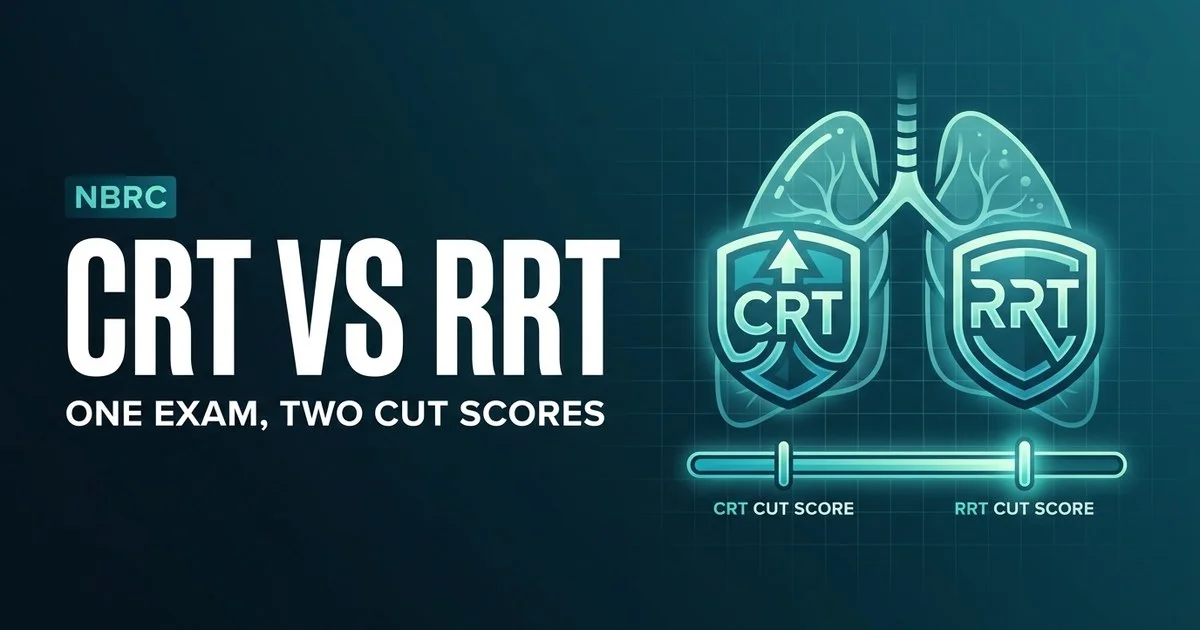
Table of Contents
The short answer
CRT and RRT are not two different exams so much as two thresholds on the same one. Both start with the NBRC Therapist Multiple-Choice (TMC) exam: clear the lower cut score and you are a Certified Respiratory Therapist; clear the higher cut score and you become eligible to sit the Clinical Simulation Exam, and passing that makes you a Registered Respiratory Therapist.
CRT vs RRT, side by side
| Aspect | CRT | RRT |
|---|---|---|
| Level | Entry-level NBRC credential | Advanced-practitioner NBRC credential; prerequisite for NPS and ACCS specialty exams |
| Exam(s) through 2026/2027 | TMC at the low cut score | TMC at the high cut score plus the Clinical Simulation Examination (CSE) |
| Exam from Jan 1, 2027 | RT Examination at the low cut score | RT Examination at the high cut score (no separate CSE) |
| Exam fees | TMC $190 new / $150 repeat | TMC $190/$150 + CSE $200 ($390 first-time total); RT Exam from 2027 $360 new / $300 repeat covers both levels |
| Testing time | 3 hours (160 items) | 3 hours TMC + 4 hours CSE (22 problems); from 2027 one 4-hour, 185-item exam |
| 2025 first-time pass rate | 78.5% (TMC low cut) | 68.2% reached the TMC high cut; 63.6% of first-time CSE candidates passed |
| Eligibility | 18+ and at least an associate degree from a CoARC-accredited entry-into-practice program | Same, plus TMC high cut to sit the CSE; CRT-experience routes to RRT end Dec 31, 2026 |
| State licensure | Accepted for licensure in most states | Required for new licensure in 10 states (AARC, Aug 2026), e.g. CA, OH, AZ, OR, NM, GA, WA, WV, MO (2027), IN (2028) |
| Employer preference | Meets the credential requirement for many jobs | BLS notes some employers require the RRT before hiring or within a set time after hire |
| Maintenance | 5-year CMP cycle, $25/year | Same 5-year CMP cycle and $25/year; earning RRT restarts all NBRC credentials on a new 5-year term |
Which one the state and employers want
Respiratory therapists must be licensed in every state except Alaska (BLS), and the CRT satisfies the credential requirement in most states. Per the AARC (Aug 2026), 10 states now require the RRT for new licensure: Ohio, California, Arizona, Oregon, New Mexico, Georgia, Washington, West Virginia, Missouri (effective Jan 1, 2027) and Indiana (effective Jan 1, 2028), usually grandfathering existing CRT licensees. New Jersey rescinded its RRT requirement.
The route from student to RRT
Most candidates do both in one run. The route looks like this:
- 1
Complete prerequisites
0-1 yearFinish high school and the science and math prerequisites programs require, typically anatomy and physiology, chemistry, microbiology and college math.
- 2
Graduate from a CoARC-accredited program
2-4 yearsEarn at least an associate degree from a CoARC-accredited entry-into-practice respiratory care program, including clinical rotations.
- 3
Apply to NBRC and schedule with PSI
WeeksApply online at nbrc.org and book a PSI assessment center; TMC applications close Dec 15, 2026, after which you apply for the RT Examination.
- 4
Pass the exam at the low cut score
3 hours (TMC) / 4 hours (RT)The low cut on the 160-item TMC (or the 185-item RT Examination from 2027) earns the CRT; hitting the high cut on the same sitting positions you for the RRT.
- 5
Get your state license
Weeks, varies by boardMost states license with the CRT, but 10 states (AARC, Aug 2026) require the RRT for new licensees, and Alaska does not license RTs.
- 6
Upgrade to RRT
VariesPass the CSE by Dec 31, 2027 if you hit the TMC high cut by Dec 31, 2026; otherwise retest on the RT Examination and reach the high cut.
- 7
Maintain the credential
Every 5 yearsKeep the CRT through NBRC's 5-year Credential Maintenance Program ($25 per year) and renew your state license separately.
Who is eligible to sit the exam
| Route | What you need |
|---|---|
| CoARC graduate | Be 18 or older and a graduate of, with at least an associate degree from, an entry-into-practice respiratory therapy program supported or accredited by CoARC. |
| Existing CRT seeking RRT-level testing (4 years) | CRT for at least 4 years plus 62 semester hours including anatomy and physiology, chemistry, microbiology and math. Eliminated effective December 31, 2026. |
| Existing CRT seeking RRT-level testing (2 years + degree) | CRT for at least 2 years plus an associate degree from an accredited entry-level respiratory care program, or a non-RT bachelor's plus 62 qualifying semester hours. Eliminated effective December 31, 2026. |
| Canadian RRT | Hold the Canadian Society of Respiratory Therapists (CSRT) RRT credential. |
| From January 1, 2027 (RT Examination) | Be 18+ and a graduate of at least an associate-degree CoARC-supported/accredited entry-into-practice program; passing at the low cut awards CRT. |
Pay and job outlook
The US Bureau of Labor Statistics files respiratory therapists under “Respiratory Therapists (SOC 29-1126)”. Median means half earn more and half less; pay moves a long way with state, setting and experience, so read this as a benchmark, not an offer.
Keeping the credential
Requirement: Option 1: quarterly assessments and/or CE (15 or 30 CE credits depending on assessment performance, or none if performance is high enough); Option 2: retake and pass the exam for the highest credential held during the last year of the cycle; Option 3: pass an NBRC exam not previously completed (e.g. earning the RRT resets all credentials to a new 5-year term).
Fee: CMP fee $125 per 5-year term, collected as $25 per year; $250 reinstatement fee if lapsed less than 6 months
The exam is the step most people underprepare for
ExamCert AI has 500 CRT practice questions with explanations, built around the same outline this page walks through. Work them by domain, find the weak area, and fix it before test day.
Practise CRT on ExamCert AINBRC TMC Exam Content Outline 2026FAQ
Can I work as a respiratory therapist with only the CRT?
In most states, yes; the CRT meets the licensure credential requirement. However, 10 states (including California, Ohio, Arizona, Georgia and Washington, with Missouri in 2027 and Indiana in 2028) require the RRT for new licensees, and some employers require the RRT at hire or within a set time.
Do RRTs earn more than CRTs?
The BLS reports one median wage for all respiratory therapists ($82,280 in May 2025) and does not split it by credential. The RRT's practical advantage is access: more states, more employers and specialty credentials like NPS and ACCS are open to RRTs.
How do I upgrade from CRT to RRT?
If you pass the TMC at the high cut by December 31, 2026, you can take the CSE until December 31, 2027. After that, you need to pass the new RT Examination at the high cut score, and the CRT-plus-experience routes end December 31, 2026.
How long is the CRT valid?
NBRC credentials run on a five-year cycle and are maintained through assessments/CE, re-examination, or earning a new NBRC credential, plus a $25 annual CMP fee. Your state license renews on its own schedule with its own CE rules.
Sources
Figures on this page come from NBRC and the other primary sources below:
- NBRC - Certified Respiratory Therapist (CRT)
- NBRC - Registered Respiratory Therapist (RRT)
- NBRC - TMC Detailed Content Outline (effective January 2020)
- NBRC - Respiratory Therapy Examination Detailed Content Outline (effective January 2027)
- NBRC - Candidate Handbook (Sept 2026)
- NBRC - Examination Changes Coming in 2027
- NBRC - 2025 Examinations in Review
- NBRC - Credential Maintenance Program brochure (Jan 2026)
- AARC - States with RRT Entry to Licensure
- CoARC - Find an Accredited Program
- BLS Occupational Outlook Handbook - Respiratory Therapists
Checked September 25, 2026. Fees, outlines and eligibility rules change — confirm with NBRC before you book.