CMP Exam Blueprint 2026: 12 Domains, One Worth 38 Questions
Event Design alone is 38 of the 150 scored questions. Three domains are new since August 2025, and several EIC pages still describe the old nine-domain exam.
- 165 (150 scored)Questions
- 3h 30mTime
- 12Sections
- YesWeights published
- Scaled 55Pass mark
- $910Fee
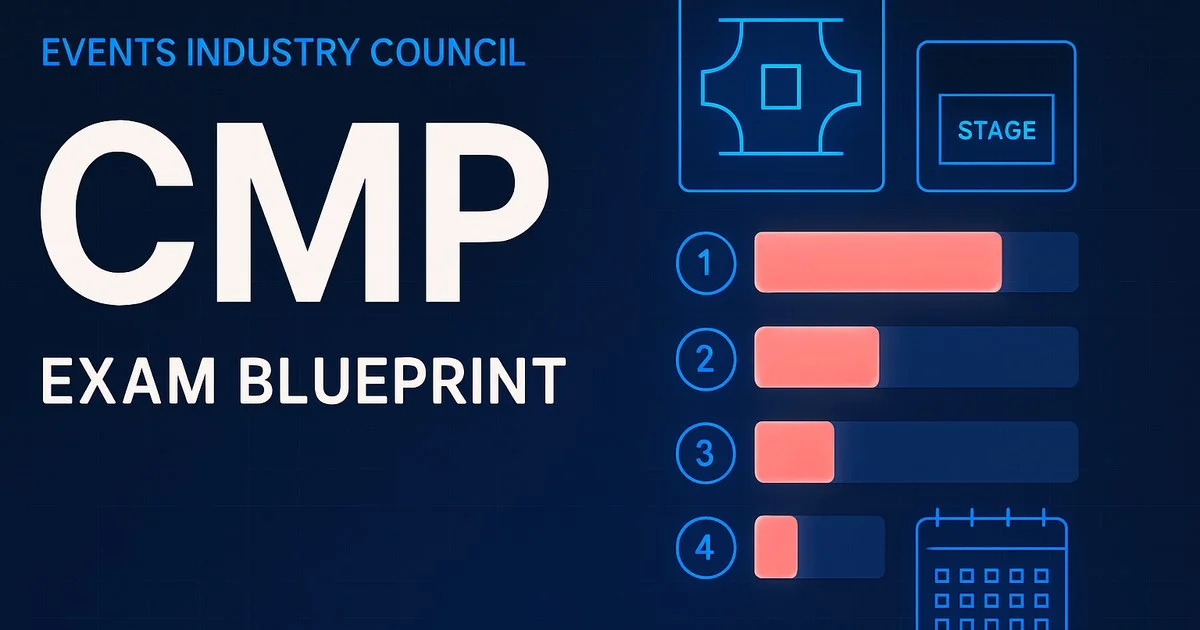
Table of Contents
The whole paper in one bar
The CMP exam blueprint from the 2025 CMP International Standards, live since August 2025 is the exam guide EIC publishes for Certified Meeting Professional (CMP), restated so you can see the shape of the paper before you read a word of the detail. The bar below is the entire syllabus: 12 sections, in the order the certifying body lists them.
- §1 Strategic Planning — 14 items (9.3%)
- §2 Project Management — 9 items (6%)
- §3 Sustainability and Social Impact Plan — 7 items (4.7%)
- §4 Risk Management Plan — 10 items (6.7%)
- §5 Financial Management — 11 items (7.3%)
- §6 Talent Management — 8 items (5.3%)
- §7 Stakeholder Management — 10 items (6.7%)
- §8 Event Design — 38 items (25.3%)
- §9 Site Management — 15 items (10%)
- §10 Marketing and Communications — 13 items (8.7%)
- §11 Technology Integration — 8 items (5.3%)
- §12 Evaluation Process — 7 items (4.7%)
Those percentages are derived from EIC’s own published question counts, not an estimate. That matters more than it sounds: most pages ranking for this query quote weightings the certifying body never published.
The syllabus, section by section
Each block below is one section of the official outline. The bullets are the sub-objectives EIC publishes underneath it — the actual scope statement, not a summary of it.
Strategic Planning
- Organisation's mission, vision, culture, values and purpose
- Needs assessment: purpose and feasibility of the event
- Value proposition and alignment with organisational strategy
- Metrics and KPIs: engagement, financial, sustainability
- Event goals and objectives; interpreting a financial analysis
- Target audience profile, psychographics and needs
- Sustainability and social impact plan; marketing and communication strategy
Project Management
- Project phases: initiation, planning, execution, monitoring and controlling
- Closure, including evaluation and reporting
- Full scope of work: every deliverable the event objectives require
- Roles and responsibilities for team members
- Organisational elements: budgeting, financing, procurement plan, policies and procedures
- Sponsorship and talent management as project elements
Sustainability and Social Impact Plan
- Policy, plan and procurement aligned with the UN Sustainable Development Goals
- Sustainability and social impact objectives, KPIs and performance reporting
- Social impact initiatives: accessibility, code of conduct, DEI
- Universal design for people with disabilities
- Positive legacy: community outreach and CSR activities
- Carbon footprint: measure, reduce, manage, mitigate
- Materials, energy and waste practices; engaging exhibitors, attendees and suppliers
Risk Management Plan
- Event risk types: conduct violations, data privacy, health and safety, property, environmental
- Analysing and prioritising risk: avoid, mitigate, transfer, accept
- Risk management and mitigation plan: contingency plans, duty of care, insurance
- Disseminating the risk management plan
- Emergency response plan
- Emergency communications before, during and after an incident
Financial Management
- Aligning financial objectives with event goals
- Building budgets on accepted accounting principles; revising existing budgets
- Funding sources and expenditures
- Pricing attendance, exhibits and sponsorships from market analysis
- Monetary transactions: payment types, exchange rates, domestic vs international
- Reading financial statements; monitoring expenses and revenue
- Final financial reconciliation
Talent Management
- Identifying talent needs: leadership, speakers, entertainment, staff, volunteers
- Defining roles for each talent group
- Inclusive recruitment: disabled people, diverse backgrounds, multi-generational teams
- Orientation and scheduling for event talent and temporary staff
- Strategic communication and training for talent and temporary staff
Stakeholder Management
- Supplier and vendor needs analysis against event goals
- Managing supplier relationships by communicating goals and objectives
- Contract considerations: cancellation, dispute resolution, force majeure, local and international rules
- Purchasing and supply chain strategy
- Managing supplier and vendor contracts
- Sponsorship and strategic partnership opportunities
- Sponsor deliverables, activation and fulfilment reporting
Event Design
- Event development: organising principles, inclusive design, programme content, in-person, hybrid and virtual delivery
- Experience design: room layouts, sensory elements, attendee interaction, signage
- Speakers, performers and dignitaries: selection, protocols, logistics
- Food and beverage: dietary needs, menus, sustainability, alcohol service rules
- Audiovisual and technical production for in-person, hybrid and virtual events
- Attendee logistics: registration and housing, travel and immigration, crowd management, accessibility
- Lodging, room blocks, transport, safety and security
- Exhibitions: floor plans, sales, exhibitor guidelines, attendee engagement and ROI
Site Management
- Site selection criteria: accessibility, budget, competing dates, rates, space
- Managing the RFP process
- Evaluating sites; impact of subventions, grants and incentives
- Site recommendation after analysis and inspection
- Contract negotiation
- Site layout: use of allotted space, site maps and floor plans
- On-site: setup, operation and takedown; team communication; adapting in real time
Marketing and Communications
- Marketing plan built from historic and current KPIs
- Target market segments and messaging strategies
- Marketing assets and channels; design specifications based on event branding
- Event narrative and promotion; social media and engagement strategy
- Media and public relations, including crisis management
- On-site communications plan, equipment and protocols, including pre-con and post-con meetings
Technology Integration
- Determining technology, virtual space and website needs
- Linking technology choices to event goals and experience design
- Assessing emerging tech: AI-enabled solutions, geolocation, virtual reality
- Technology for accessibility and sustainability practices
- Integrating technology systems and strategies
Evaluation Process
- Measuring outcomes and financial performance against predefined goals
- KPIs: attendance, economic impact, legacy, ROI, sustainability
- Post-event surveys for every participant group
- Interpreting survey data against critical success factors
- Post-event debrief with team, stakeholders and suppliers
- Customised reporting for future planning and auditing
EIC publishes the blueprint twice: as rounded percentages in the CMP-IS domain table, and as exact item counts in the test specifications that follow it. The counts add up to 150, the scored part of the 165-question exam; the other 15 are unlabelled pretest items. This page uses the counts, which is why Strategic Planning reads 9.3% here rather than EIC's rounded 9%. EIC also says scaling means each form may carry a different number of questions per domain, so treat the counts as the target, not a promise. Every item is four-option multiple choice with one correct answer, no 'all of the above', and English only.
What the weightings really mean
A percentage in an exam guide is a promise about how many questions get drawn from a section, not about how hard those questions are. On a paper of roughly 150 items, Event Design at 38 items (25.3%) is worth about 38 questions and Sustainability and Social Impact Plan at 7 items (4.7%) is worth about 7. No single section decides the result on its own here - the largest is 38 items (25.3%) of the paper - so the result is decided by how few sections you leave weak, not by how well you master one.
The trap is treating that arithmetic as permission to skip. Weightings are the floor of what a section costs you, because the low-weight sections on almost every blueprint are the ones that supply context for questions filed under a different heading. You lose those marks in the heavy section and never find out why.
Reading the verbs in the objectives
The verb at the front of each sub-objective is the part candidates skim and examiners take literally. It sets the depth you are tested at, and it is the difference between recognising a term and being asked to choose between two answers that both look right.
| Verb | What a question at that depth looks like |
|---|---|
| Determine / Identify | Planning-stage questions: which need, selection criterion, risk type or KPI comes first. Wrong answers are usually sensible steps taken out of sequence. |
| Coordinate / Manage | The bulk of Event Design and Site Management. The stem puts you mid-project with a supplier, speaker or room-block problem and asks for the planner's next action. |
| Develop / Design | Building the artefact: a budget, a risk plan, a programme, a floor plan. Questions ask what the plan must contain and in what order, not which software to use. |
| Interpret / Measure | Financial statements, survey data and ROI against predefined objectives. This is where the new Evaluation Process domain and Financial Management overlap. |
EIC says each item presents a problem to resolve and that there are very few recall questions. The CMP-IS describes proven industry practice, and EIC warns that it may differ from how your own organisation works. When they disagree, answer by the standard.
Study it in this order, not the syllabus order
Exam guides are written to describe what a candidate must know, not to teach it. The published order is almost never the order that builds knowledge fastest. This is the sequence that front-loads the material everything else depends on.
| Order | Why here |
|---|---|
| 1. Strategic Planning + Project Management | 23 items between them (15.3%). Goals, objectives, needs assessment, KPIs and scope are the reference points most other questions assume, so learn this vocabulary first. |
| 2. Event Design | 38 items, a quarter of the paper (25.3%). Programme, F&B, AV, attendee logistics, exhibitions. Long, but it builds directly on the objectives from step 1. |
| 3. Site Management + Stakeholder Management | 25 items (16.7%). Site selection, RFPs, contracts, suppliers and sponsors overlap heavily; cancellation and force majeure clauses turn up in both. |
| 4. Financial Management + Risk Management Plan | 21 items (14%). Budgets, pricing and reconciliation, then risk analysis, insurance and emergency plans. Both reward structured, rule-based answers. |
| 5. Marketing and Communications + Talent Management | 21 items (14%). Marketing plans, PR and on-site communications, then talent roles, inclusive recruitment and training. Familiar ground for most working planners. |
| 6. Sustainability, Technology Integration, Evaluation Process | 22 items (14.7%), all three new in the 2025 CMP-IS. The 9th-edition EIC Manual predates them, so work from the CMP-IS text and the EIC sustainability and hybrid-events guidebooks EIC lists as item-bank sources. |
EIC lists Event Design eighth of twelve. Studying it second, after the planning vocabulary it depends on, is faster. The three new domains are only 22 items together, but they are where older study material is thinnest.
What changed, and how to spot the next change
The blueprint is new. EIC released revised CMP International Standards in January 2025, beta-tested the exam in April-May 2025, and the updated exam went live on 11 August 2025. It added three domains - Sustainability and Social Impact Plan, Technology Integration and Evaluation Process - and cut Event Design from 34% to 25%, Site Management from 14% to 10% and Financial Management from 11% to 7%. The format did not change: 165 questions, 150 scored, three and a half hours, pass at scaled 55. Watch for stale pages: EIC's exam-structure, eligibility and applicant FAQ pages still say nine domains, and the FAQ quotes $350 and $525 where the fee page says $375 and $535. The updated EIC Manual promised for late 2025 or early 2026 has not appeared; EIC still lists the 9th edition. Once certified, you recertify every five years; the 2026 fee is $335-$385 depending on when you file.
Two habits keep you from studying a retired outline. First, open the official exam guide and look for its revision date before you buy anything — courses and question banks lag a syllabus change by months, and the cheapest ones never catch up. Second, re-check it the week you book. A revision announced after you started studying is still a revision you sit.
Turn the syllabus into questions
Reading an outline tells you the shape of the paper. Answering questions tells you which sections you would actually lose marks on. Start free, then $5.99 unlocks the full CMP bank.
App StoreGoogle PlayFree practice testCMP exam pageFAQ
What are the CMP exam domains and their weightings?
Twelve, from the 2025 CMP-IS: Strategic Planning 9% (14 items), Project Management 6% (9), Sustainability and Social Impact Plan 5% (7), Risk Management Plan 7% (10), Financial Management 7% (11), Talent Management 5% (8), Stakeholder Management 7% (10), Event Design 25% (38), Site Management 10% (15), Marketing and Communications 9% (13), Technology Integration 5% (8) and Evaluation Process 5% (7). The item counts add up to the 150 scored questions.
What is the passing score for the CMP exam?
A scaled score of 55. Scores run from about 20 to above 55, and EIC states that 55 is neither a number of correct answers nor a percentage. Only the 150 operational items count; the 15 pretest items do not. If you pass, the report says pass with no number. If you fail, you get a scaled score between 20 and 54 and a two-level diagnostic for each domain.
How long do I have to pass the CMP after my application is approved?
Twelve months. In that eligibility year you pay the exam fee, book with Prometric at a test centre or by remote proctoring, and pass. A failed attempt means a 90-day wait and another exam fee; if the wait runs past your year, you reapply. Eligibility needs 36 months of industry experience in the past five years, or 24 with an industry degree, plus 25 clock hours of education or a 200-hour internship.
How much does the CMP cost in total?
$910 for one attempt: a $375 application submission fee plus a $535 exam fee, both non-refundable and payable in US dollars, according to EIC's fee page. EIC's applicant FAQ still quotes $350 and $525, so check the fee page before paying. Each retake costs the exam fee again. Recertification every five years adds $335 to $385 in 2026, depending on when in the year you file.
Sources
Every section title, sub-objective and number on this page comes from the certifying body:
- https://news.eventscouncil.org/wp-content/uploads/2025/01/CMP-International-Standards-2025.pdf
- https://eventscouncil.org/Portals/0/CMP%20Handbook%202025_8_18_25-distilled.pdf
- https://eventscouncil.org/CMP/Future-CMPs/exam-structure-and-scoring
- https://eventscouncil.org/CMP/Future-CMPs/fee-structure
- https://news.eventscouncil.org/cmp-is-faq/
- https://eventscouncil.org/CMP/Current-CMPs/Recert-Deadlines-and-Fees
Checked October 7, 2026. Exam guides are revised without notice — confirm against EIC before you build a study plan around this page.