
ARRT Radiography Exam Content Outline 2026: Every Category
Every ARRT Radiography domain, how much of the paper it is, what its questions ask you to do and the order to study it in, straight from the ARRT outline.
- 4Domains
- 230Questions
- 230 minTime
- 33%Heaviest area
- $225Exam fee
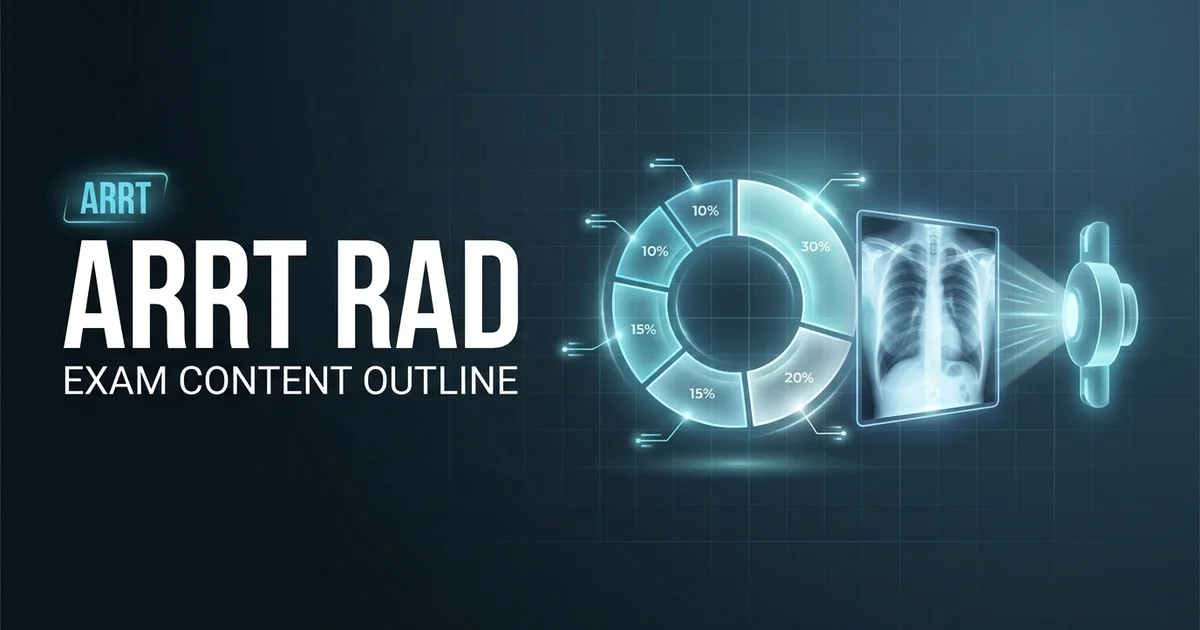
Table of Contents
The outline at a glance
The American Registry of Radiologic Technologists publishes the ARRT Radiography (RAD) outline that every ARRT Radiography question is written against (Examination Content Specifications - Radiography, Board approved January 2021, implemented January 1, 2022; valid through February 28, 2027. Replaced by the version effective March 1, 2027 (Board approved January 2026)). This page turns that document into what you actually need before you study: how big each area is, what the questions in it ask you to do, and the order to learn it in.
- Procedures~66 questions33%
- Image Production~51 questions25.5%
- Safety~50 questions25%
- Patient Care~33 questions16.5%
What each domain actually asks
The official outline describes what each area covers. Below is what the questions in it ask you to do, which is what decides how you should study it.
Procedures
33%~66 itemsIt asks you to: The largest section tests positioning: which projection shows a structure, where to centre and angle the central ray, what anatomy appears, and how to correct a rotated or clipped image.
- Head, Spine and Pelvis Procedures (18)
- Thorax and Abdomen Procedures (20)
- Extremity Procedures (28)
- Positioning, central ray and anatomy shown for each projection
- Contrast studies (GI, GU) and special procedures
- Evaluating images for correct positioning
Image Production
25.5%~51 itemsIt asks you to: Given an image problem (noise, poor contrast, distortion, an exposure-indicator value out of range), you pick the cause and the technical fix, or decide how to adjust factors when the patient, grid or distance changes.
- Image Acquisition and Evaluation (26)
- Equipment Operation and Quality Assurance (25)
- Factors affecting radiographic quality; technique charts
- Automatic exposure control (AEC)
- Digital imaging characteristics and image processing/display
- Quality control of imaging equipment
Safety
25%~50 itemsIt asks you to: Expect physics and dose reasoning: how a change in kVp, mAs, distance or collimation affects patient dose and scatter, which interaction dominates, and what protection step or dose limit applies to the patient, the public or you.
- Radiation Physics and Radiobiology (21)
- Radiation Protection (29)
- X-ray production and interactions with matter; SI units
- Biological effects of radiation
- Minimizing patient exposure (collimation, shielding, repeats)
- Personnel protection and dose limits
Patient Care
16.5%~33 itemsIt asks you to: You choose the right action with a patient in front of you: verifying the order and identity, spotting and responding to a contrast reaction or emergency, applying standard or transmission-based precautions, and staying within legal and ethical rules.
- Patient Interactions and Management (33)
- Ethical and legal aspects: consent, HIPAA, patients' rights, ARRT Standards of Ethics
- Interpersonal communication and patient education
- Ergonomics, patient transfer and monitoring
- Medical emergencies (allergic reactions, cardiac/respiratory arrest, trauma)
- Infection control; contrast media and pharmacology
Study it in this order
Weight is the only honest guide to where your hours go. The areas that make up the first half of the paper are core; the next third is support; whatever is left is a quick win you review last, not skip.
| Domain | Weight | Items | Priority |
|---|---|---|---|
| Procedures | 33% | ~66 | Core |
| Image Production | 25.5% | ~51 | Core |
| Safety | 25% | ~50 | Support |
| Patient Care | 16.5% | ~33 | Quick win |
Item counts are the weight applied to 200 scored questions and rounded, so treat them as approximate.
How the exam is built
| Item | Detail |
|---|---|
| Questions | 230 |
| Scored questions | 200 |
| Unscored pretest items | 30 |
| Time | 230 minutes |
| Question types | Multiple choice with one best answer (most questions), Select multiple answers from a list, Sorted-list (drag options into order), Select an area on an image (hot spot), Multiple choice after viewing a short video clip |
| Delivery | Computer-based at Pearson VUE test centers, scheduled any time within your one-year (365-day) exam window. |
| Passing standard | Total scaled score of 75 on ARRT's 1-99 scale (a 75 does not mean 75% correct). ARRT's 2025 report puts the approximate percentage correct needed to pass Radiography at 67%. A new standard (equivalent to 130 of 200 items on the reference form) takes effect March 2027. |
| Fee | $225 — $225 application fee for primary credentials, including Radiography; nonrefundable and nontransferable. Each attempt needs a new application and fee. Appointment length is 250 minutes: 230 min of testing plus an 8-min tutorial, 2-min nondisclosure agreement and 10-min survey. Optional ethics preapplication review costs $100. |
| Retakes | Three attempts to pass within three years of the date your first exam window opens; each attempt needs a new application and fee. Attempts taken as a state licensing candidate count against the limit. After three attempts or three years you must requalify (repeat education) to become eligible again. |
| Published pass rate | 85.8% (First-time Radiography candidates, n = 14,072 (ARRT summary table rounds to 86%), 2025) |
Where candidates lose marks
These are the places the outline and the real exam part ways, the parts of the outline candidates misjudge most often:
- Underweighting positioning: Procedures is the largest section (66 of 200 now, rising to 72 in March 2027), and central-ray location, angle and evaluation criteria are memory-heavy.
- Mixing up units: ARRT uses SI units (Gy, Sv, C/kg) as the primary units of radiation measurement, so conventional-unit habits cost points.
- Studying from pre-2027 materials after March 1, 2027: CR and IV urography content is removed and virtual grids, teleradiography and new procedure content are added.
- Treating 75 as 75% correct: it is a scaled score, and about 67% correct has been enough to pass. Chasing perfection in physics at the expense of procedures is a common misallocation.
- Not using the full clock: you get about one minute per question, and unanswered questions count wrong, so guess and flag rather than leave blanks.
Turn the outline into practice
ExamCert AI has 500 ARRT Radiography practice questions with explanations, built around the same outline this page walks through. Work them by domain, find the weak area, and fix it before test day.
Practise ARRT Radiography on ExamCert AIHow to Become a Radiologic Technologist in 2026FAQ
How many questions are on the ARRT Radiography exam?
There are 230 questions: 200 scored and 30 unscored pilot questions that you cannot tell apart. You get 230 minutes of testing time within a 250-minute appointment.
What are the ARRT Radiography content categories?
Through February 28, 2027 the 200 scored questions are Patient Care 33, Safety 50, Image Production 51 and Procedures 66. From March 1, 2027 they become 31, 46, 51 and 72.
What score do you need to pass the ARRT registry?
You need a total scaled score of 75 on a 1-99 scale. That is not 75% correct: ARRT's 2025 report says about 67% correct was needed on Radiography.
What kinds of questions are on the exam?
Most are single-best-answer multiple choice. Some ask you to select several answers, sort options into order, click an area of an image, or answer after watching a short video clip.
Sources
Figures on this page come from ARRT and the other primary sources below:
- ARRT - Radiography Examination Content Specifications (through Feb 28, 2027)
- ARRT - Radiography Content Specifications effective March 1, 2027
- ARRT News - Updated Radiography Documents (May 1, 2026)
- ARRT - Radiography Standard Setting Report, effective March 2027
- ARRT - 2026 Primary Eligibility Pathway Handbook
- ARRT - Guide to Maintaining Your ARRT Credential
- ARRT - Annual Exam Report 2025
- ARRT - Application Fees
- ARRT - Education Requirements, Primary Eligibility Pathway
- BLS Occupational Outlook Handbook - Radiologic and MRI Technologists
Checked September 25, 2026. Fees, outlines and eligibility rules change — confirm with ARRT before you book.