
300-420 ENSLD Syllabus 2026: The v1.1 Blueprint in Full
Cisco publishes the weightings for this exam but not the question count and not the pass mark. Here is the v1.1 blueprint in full, and what the 2026 track changes mean for it.
- Not publishedQuestions
- 90 minTime
- 5Sections
- YesWeights published
- Not publishedPass mark
- $300Fee
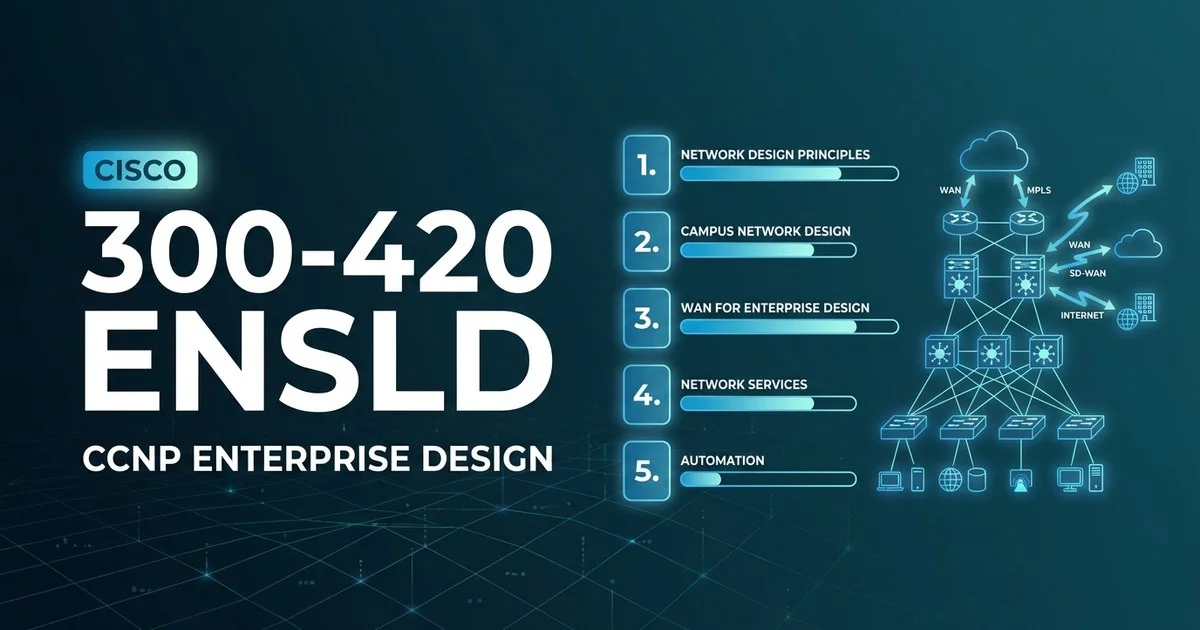
Table of Contents
The whole paper in one bar
Exam topics v1.1 is the exam guide Cisco publishes for Designing Cisco Enterprise Networks v1.1 (ENSLD 300-420), restated so you can see the shape of the paper before you read a word of the detail. The bar below is the entire syllabus: 5 sections, in the order the certifying body lists them.
- §1 Advanced Addressing and Routing Solutions — 25%
- §2 Advanced Enterprise Campus Networks — 25%
- §3 WAN for Enterprise Networks — 20%
- §4 Network Services — 20%
- §5 Automation — 10%
Those percentages are Cisco’s own, not an estimate. That matters more than it sounds: most pages ranking for this query quote weightings the vendor never published.
The syllabus, section by section
Each block below is one section of the official outline. The bullets are the sub-objectives Cisco publishes underneath it — the actual scope statement, not a summary of it.
Advanced Addressing and Routing Solutions
- Structured addressing plans for IPv4 and IPv6
- Stable, secure, scalable IS-IS designs
- Stable, secure, scalable EIGRP designs
- Stable, secure, scalable OSPF designs
- BGP design - address families, filtering, path attributes, route reflectors, load sharing
- IPv6 migration strategies - tunnelling, dual-stack, translation boundaries
Advanced Enterprise Campus Networks
- Campus high availability - FHRP, graceful restart, BFD
- Layer 2 design - STP scalability, fast convergence, loop-free technologies, PoE, WoL
- Layer 2 security - STP security, port security, VACLs
- Multicampus Layer 3 - convergence, load sharing, summarisation, VRFs, redistribution
- SD-Access architecture - underlay, overlay, control and data plane, automation
- SD-Access fabric design for wired and wireless access
WAN for Enterprise Networks
- WAN connectivity options - L2VPN, MPLS L3VPN, Metro Ethernet, DWDM, 4G/5G
- Site-to-site VPN design - DMVPN, IPsec, GRE, GET VPN
- WAN high availability - single-homed, multihomed, backup, failover
- Cisco SD-WAN architecture - orchestration, management, control and data planes
- SD-WAN design considerations - overlay, LAN, HA, security, QoS and multicast
Network Services
- Selecting a QoS strategy - DiffServ versus IntServ
- End-to-end QoS - classification, marking, shaping, policing, queuing
- Network management design - in-band versus out-of-band, segmented management
- Multicast routing concepts - source trees, shared trees, RPF, rendezvous points
- Multicast services design - SSM, PIM bidirectional, MSDP
Automation
- IETF versus OpenConfig versus Cisco YANG models
- NETCONF versus RESTCONF
- Model-driven telemetry - periodic and on-change publication
- gRPC and gNMI
- Cloud connectivity - direct connect, cloud on-ramp, WAN integration
- Cloud service models in private, public and hybrid deployments
Two things the blueprint will not tell you. Cisco does not publish an item count for this exam - only the 90-minute seat time - so the 55, 60 or 65 figures circulating online are estimates. And Cisco does not publish a passing score for any exam: cut scores are set by statistical analysis and can change without notice, which is why the widely quoted 825/1000 is a community guess. You do get a section-level performance breakdown on your score report.
What the weightings really mean
Cisco publishes the proportions but not the number of items on the paper, so the honest version of this section stops at ratios. Advanced Addressing and Routing Solutions at 25% is worth two and a half times what Automation at 10% is worth, whatever the item count turns out to be, and your study hours should follow that ratio rather than the order the blueprint happens to list things in.
The trap is treating a low percentage as permission to skip. Weightings are the floor of what a section costs you, because the small sections on almost every blueprint supply the context for questions filed under a different heading. You lose those marks in the heavy section and never find out why.
Reading the verbs in the objectives
The verb at the front of each sub-objective is the part candidates skim and examiners take literally. It sets the depth you are tested at, and it is the difference between recognising a service name and being asked to choose between two that both look right.
| Verb | What a question at that depth looks like |
|---|---|
| Create | The design verb, and it opens every objective in the 25% routing section. You are given requirements and asked which addressing plan or routing design satisfies them - not how to configure it. |
| Design | Same depth, applied to campus, WAN and services. Expect constraints such as convergence time, failure domain size or segmentation to decide the answer. |
| Describe | Reserved almost entirely for SD-Access, SD-WAN and the automation section. Recognition-level, which is why the 10% automation domain is the cheapest marks on the paper. |
| Differentiate | Only in automation - YANG model flavours, NETCONF versus RESTCONF. Pure comparison recall. |
This is a design exam, not a configuration exam. No objective asks you to configure anything, and that single fact separates candidates who pass from CCNP-level engineers who fail it because they answered as an implementer. Cisco recommends three to five years of enterprise design experience.
Study it in this order, not the syllabus order
Exam guides are written to describe a job role, not to teach one. The published order is almost never the order that builds knowledge fastest. This is the sequence that front-loads the material everything else depends on.
| Order | Why here |
|---|---|
| 1. Advanced addressing and routing | 25%, and the section every other one leans on. Nothing in campus or WAN design makes sense before the routing protocol design choices do. |
| 2. Advanced enterprise campus | The other 25%. Layer 2/Layer 3 boundary placement, high availability, then SD-Access, which is heavily Describe-level and quick to bank. |
| 3. WAN | 20%. SD-WAN carries two of the five sub-topics on its own and is largely descriptive - learn the plane architecture and the design-consideration list. |
| 4. Network services | 20%. QoS and multicast. Multicast is the topic candidates most often leave until it is too late; it is not large but it is unforgiving. |
| 5. Automation | 10% and last. Six sub-topics, all recognition-level, and the fastest marks per hour on the whole blueprint. |
Half the paper is in the first two sections. If the exam date is close, the highest-yield revision is routing design plus campus design, then a fast pass over automation, which is small, descriptive and cheap to bank.
What changed, and how to spot the next change
The blueprint itself is unchanged - v1.1 is still what a 2026 candidate sits, and no revision or retirement has been announced. What changed is the track around it. The CCNP Enterprise core moved to ENCOR v1.2, first testable 19 March 2026, and wireless content was pulled out of the core into a new dedicated CCNP Wireless and CCIE Wireless track launched the same month, taking the wireless concentration exams with it. ENSLD remains an Enterprise concentration and its topics are untouched. One stale detail to expect: the blueprint still says Cisco DNA Center in the SD-Access topics, and the product has since been renamed Catalyst Center.
Two habits keep you from studying a retired outline. First, open the official exam guide and look for its revision date before you buy anything — courses and question banks lag a syllabus change by months, and the cheapest ones never catch up. Second, re-check it the week you book. A revision announced after you started studying is still a revision you sit.
Turn the syllabus into questions
Reading an outline tells you the shape of the paper. Answering questions tells you which sections you would actually lose marks on. Start free, then $5.99 unlocks the full 300-420 ENSLD bank.
Free practice test300-420 ENSLD exam pageFAQ
How many questions are on the 300-420 ENSLD exam?
Cisco does not publish an item count for this exam. The official topics document and exam page state only the 90-minute duration, so any specific number you see quoted is a third-party estimate rather than a Cisco figure.
What is the passing score for 300-420?
Cisco does not publish passing scores for any exam. Its policy page states that cut scores are set by statistical analysis and are subject to change without notice. The 825/1000 figure that circulates online is a community estimate.
What are the 300-420 exam topics and their weightings?
Five domains: Advanced Addressing and Routing Solutions 25%, Advanced Enterprise Campus Networks 25%, WAN for Enterprise Networks 20%, Network Services 20% and Automation 10%. Those are Cisco's own published percentages from the v1.1 exam topics document.
Does passing 300-420 give me CCNP Enterprise?
Not on its own. Passing 300-420 earns Cisco Certified Specialist - Enterprise Design. CCNP Enterprise needs the core exam 350-401 ENCOR as well, which moved to v1.2 in March 2026.
Sources
Every section title, sub-objective and number on this page comes from the certifying body:
- https://learningcontent.cisco.com/documents/marketing/exam-topics/300-420-ENSLD-v1.1.pdf
- https://www.cisco.com/site/us/en/learn/training-certifications/exams/ensld.html
- https://www.cisco.com/site/us/en/learn/training-certifications/exams/policies.html
Checked September 2, 2026. Exam guides are revised without notice — confirm against Cisco before you build a study plan around this page.