PMP Prerequisites & Eligibility
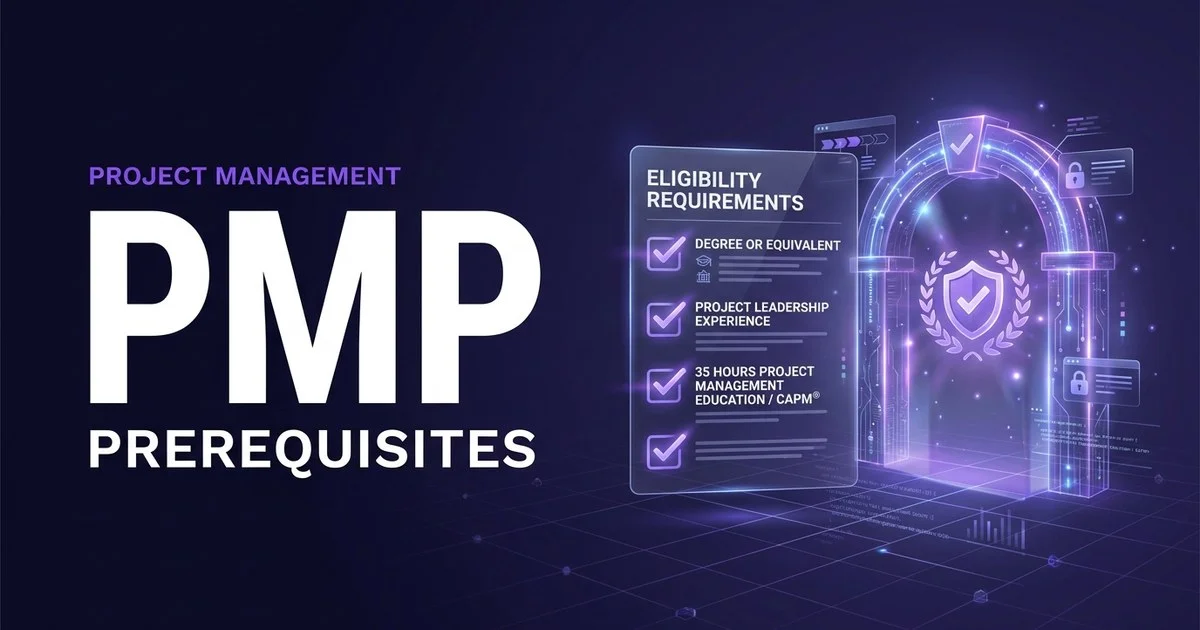
Unlike most IT certifications, the PMP has real eligibility requirements you must meet before you can even apply: a set amount of project experience plus 35 contact hours of formal education. Here is exactly what you need, the experience-and-education matrix, the application and audit, and how to know if you qualify yet.
01 The short answer
This is what makes the PMP different from most cloud or IT exams — there is no “just book it and sit” option. You apply to PMI, your experience and education are checked, and only then are you cleared to schedule the exam. The good news: the requirements are clear and most working project professionals already meet them without realising it.
Project-management experience Required
36 months (with a degree) or 60 months (without) of leading and directing projects, completed within the last several years.
35 contact hours of PM education Required
Formal, structured project-management training — a prep course counts; reading books or free videos does not. A current CAPM substitutes for this.
Documentation ready for audit Recommended
Have supervisor/client contacts and course certificates ready — PMI audits a random sample of applications.
02 The experience-and-education matrix
Your education level sets how much project experience you must show. These are the standard paths — in all cases the experience must be in leading and directing projects, not just participating.
| Your education | Project-leadership experience | Contact hours |
|---|---|---|
| Four-year degree (bachelor's or global equivalent) | 36 months (about 4,500 hours) | 35 hours |
| Secondary diploma (high-school or associate degree) | 60 months (about 7,500 hours) | 35 hours |
| Bachelor's from a GAC-accredited programme | 24 months (reduced) | 35 hours |
03 The 35 contact hours, explained
The contact-hours requirement trips up a lot of first-time applicants because not everything counts. Here is what does and does not.
A structured PMP prep course Counts
Online or in-person courses from an authorised training provider are the most common route — most are built to deliver exactly 35 hours.
University / college PM courses Counts
Formal academic project-management courses count toward the 35 hours.
Holding a current CAPM Substitutes
If you already hold the CAPM certification, it satisfies the education requirement in place of the 35 contact hours.
Books, free videos, on-the-job learning Does not count
Informal self-study, however useful, does not satisfy the contact-hours requirement — it must be structured, trackable training.
04 The path from “eligible” to “exam booked”
Meeting the prerequisites is step one. Here is the full sequence before you actually sit the exam.
Earn the experience
Accumulate your 36 or 60 months of leading and directing projects.
Get 35 contact hours
Complete a formal prep course (or hold a current CAPM).
Apply on PMI.org
Submit your experience and education in the online application.
Clear review / audit
Pay the fee, clear any audit, then schedule the exam.
05 Is the PMP right for you yet?
If you do not meet the experience bar yet, that is not a dead end — it usually just means the CAPM first.
You're ready to pursue the PMP
- You have 36+ months (degree) or 60+ months (no degree) leading projects
- You can get 35 contact hours from a prep course
- You can evidence your experience if audited
- You want the senior, salary-lifting credential
Consider the CAPM first
- You are early-career or new to formal project management
- You do not yet have the months of project-leadership experience
- The CAPM has no experience requirement — just the education
- It later satisfies the PMP's 35 contact hours, so it is not wasted
06 FAQ
What are the prerequisites for the PMP exam?
Two things: project-management experience and 35 contact hours of formal PM education. The experience depends on your education — with a four-year degree you need 36 months of leading projects; with a secondary diploma you need 60 months. The 35 contact hours are required in every case, unless you hold a current CAPM, which substitutes for them.
Do you need a degree to take the PMP?
No. You do not need a university degree. Candidates with only a secondary diploma (high school or associate degree) can qualify, but must show 60 months of project-leadership experience instead of the 36 months required of degree holders. The 35 contact hours are required either way.
How many contact hours do you need for the PMP?
35 contact hours of formal project-management education before you apply, from a structured prep course, university course, or PMI-authorised training. Informal self-study such as reading books or watching free videos does not count. Holding a current CAPM satisfies this in place of the 35 hours.
What happens if my PMP application is audited?
PMI audits a random sample of applications. If selected, you provide evidence: signed verification of your project experience from supervisors or clients, and certificates for your 35 contact hours. Keep this ready before you apply, because you cannot sit the exam until an audit is cleared.