How Long to Study for the PMP Exam?
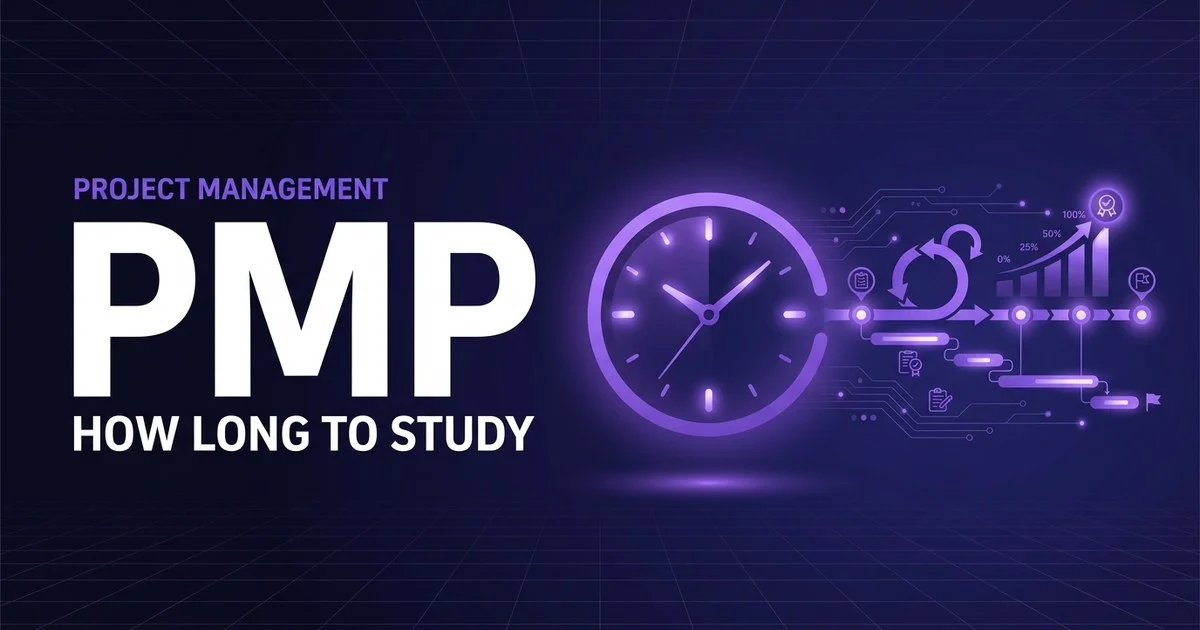
Most people need 70 to 200 hours — roughly 8 to 16 weeks — depending on how much real project-management experience they bring. Here is the honest timeline by experience level, a week-by-week 12-week plan, and what makes prep faster or slower.
01 The short answer
The PMP is not a memorisation exam, and that is exactly why raw hours matter less than how you spend them. The 2026 exam is 180 questions in 230 minutes, mixing multiple-choice, multiple-response, matching, hotspot, and drag-and-drop items. Almost every question is a scenario that asks for the best next action — so practice and the PMI “mindset” eat more of your hours than reading ever will.
02 How long it takes by experience level
Your starting point matters more than any other factor. Find the lane that sounds most like you — the bar shows roughly how much ground you have to cover.
Active project manager
70–85 hrsYou lead projects today, know agile and hybrid delivery, and just need to map your experience onto PMI’s language and the Exam Content Outline.
Pace: ~6–8 weeks at 10 hrs/weekSome PM exposure
100–140 hrsYou coordinate work or run small projects but never formally studied frameworks. You meet the experience bar but agile and earned-value thinking are new.
Pace: ~10–12 weeks at 10–12 hrs/weekNew to formal PM
150–200 hrsYou qualify on experience (perhaps as an “accidental” PM) but the vocabulary, process groups, and agile mindset are mostly unfamiliar territory.
Pace: ~14–16 weeks at 10–12 hrs/week03 A week-by-week 12-week plan
This is the “some PM exposure” track — the most common starting point. Compress it to 8 weeks if you are an active PM, or stretch it to 16 if formal PM is brand new. The order matters: build the mindset early, then weight your time toward the heavy domains.
1–2
Foundations & the 35 contact hours
Knock out a prep course (covers the mandatory 35 contact hours), skim the PMI Exam Content Outline, and learn the three domains and their weights. Goal: understand the “servant-leader, value-first” mindset before any deep study.
~20–25 hrs3–5
People domain (42%)
Leadership, team building, conflict resolution, coaching, and removing blockers. This is the largest single slice of the exam, so give it real time. Drill 20–30 scenario questions per session and review every wrong answer.
~30–35 hrs6–8
Process domain (50%)
Predictive, agile, and hybrid delivery: planning, scope, schedule, risk, procurement, and quality. Half the exam lives here. Learn when each approach applies rather than memorising tools in isolation.
~35–40 hrs9
Business Environment (8%)
Compliance, organisational change, benefits realisation, and delivering value. Small weight, but easy marks if you understand how projects connect to strategy.
~10 hrs10–11
Full-length mock exams
Sit at least three complete 180-question, timed simulations. Score each domain separately and pour your remaining time into whichever falls below 75%. This is where readiness is actually proven.
~25–30 hrs12
Final review & book
Light review of weak areas, re-read the mindset principles, rest the day before, and sit the exam. Don’t cram new material in the last 48 hours — protect your recall.
~10 hrs04 What makes your timeline faster or slower
Two people with identical job titles can need wildly different hours. These are the factors that move the needle most.
▲ Speeds you up
- You currently lead projects and can map real experience to PMI terms
- Recent hands-on agile or Scrum delivery
- You can study full-time or in long focused blocks
- Prior CAPM or a strong prep course with a question bank
- You test yourself early instead of only reading
▼ Slows you down
- No formal project-management background
- Agile and hybrid delivery are new concepts
- Studying 30–45 minutes at a time around a full-time job and family
- English is a second language (more reading time per question)
- Relying on reading and videos instead of practice questions
05 A realistic weekly schedule
Most people pass while working full time. The trick is consistency, not heroics — this ~11-hour week is sustainable for the whole 10–12 weeks.
| Day | Time | Focus |
|---|---|---|
| Mon–Thu | 1.5 hrs (evening) | Read one ECO topic, then answer 20–25 practice questions and review every miss |
| Friday | Rest | No study — protect against burnout |
| Saturday | 3 hrs | One timed mini-mock (45–60 questions) plus a full review of wrong answers |
| Sunday | 2 hrs | Attack your weakest domain and refresh flashcards / formulas |
06 FAQ
How many hours do you need to study for the PMP?
Most candidates need 70–200 hours of focused study. Active project managers who already think in PMI terms can be ready in roughly 70–85 hours; people newer to formal project management usually need 150–200 hours. Spread over a typical 10–12 hours per week, that is about 8–16 weeks.
Can you study for the PMP in one month?
It is possible but only realistic for experienced project managers who can commit 5–6 hours a day and already understand agile and hybrid delivery. For a working professional studying 1–2 hours an evening, one month is too tight and usually leads to a Below Target result. A 10–12 week plan is far safer.
What is the passing score for the PMP exam?
PMI does not publish a fixed passing percentage. Your result is reported as Above Target, Target, Below Target, or Needs Improvement across the domains, based on a psychometric model. As a practical readiness proxy, aim for a consistent 80%+ on full-length practice exams before you book.
How long before the exam should I take practice tests?
Do light practice questions from week one to learn the PMI mindset, but reserve the final 2–3 weeks for full-length, timed mock exams. You want at least three complete 180-question simulations under exam conditions, with every domain above 75%, before scheduling the real thing.