PMP Exam Format: What to Expect
The PMI Project Management Professional exam is 180 questions in 230 minutes, with two scheduled 10-minute breaks and a mix of question types — and there is no published passing percentage. Here is exactly what the exam looks like on screen, the question types, what exam day feels like, and how the band-based scoring works.
01 The format in one minute
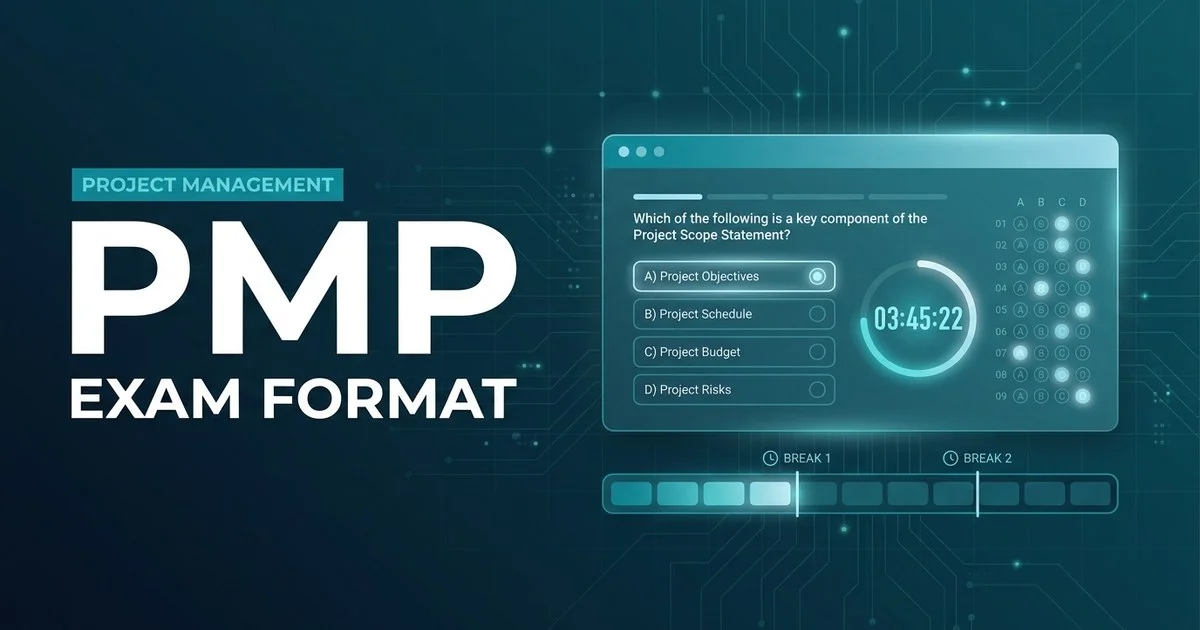
Below is a close approximation of what a single question looks like in the Pearson VUE test engine. The header shows your position and the countdown clock; the footer holds the flag-for-review toggle and navigation:
Midway through an agile project, a key stakeholder bypasses the product owner and asks a developer to add an unplanned feature directly to the current sprint. The developer is unsure how to respond. What should the project manager do first?
Illustration of the test-engine layout — not an actual exam question.
That single screen captures most of what makes the PMP tick: situational stems where several options “work” but only one reflects the right project-management mindset, options that span agile and predictive thinking, and a clock that averages out to roughly 75 seconds per question. Note the position counter — the exam is delivered in three sections of 60, with a break offered between each.
02 Question types you'll face
PMI varies the form of PMP questions more than many exams, but the substance is consistent: nearly every item is a situational judgement. Knowing the formats in advance keeps the unfamiliar ones from costing you time on exam day.
Multiple choice
Four options, exactly one correct. The other three are plausible actions that are weaker or premature. This is the large majority of the exam.
Most questionsMultiple response
“Choose all that apply.” You select every correct option and no wrong ones; PMI does not document partial credit, so treat each as all-or-nothing.
Some questionsMatching / hotspot / fill-in
A few items ask you to match pairs, click a region of an image (hotspot), or type a short numeric or one-word answer. Limited in number but worth practising.
A fewSituational framing
Not a separate type, but the defining trait: most stems wrap a mini scenario around the question across predictive, agile and hybrid approaches — the “best next action” is the deciding judgement.
Throughout03 Domains, weighting & the two breaks
You have 230 minutes for 180 questions. Only 175 are scored — the other 5 are unscored pretest items PMI is trialling for future exams. They are mixed in invisibly, so treat all 180 as real. Every question maps to one of three performance domains, and the questions blend predictive, agile and hybrid approaches throughout rather than being grouped by methodology.
| Domain | Weight | What it covers |
|---|---|---|
| 1. People | 42% | Leading and building teams, conflict, negotiation, stakeholder engagement, servant leadership |
| 2. Process | 50% | The technical work of managing the project — scope, schedule, risk, quality, value delivery |
| 3. Business Environment | 8% | Compliance, organisational change, benefits realisation, project-to-strategy alignment |
Roughly half the exam is Process and just over four in ten questions are People, so the bulk of your study should sit there — Business Environment is a small slice but still appears. Across all three domains, expect predictive, agile and hybrid framing mixed together, because today's PMP assumes you can work in whichever environment the scenario describes.
04 What exam day actually looks like
You can sit the PMP two ways: at a Pearson VUE test centre, or online with a remote proctor from home. The exam itself is identical; the check-in is what differs. Here is the typical flow for an online-proctored sitting.
Log in and launch early
Open the OnVUE software, run the system test, and start check-in up to 30 minutes ahead. Late arrivals can be refused.
ID & room scan
Photograph your government ID and your workspace from four angles. Your desk must be clear — no notes, phone, second monitor, or drinks unless explicitly allowed.
Section 1 — questions 1–60
A brief tutorial first, then the clock starts. Work through the first 60 situational questions, flagging and revisiting freely within the section.
Optional 10-minute break
After question 60 you may step away; the clock pauses. Once you leave, section 1 locks — confirm those answers first. Skip the break if you prefer to keep momentum.
Section 2, then second break
Questions 61–120, then a second optional 10-minute break after question 120 with the same lock rule, before the final 60 questions.
Submit & provisional result
After question 180 you submit and complete a short optional survey. A pass/fail result appears on screen, with the full domain report following in your PMI account.
Allowed
- A valid, unexpired government photo ID
- The two scheduled 10-minute breaks (clock pauses)
- Flagging and reviewing questions within the current section
- An on-screen marker/strike-out tool for the test engine
Not allowed
- Phones, smartwatches, headphones, or second screens
- Notes, books, or scratch paper (online proctoring)
- Returning to a prior section after taking its break
- Leaving your seat outside the scheduled breaks without permission
05 How scoring & results work
This is where the PMP differs most from a typical certification: PMI does not publish a passing score, percentage, or cut line. The overall pass/fail decision is set psychometrically from the difficulty of the questions you were given, and PMI deliberately keeps the exact threshold private. So there is no “you need 72%” target to chase.
You will see a provisional pass/fail message on screen the moment you submit, and the detailed domain report becomes available in your PMI account shortly afterwards. If you do not pass, the PMP eligibility model gives you up to three attempts within your one-year eligibility period; each retake carries a reduced re-examination fee rather than the full price. Exhaust all three and you wait out the eligibility year before reapplying. (PMI can adjust these policies, so confirm the current rules when you book.)
06 FAQ
How many questions are on the PMP exam and how long is it?
180 questions in 230 minutes. Only 175 are scored — the other 5 are unscored pretest questions PMI uses to trial future items, and you cannot tell which is which, so answer all 180 as if they count.
What is the passing score for the PMP exam?
PMI does not publish a numeric passing score or percentage. Your report rates each of the three domains — People, Process and Business Environment — as Above Target, Target, Below Target or Needs Improvement, and the overall pass/fail is set psychometrically. With no public cut score, candidates aim to perform at Target or above across all domains in practice.
How do the breaks work on the PMP exam?
There are two optional, scheduled 10-minute breaks — one after question 60 and one after question 120. The 230-minute clock pauses during a break, but once you take it you cannot return to the questions in the section you just finished, so review and confirm those answers before you start the break.
What types of questions are on the PMP exam?
A mix: mostly multiple choice (one correct answer), some multiple response (choose all that apply), and a few matching, hotspot and limited fill-in-the-blank items. Questions are heavily situational and span predictive, agile and hybrid approaches. There are no hands-on labs.