Jobs You Can Get With AZ-104 (Azure Administrator)
The AZ-104 is the core Microsoft Azure associate certification — the credential most cloud admin and engineer postings ask for first. Here are the roles it actually opens, realistic US salary ranges by level, and the ladder from IT support to cloud architect.
01 The short answer
It helps to know where Azure sits. It is the second-largest cloud platform and the default choice for the enormous base of organisations already running Microsoft 365, Active Directory, and Windows Server — which means steady, corporate, enterprise-grade demand rather than just startup hype. Where AWS dominates the cloud-native and startup world, Azure wins inside large, established companies that already pay for Microsoft licensing and want one vendor, one identity provider, and one support relationship. For a job seeker that translates into a deep, durable pool of roles at banks, insurers, hospitals, manufacturers, and public-sector bodies — the kind of employers that hire steadily through good times and bad.
The AZ-104 is also the recognised springboard to the AZ-305 (Solutions Architect Expert) and AZ-400 (DevOps Engineer Expert) certifications, so it sits at the foot of a well-defined ladder rather than being a dead end. Microsoft has deliberately positioned it as the associate-level prerequisite mindset for those expert tracks, which is part of why recruiters treat it as the baseline Azure credential. Pass it and you have not just one cert — you have a clear, signposted route to the higher-paying architect and DevOps bands.
Be realistic about entry, though. The AZ-104 is an associate certification, and most employers pair it with hands-on experience. It assumes you already understand core Azure concepts — the kind covered by the AZ-900 fundamentals exam — and can work confidently in the portal, with the CLI, and with templates. Career changers usually land an IT support, cloud support, or junior cloud role first, then move into administrator and engineer titles within a year or two. The certification gets you past the résumé screen; a portfolio of real Azure work gets you the offer.
02 Jobs you can target
These are the roles where the AZ-104 most directly moves the needle. The seniority tag shows where each typically sits.
Azure Administrator
MidImplement, manage, and monitor identity, storage, networking, and compute in Azure. The role the cert is named for.
Cloud Engineer (Azure)
MidBuild and run Azure infrastructure with IaC, networking, and automation. The most common AZ-104-adjacent role.
Cloud Administrator
Entry–MidDay-to-day operations, access control, and cost management across cloud subscriptions. A common entry point.
Systems Engineer (Azure)
MidRun hybrid Windows and Azure environments. A natural move for sysadmins adding cloud to their skill set.
Cloud Operations Engineer
MidKeep cloud workloads healthy — monitoring, patching, backup, and incident response on Azure.
Azure Infrastructure Engineer
Mid–SeniorDesign and harden the core platform — networking, identity, and governance — that everything else runs on.
03 The career ladder
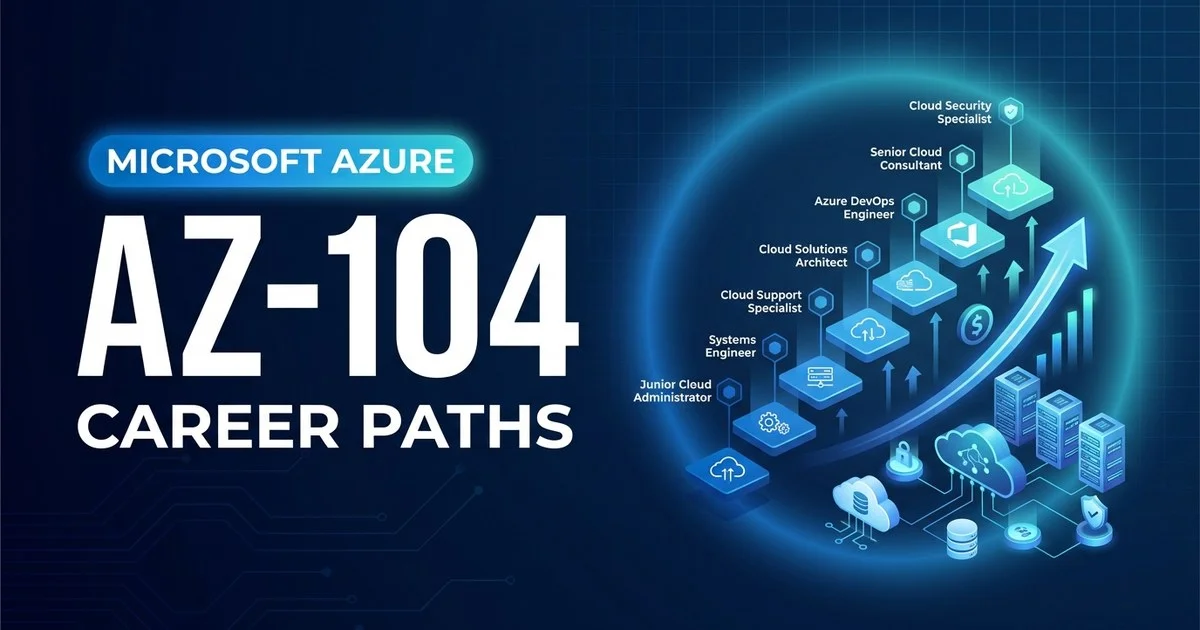
Azure careers progress fast for people who keep building. Here is a typical path with the AZ-104 as your foundation — salary bands are US guides.
Entry — Cloud / IT Support moving to Azure
Get hands on real Azure subscriptions, learn how production actually breaks, and build the experience the AZ-104 implies. Many enter here from an IT, help-desk, or Windows admin background.
~$70K–$100KMid — Azure Administrator / Cloud Engineer
Own subscriptions, run migrations, and make the identity, networking, and cost trade-offs the exam drilled into you. This is where the AZ-104 most clearly pays for itself.
~$95K–$150KSenior — Senior Azure / Cloud Engineer
Set standards across teams, mentor engineers, and own large or regulated workloads. Often the point where people add the AZ-305 architect certification.
~$140K–$180KLead — Cloud / Azure Architect or Practice Lead
Shape Azure strategy for the whole organisation or practice. Compensation here is heavily weighted toward total package, not just base.
~$170K–$230K+04 Who is hiring
Azure skills are in demand almost everywhere, because so many organisations already run on Microsoft and are moving the rest to the cloud. The pattern is consistent: a company that has used Windows Server and Active Directory for two decades reaches for Azure first because the identity, licensing, and support all carry over. That installed base is why Azure roles show up far beyond Silicon Valley — in regional banks, regulated healthcare systems, government agencies, and traditional enterprises that are not famous tech names but pay well and hire steadily. The biggest employers of AZ-104 holders cluster into a few groups.
| Employer type | Why they want the AZ-104 |
|---|---|
| Microsoft partner consultancies | Bill clients for migrations and managed Azure; certifications are a partnership requirement |
| Enterprises on Microsoft 365 & Azure | Already invested in the Microsoft stack and need admins who can run and secure it |
| Finance & healthcare | Regulated, often hybrid, and migrating to Azure — they value identity and governance skills |
| Government & public sector | Cloud-first mandates plus Azure Government create steady demand for certified staff |
| Managed service providers (MSPs) | Run Azure for many customers; certified staff are a selling point and an SLA backstop |
05 How to actually land the job
The certificate gets you noticed; these four moves get you hired.
One last point on positioning. Because Azure lives inside Microsoft-heavy organisations, the AZ-104 pairs unusually well with adjacent Microsoft skills — Entra ID (formerly Azure AD), Intune, Microsoft 365 administration, and Windows Server. If you already have any of those on your résumé, lead with the combination: an administrator who can connect on-premises identity to the cloud and govern access end to end is exactly who enterprise hiring managers are short of. That blend, plus the AZ-104 and a visible portfolio, is what turns a screening into an interview and an interview into an offer.
06 FAQ
What jobs can you get with the Azure Administrator (AZ-104) certification?
It is most directly aimed at the Azure Administrator role, but it is valued across Cloud Engineer, Cloud Administrator, Systems Engineer, Cloud Operations Engineer, and Azure Infrastructure Engineer positions. Because Azure is the second-largest cloud and dominant in Microsoft-heavy enterprises, the cert strengthens applications well beyond the administrator title itself.
Is the AZ-104 enough to get a job?
It is a strong signal but rarely the only thing employers want. The candidates who land roles fastest pair the certification with hands-on practice — a free Azure account, a few deployed environments, and some infrastructure-as-code on GitHub. Many people enter through an IT support or junior cloud role and move into administrator and engineer titles within a year or two.
How much does an Azure Administrator make?
In the US, certified Azure Administrators commonly earn a base of roughly $90K–$135K, with Azure Cloud Engineers around $110K–$150K and senior engineers reaching $180K or more. Figures vary widely by location, employer, and experience, and total compensation can be higher once bonus and equity are included.
Can you get an Azure job with no experience and just the AZ-104?
It is possible, but the realistic path is an entry role first — IT or cloud support, a junior cloud role, or an internal move from a sysadmin job — then progressing to administrator and engineer titles. The certification plus a visible portfolio of hands-on Azure work is far more convincing than the certificate alone.