How to Renew Your PMP Certification
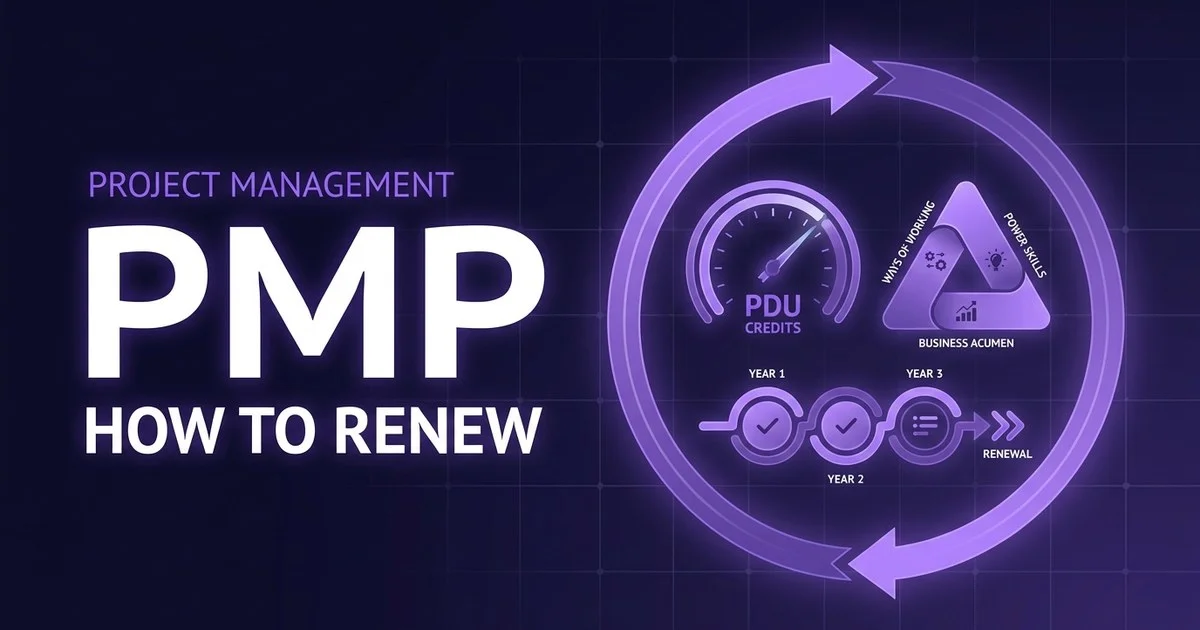
Your PMP is valid for three years. To keep it, you earn 60 PDUs and pay a small renewal fee — no re-exam required. Here is exactly how the CCR cycle works, the fastest ways to earn PDUs, and what happens if you let it lapse.
01 The short answer
The mistake people make is treating renewal as a year-three sprint. It is not: PMI's Continuing Certification Requirements (CCR) programme expects you to keep learning throughout the cycle, and 60 PDUs spreads to a comfortable 20 per year. The clock starts the day you pass the exam — not a calendar year — so your deadline is your personal anniversary, three years out. One PDU is broadly one hour of qualifying learning or contribution, so 60 PDUs is roughly 60 hours of professional development spread over 36 months: very manageable if you do not leave it all to the end.
This same CCR engine renews every active PMI certification — CAPM, PMI-ACP, PgMP and the rest — just with different PDU totals. The PMP figure to memorise is 60. If you also hold another PMI credential, many activities can be claimed once and applied across certifications where the requirements overlap, so the practical workload is lower than the raw numbers suggest.
02 The PDU requirement, in detail
The 60 PDUs are not interchangeable. PMI splits them across two activity types — Education and Giving Back — with a hard minimum on education, and within education you must also spread credits across the three sides of the PMI Talent Triangle.
| Requirement | Amount | What counts |
|---|---|---|
| Total PDUs / cycle | 60 over 3 years | Education plus Giving Back, combined |
| Education (required) | At least 35 | Courses, webinars, reading, and self-study that build your project skills |
| Talent Triangle minimum | 8 in each area | Within Education: minimum 8 PDUs each in Ways of Working, Power Skills, and Business Acumen |
| Giving Back (optional) | Up to 25 | Volunteering, creating content, mentoring, and working as a practitioner (working capped at 8) |
So the floor is 35 Education PDUs, of which 24 are locked by the Talent Triangle (8 + 8 + 8); the remaining 11 education credits and any Giving Back credits are yours to distribute up to the 60 total. You can over-deliver on Education and skip Giving Back entirely — but you can never substitute Giving Back for the 35-PDU education floor.
It helps to understand what each Talent Triangle side means, because CCRS asks you to tag every Education PDU to one of them. Ways of Working covers the technical craft of delivery — predictive, agile, and hybrid methods, scheduling, risk, and the mechanics of running projects. Power Skills are the interpersonal and leadership capabilities: communication, stakeholder management, conflict resolution, and influencing. Business Acumen is the strategic side — aligning projects to organisational goals, understanding the industry, and connecting delivery to value. Picking learning that deliberately touches all three is the easiest way to clear the 8-per-area minimum without backtracking late in the cycle.
03 The fastest ways to earn PDUs
You do not need to spend a penny to clear 60 PDUs. A mix of free and paid activities — several of which you already do at work — gets you there comfortably across three years. This is the big practical advantage of the PMP renewal model: free PDUs are abundant, so the only real cost most people face is the one-off renewal fee. Below are the six richest sources, each tagged with how it counts.
PMI & partner webinars
ProjectManagement.com and PMI's webinar library host hundreds of free on-demand sessions that auto-post Education PDUs straight into your CCRS record.
Local chapter meetings
Your PMI chapter runs events, study groups, and talks that earn PDUs — often free or a few dollars, and great for networking while you learn.
Read & reflect
Reading project-management books, standards, and articles counts as Education PDUs (roughly 1 per hour). The PMBOK Guide and Agile Practice Guide are obvious starting points.
Courses & conferences
A structured online course or a multi-day conference can earn 15–40 PDUs at once — often the single fastest way to clear most of a cycle in one go.
Volunteer, mentor, create
Volunteering for PMI, mentoring, speaking, or writing project content earns Giving Back PDUs — up to 25 toward your 60.
Work as a practitioner
Simply doing the job — running real projects — earns Giving Back PDUs, but is capped at 8 per cycle, so it cannot carry your renewal alone.
04 The renewal cycle, step by step
↻ Repeats every 3 years
Earn PDUs
Accumulate 60 PDUs year-round from webinars, courses, reading, chapter events, and giving back — aim for 20 a year.
Log in CCRS
Record each activity in the CCRS portal and keep your supporting evidence in case PMI audits your renewal.
Pay the fee
Submit your renewal and pay $60 as a PMI member or $150 as a non-member — once per three-year cycle.
Stay certified
PMI confirms your renewal and a fresh three-year cycle begins — no re-exam, no reapplication.
05 What happens if your PMP lapses
Missing the requirements is recoverable if you act fast, but expensive if you ignore it. Unlike a single hard cut-off, PMI gives you a staged off-ramp — but each stage costs you more, so the goal is to never leave the first one. Here is the sequence PMI follows.
The practical takeaway: set a calendar reminder for roughly six months before your cycle-end date, do a quick PDU audit in CCRS, and book whatever learning you still need. Because so many PDUs are free and post automatically, most people who plan even a little never see the suspension window at all. The renewal itself takes minutes once your 60 PDUs are logged — you click submit, accept PMI's Code of Ethics, pay the fee, and a fresh three-year cycle begins.
06 FAQ
How many PDUs does PMP renewal require?
You must earn 60 PDUs over each three-year CCR cycle, about 20 per year. Of those 60, at least 35 must be Education PDUs and a maximum of 25 can be Giving Back PDUs. Within the Education total you also need a minimum of 8 PDUs in each of the three PMI Talent Triangle areas: Ways of Working, Power Skills, and Business Acumen.
How much does it cost to renew a PMP?
PMI charges a renewal fee of $60 for PMI members and $150 for non-members, paid once per three-year cycle when you submit your renewal in CCRS. The fee is separate from any cost of the activities you use to earn PDUs, and many PDU sources are completely free.
What happens if my PMP expires?
If you do not complete the 60 PDUs and pay the fee before your cycle ends, your PMP enters a one-year suspension period during which you cannot use the credential but can still catch up. Miss that window too and the certification expires permanently, and the only route back is to apply and sit the PMP exam again.
Can I renew PMP without retaking the exam?
Yes. The normal path is recertification by PDU: earn 60 PDUs across three years, log them in CCRS, and pay the renewal fee, and you never have to retake the exam. Sitting the PMP exam again is only required if you let the certification lapse through the suspension period and it expires.