How to Get an Entry-Level IT Job With No Experience
Entry-level IT — help desk and desktop support — is the classic no-degree on-ramp to the whole tech industry. You do not need a job behind you, only provable skills and a clear path. Here is the realistic zero-to-hired roadmap: what to learn, the first certification that opens doors, and the entry roles you can actually land.
01 Can you really break in with no experience?
This is the one corner of tech where “no experience” is genuinely expected. Almost everyone working in IT today started on a help desk or behind a support ticket. From there, the field opens out into networking, systems administration, cloud, security, and beyond — but the first rung is deliberately low. The myths below are what stop most people from reaching for it. None of them hold up.
✗ Myth
You need a degree to get a help desk or support job.
✓ Reality
The US Bureau of Labor Statistics notes you can qualify for support roles with a high school diploma plus IT certifications. A+ routinely stands in for a degree.
✗ Myth
You have to be a programmer or “computer genius” first.
✓ Reality
Day-one support work is troubleshooting, password resets, and patient help. No coding required — methodical problem-solving and people skills matter far more.
✗ Myth
“No experience” means you have nothing to put on a resume.
✓ Reality
A home lab, a PC you built, and a cert are experience employers value — and customer-service skills from any past job transfer directly.
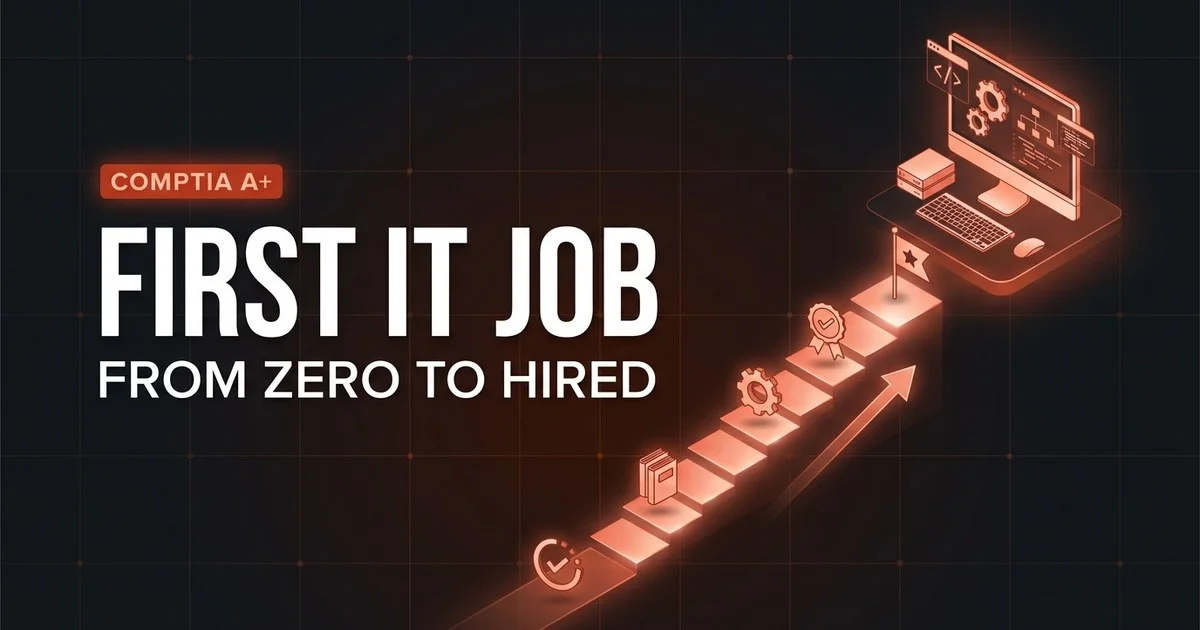
02 The zero-to-hired roadmap
There is no single route, but this sequence is the one that works most reliably for people starting from scratch. Expect roughly three to six months of consistent part-time effort from a standing start to your first interview — faster than almost any other tech path.
Start where you are You are here
List your transferable strengths — customer service, patience, problem-solving, attention to detail. Helping people calmly under pressure is half of a support job, and it belongs on your resume now.
Learn the fundamentals Month 1–2
Get comfortable with PC hardware, how Windows and Linux work, and basic networking (IP addresses, DNS, Wi-Fi, ports). Plenty of free material covers this — the goal is fluency with the everyday building blocks of IT.
Earn CompTIA A+ Month 2–4
A+ is the standard door-opener for entry IT: vendor-neutral and built for support roles. Note it is two exams — Core 1 (220-1101) and Core 2 (220-1102) — and you must pass both to earn the certification.
Build hands-on proof Ongoing
Set up a home lab, install and break operating systems, and — if you can — build a PC from parts. Nothing says “I can do this job” like having assembled and fixed real hardware with your own hands.
Land a help-desk or desktop-support role Get hired
Aim at help desk, desktop support, or field technician openings — the genuine entry points. Tailor each application to your A+ and the hands-on work you can point to, and apply in volume.
03 The skills employers actually want
You do not need all of these on day one, but the “core” items are what separate a hireable candidate from a hopeful applicant. Build them as you study for A+ — every topic on the exam maps to a real support task.
PC hardware
Components, assembly, peripherals, and basic repair — swapping RAM, drives, and parts, and diagnosing why a machine will not boot.
CoreOperating systems
Working knowledge of Windows and a little Linux: installs, user accounts, permissions, updates, and the command line.
CoreNetworking basics
IP addresses, DNS, Wi-Fi, cables, and ports — enough to tell whether a problem is the device, the network, or the user.
CoreTroubleshooting
A repeatable method: reproduce, isolate, test one change at a time, document. This methodical mindset is the heart of the job.
CoreCustomer service
Clear communication, patience, and calm with frustrated users. The skill that most often decides who gets hired and who gets promoted.
Nice to haveTicketing / ITSM
Familiarity with tools like ServiceNow, Jira, or Zendesk and how tickets are logged, prioritised, and escalated. Easy to pick up on the job.
Nice to have04 The certification that opens the door
When you have no work history, a certification does two jobs: it teaches you the baseline, and it gives a recruiter a reason to call. For entry IT, CompTIA A+ is the near-universal first choice — it is vendor-neutral, has no formal prerequisites, and is built specifically for support roles. Remember it is two required exams: Core 1 (220-1101) covers hardware, networking, and mobile devices; Core 2 (220-1102) covers operating systems, security, and troubleshooting. You earn A+ only by passing both.
| If you want to… | Consider |
|---|---|
| Get your first IT job | CompTIA A+ (220-1101 + 220-1102) — the standard starting point |
| Move toward networking | A+ first, then CompTIA Network+ to specialise |
| Move toward cybersecurity | A+ first, then CompTIA Security+ to specialise |
| Lean toward cloud | A+ for fundamentals, then an entry cloud cert (AWS or Azure) |
05 Your first roles & what they pay
Aim at genuine entry points, not mid-level postings dressed up as “junior.” These are the roles that hire people without prior IT titles. Pay figures are typical US starting ranges from public aggregators — they vary widely by location, employer, company size, and the skills you can demonstrate, so treat them as a guide, not a quote.
Help Desk Technician
~$40k–$55k
Answer tickets and calls, reset passwords, fix everyday problems. The classic first IT job and the most common entry point of all.
Desktop Support
~$50k–$70k
Hands-on support for laptops, desktops, and peripherals — often in person. A natural step up from, or alongside, the help desk.
IT Support Specialist
~$50k–$70k
Broader support across hardware, software, and accounts, often as the go-to person for a small office or team.
Field / Desktop Technician
~$45k–$62k
Travel between sites to install, repair, and set up equipment. Great if you prefer hands-on work over a fixed desk.
06 FAQ
Can you get an entry-level IT job with no experience?
Yes. Entry-level IT (help desk and desktop support) is the classic no-experience on-ramp into the whole tech industry. Employers are not asking for a previous IT job — they want evidence you can troubleshoot and help users. You build that without being hired: learn the fundamentals, earn CompTIA A+, build a home lab, and even build a PC. “No experience” means no job title yet, not no skills.
Do you need a degree for an entry-level IT job?
No. A degree is not required for most help desk and desktop support roles. According to the US Bureau of Labor Statistics, candidates can qualify for computer support roles with a high school diploma plus relevant IT certifications. Many employers list a degree as “preferred” and routinely accept CompTIA A+ plus demonstrable hands-on skills in its place.
What is the first IT certification to get with no experience?
CompTIA A+ is the most widely recommended first IT certification. It is vendor-neutral, has no formal prerequisites, and is built specifically for entry-level support roles. A+ requires passing two exams — Core 1 (220-1101), covering hardware, networking and mobile devices, and Core 2 (220-1102), covering operating systems, security and troubleshooting. You must pass both to earn the certification.
What entry-level IT jobs can you get with no experience?
The common entry points are Help Desk Technician, Desktop Support, IT Support Specialist, and Field/Desktop Technician. In the US these typically pay roughly $40,000–$70,000 to start, with help desk usually at the lower end and desktop or field support a little higher. Figures vary widely by location, employer, and the skills you can demonstrate.