CompTIA A+ Passing Score
A+ is two exams with two different pass marks: Core 1 (220-1101) needs 675 and Core 2 (220-1102) needs 700, both on a scaled 100–900 range. You must pass both. Here is how the scoring actually works, the domain weights, and the retake policy.
01 The short answer
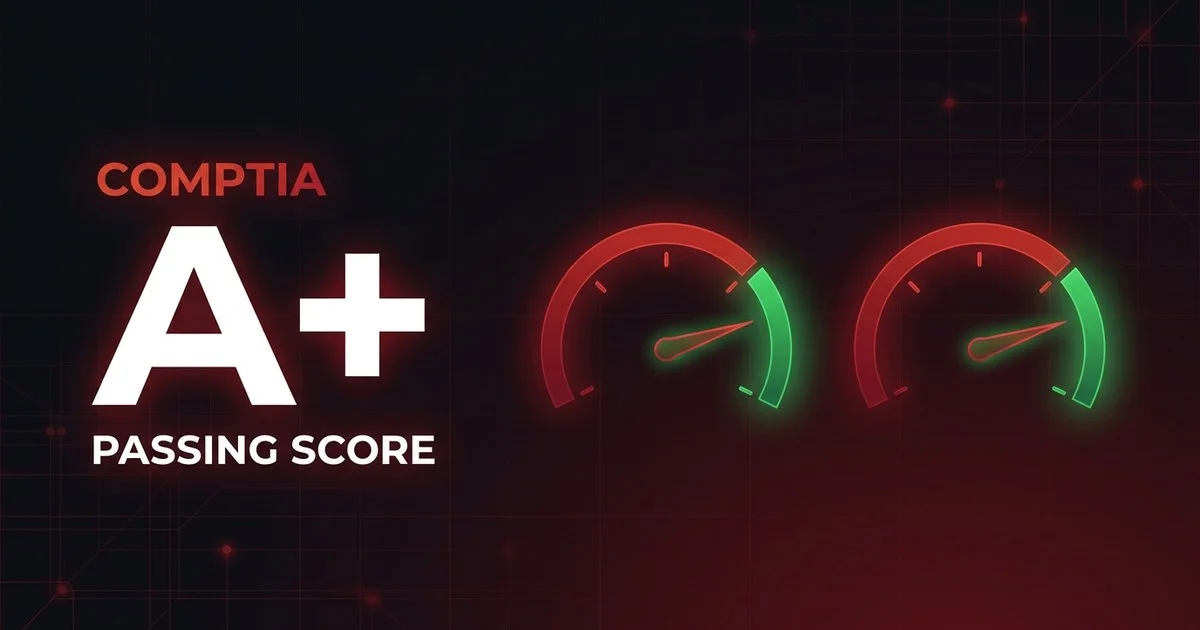
Both marks sit on the same 100–900 track above. Core 1 clears at 675; Core 2 sets the bar a touch higher at 700. The green band marks the safest zone — aim above 700 on both and neither exam is in doubt. The certification itself is awarded only when both score reports read “pass”; there is no partial A+, and a Core 1 pass on its own carries no standalone credential. That is the single most important thing to internalise before you book either test: you are clearing two bars, not one, and the second bar is the higher of the pair.
Worth flagging early: you can sit the two Core exams in either order and on separate days. There is no rule that forces Core 1 before Core 2, though most candidates take them in numerical order because Core 1’s hardware and networking groundwork makes Core 2’s operating-system and security material feel more grounded. Whichever order you choose, both passes must be valid at the same time for the certification to issue.
02 How A+ scoring actually works
Two design choices in CompTIA’s scoring model explain almost every question about the 675 and 700 numbers.
1. They are scaled scores, not raw percentages
CompTIA converts your raw result (how many questions you got right) into a scaled score from 100 to 900. Scaling equates results across different versions of each exam that may be slightly harder or easier, so every candidate is held to the same standard. The practical effect: 675 does not mean 75% correct, and 700 does not mean 78% correct. Depending on how hard your particular form was, the raw percentage you needed could sit a little above or below those figures. Aim well clear of the line so form difficulty never decides your result.
This is also why chasing an exact target percentage is a trap. Two candidates can answer the same number of questions correctly on two different forms of Core 1 and walk away with slightly different scaled scores, because the harder form is worth marginally more per item. The honest takeaway is that you cannot reverse-engineer the precise raw cut from the 675 or 700 figure, and you should not try. Build a comfortable margin instead, so that whichever form you draw on the day, you are clearly inside the pass zone rather than balanced on the edge of it.
2. The two Core exams have different cut scores
This is the detail most candidates miss. Core 1 and Core 2 do not share a pass mark: Core 1 (220-1101) passes at 675, while Core 2 (220-1102) passes at 700. Same 100–900 scale, different bar. Treat them as two distinct hurdles — do not memorise a single number and assume it covers both. There is no published per-domain minimum either, so your overall scaled score on each exam is what counts; a strong domain can offset a weaker one within the same exam.
The 25-point gap between the two cut scores is small in absolute terms but meaningful in practice. It tells you that CompTIA holds Core 2 to a marginally tighter standard, which matches its content: operating systems, security and operational procedures leave less room for educated guessing than Core 1’s more concrete hardware questions. So if you are the kind of candidate who scrapes a pass on practice tests, expect Core 2 to feel less forgiving, and pad your preparation for it accordingly rather than assuming the Core 1 result predicts the Core 2 one.
03 The domains and their weights
Because each exam scores on the overall total, the smart move is to weight your study toward the heaviest domains on each Core. Core 1 leans hard on troubleshooting and hardware; Core 2 is dominated by operating systems and security. The bars below show the published objective weights for each exam, ordered from heaviest to lightest so you can see at a glance where the marks concentrate.
04 What practice score means you are ready
Because both exams are scaled, the best readiness signal is a repeatable score on fresh, full-length, timed practice exams for each Core — not one lucky run. Track each exam separately, since their cut scores differ. The bands below set a deliberately higher target than the bare 675 and 700 cut scores, because a practice percentage is not a scaled score and the safest way to absorb that uncertainty is to over-prepare. Use this scale per Core.
05 If you fail: the retake policy
Falling short on either Core is not the end — but CompTIA charges the full fee again per exam, and the wait grows after repeated attempts, so it is worth being ready first. The rules apply to each Core exam independently, so a fail on Core 2 does not affect a Core 1 pass you already hold, and vice versa. CompTIA does not publish official pass rates for either exam, so ignore the unofficial figures that circulate online and judge your own readiness purely from your repeatable practice scores.
| Rule | Detail |
|---|---|
| First retake | No mandatory wait between your first and second attempt — you can rebook straight away |
| From the third attempt | A 14-day wait applies between the third and every subsequent attempt of the same exam |
| Attempt limit | No cap on total attempts (the 14-day wait applies once you reach the third try) |
| Cost per attempt | The full exam fee for that Core every time — no discounted retake voucher |
| Your score report | Shows the per-domain breakdown for that Core — use it to target your weakest area before rebooking |
06 FAQ
What is the passing score for CompTIA A+?
A+ is two separate exams with two different pass marks. Core 1 (220-1101) requires 675 and Core 2 (220-1102) requires 700, both on a scaled range of 100 to 900. You must pass both exams to earn the A+ certification.
Are the A+ pass marks the same for both exams?
No. The two A+ exams have different cut scores. Core 1 (220-1101) passes at 675 out of 900, while Core 2 (220-1102) passes at 700 out of 900. Both use the same 100 to 900 scaled range, but Core 2 sets the bar slightly higher, so do not assume one number covers both exams.
Is a 675 the same as getting 75% of questions correct?
No. CompTIA reports a scaled score from 100 to 900, not a raw percentage. A 675 on Core 1 or a 700 on Core 2 does not map directly to a fixed percentage of questions answered correctly, because scaling equates results across exam versions of slightly different difficulty. Aim well clear of the line rather than targeting an exact percentage.
How long do I wait to retake an A+ exam if I fail?
CompTIA does not require a wait between your first and second attempt, so you can retake immediately. From the third attempt onward there is a mandatory 14-day wait between tries. There is no cap on total attempts, but you pay the full exam fee for each Core exam every time, so it pays to be ready first.