CCNA Practice Test 2026: Cisco 200-301 Exam Prep Guide
The complete guide to preparing for the Cisco CCNA 200-301 exam. Exam format, key domains, best practice test resources, and a proven study plan to pass on your first attempt.
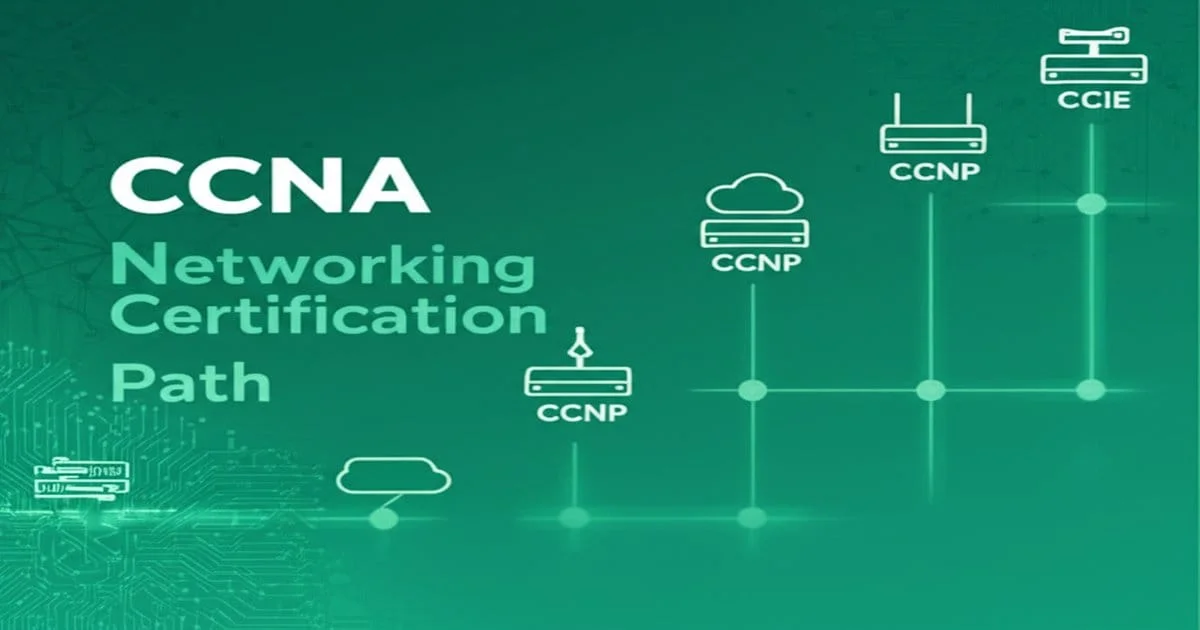
Table of Contents
CCNA 200-301 Exam Overview
The Cisco Certified Network Associate (CCNA 200-301) is the most recognized networking certification in the IT industry. It validates your ability to install, configure, operate, and troubleshoot medium-sized routed and switched networks. Whether you're starting a networking career or adding credentials to your resume, the CCNA is the industry standard.
Since Cisco consolidated its associate-level certifications in 2020, the single CCNA 200-301 exam covers everything from network fundamentals to automation and programmability. This makes it broader than previous CCNA versions but also more versatile—one exam, one certification. For official details, visit the Cisco CCNA certification page.
Who is this for? Network engineers, system administrators, help desk professionals, and anyone looking to build a career in networking. No prerequisites are required, though Cisco recommends 1+ year of networking experience.
Exam Format & Key Stats
Question Types
The CCNA uses several question formats to test both knowledge and practical skills:
- Multiple Choice: Select one correct answer from four options
- Multiple Response: Select two or more correct answers
- Drag and Drop: Match items to their correct categories or sequences
- Simulation: Configure actual Cisco IOS commands in a simulated environment
Simulation questions are heavily weighted. Unlike multiple-choice questions, simulations test your ability to actually configure Cisco devices. Practice with Packet Tracer or GNS3 to build muscle memory for IOS commands. Getting these wrong has a significant impact on your score.
Exam Domains Breakdown
The CCNA 200-301 covers six domains. The heavier weighting on networking fundamentals and access reflects Cisco's focus on practical network skills:
OSI and TCP/IP models, IPv4/IPv6 addressing and subnetting, Ethernet switching, wireless fundamentals, and network topologies. The foundation everything else builds on.
VLANs, inter-VLAN routing, EtherChannel, Spanning Tree Protocol (STP), wireless architectures (autonomous vs controller-based), and physical layer connectivity.
The largest domain. Covers static routing, OSPF (single-area), first-hop redundancy protocols (HSRP), and IP routing concepts. Know how to interpret routing tables and configure OSPF.
NTP, DHCP, DNS, SNMP, Syslog, NAT/PAT, QoS concepts, and TFTP/FTP. Small domain but frequently tested. Know how to configure and verify NAT.
Port security, AAA concepts, ACLs, Layer 2 security (DHCP snooping, dynamic ARP inspection), and wireless security protocols (WPA3). Know how to configure and verify ACLs.
REST APIs, configuration management tools (Ansible, Puppet, Chef), JSON data encoding, and SDN concepts (controller-based vs traditional). Newer topic area that catches many candidates off guard.
Ready to Start Practicing?
Get access to CCNA practice questions with detailed explanations for every answer
Start Practicing NowPlan Your Study Journey
Use our free tools to optimize your preparation
Why Quality Practice Tests Matter
The CCNA covers an enormous breadth of networking topics. Practice tests are essential for identifying weak areas and building the speed needed to complete 100+ questions in 120 minutes. But not all practice resources are equal.
The problem with brain dumps: Sites that offer "real exam questions" are not only violating Cisco's NDA—they also provide questions with incorrect or outdated answers. Candidates who rely on these often fail because they've memorized wrong information and can't adapt to differently-worded questions on the actual exam.
Unlike generic question dumps, ExamCert provides detailed explanations for every answer, including why wrong answers are wrong. This teaches you the underlying networking concepts rather than just pattern-matching answers. When the exam presents a scenario you haven't seen before, you'll have the knowledge to work through it.
What to Look for in CCNA Practice Questions
- Detailed explanations: Every answer (correct and incorrect) should have a clear explanation
- Simulation-style questions: Practice actual IOS command syntax, not just theory
- Updated content: Questions should cover automation/programmability topics added in the current exam version
- Domain coverage: Questions should span all 6 domains proportionally
Study Plan for CCNA
Phase 1: Build the Foundation
- Master subnetting (you must be fast at this—it's tested everywhere)
- Understand the OSI model and how protocols map to each layer
- Set up Cisco Packet Tracer and practice basic switch/router configs
- Study IPv4 and IPv6 addressing schemes thoroughly
Phase 2: Core Technologies
- Deep dive into VLANs, trunking, STP, and EtherChannel
- Master OSPF configuration and verification
- Practice NAT/PAT and ACL configuration on Packet Tracer
- Study wireless architectures and security protocols
Phase 3: Practice & Refine
- Complete 300+ practice questions across all domains
- Take timed full-length practice exams
- Review incorrect answers and study the underlying concepts
- Practice IOS commands until they're muscle memory
- Don't neglect Automation & Programmability—it's 10% of the exam
500+ CCNA Practice Questions
Comprehensive Cisco 200-301 practice tests with detailed explanations. Know the "why" behind every answer.
Start Free PracticeExam Day Tips
- Manage your time: With 100-120 questions in 120 minutes, you have roughly 1 minute per question. Don't get stuck on simulations—flag them and come back
- Read carefully: Cisco questions often include subtle details that change the correct answer. Words like "MOST efficient" or "LEAST administrative overhead" matter
- Subnetting speed: If you can't subnet in your head quickly, you'll waste precious time. Practice until it's automatic
- Simulations first or last: Some candidates prefer tackling simulations first while fresh. Others save them for last. Choose your strategy beforehand
- No going back: Unlike some exams, Cisco exams don't always let you return to previous questions. Answer carefully the first time
Frequently Asked Questions
How many questions are on the CCNA 200-301 exam?
The exam has approximately 100-120 questions to complete in 120 minutes. The exact number varies per session. Question types include multiple-choice, drag-and-drop, and simulation-based formats.
What is the CCNA passing score?
Cisco doesn't publicly disclose the exact passing score. The exam uses a scaled scoring system from 300 to 1000. Most candidates report the threshold is around 825-850, but this can vary by exam session.
Is the CCNA 200-301 exam hard?
The CCNA is moderately difficult due to its broad scope—covering everything from Layer 2 switching to REST APIs. Candidates with hands-on networking experience typically find it more manageable. Plan for 2-4 months of dedicated study.
How long is the CCNA certification valid?
The CCNA is valid for 3 years. To recertify, you can retake the current exam, earn a higher-level Cisco certification (CCNP, CCIE), or accumulate 30 Continuing Education credits through Cisco's CE program.
Should I use brain dumps to study for CCNA?
No. Brain dumps violate Cisco's NDA and can result in certification revocation and a lifetime ban from Cisco exams. More importantly, memorizing answers without understanding concepts leaves you unprepared for real networking work. Use legitimate practice tests with detailed explanations instead.
Ready to Pass the CCNA?
Get 500+ practice questions with detailed explanations for $5.99
Start Your CCNA Preparation Today
Join thousands who passed with ExamCert. Practice questions with detailed explanations and 100% money-back guarantee.