SC-500 Exam Guide 2026: Cloud and AI Security Engineer Associate
AZ-500 and the Azure Security Engineer certification retire on 31 August 2026. SC-500 is not a renumbering — it adds a whole AI security discipline, and the AZ-500 renewal assessment dies with the exam.
On this page
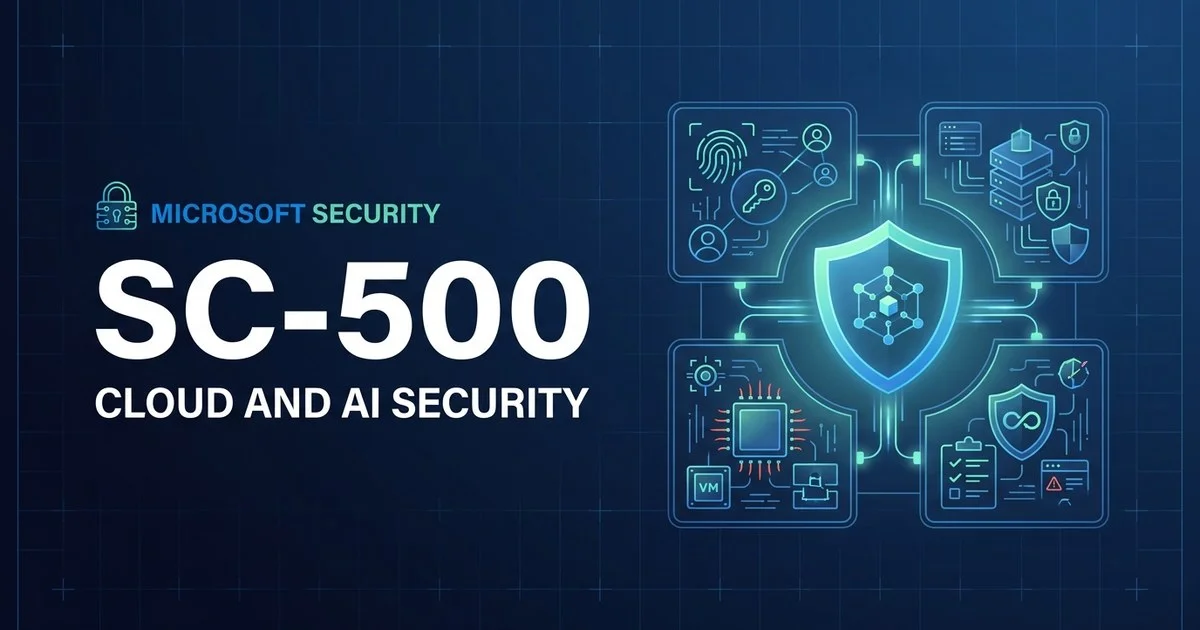
SC-500 — Implementing End-to-End Security Controls for Cloud and AI Workloads — leads to the Microsoft Certified: Cloud and AI Security Engineer Associate credential. It went generally available on 21 July 2026 and replaces AZ-500.
This brief is built against the official skills-measured document as published on 31 July 2026.
AZ-500 retires 31 August 2026 at 11:59 PM CST. If you are mid-preparation for AZ-500, the decision of whether to sit it or pivot is a matter of days, not months. Read the next section before you book anything.
The AZ-500 retirement, and the renewal trap
Two things people get wrong about this transition.
First: there is no conversion. SC-500 is a separate certification. Microsoft is not migrating AZ-500 holders across, there is no discounted upgrade path, and holding AZ-500 gives you no equivalency claim. If you want the Cloud and AI Security Engineer credential, you sit SC-500.
Second, and more damaging: the renewal assessment retires with the exam. Microsoft role-based certifications stay alive through a free online renewal assessment that opens six months before your expiry date. When AZ-500 retires, its renewal assessment goes with it.
| Your AZ-500 expiry date | What happens |
|---|---|
| Before 31 August 2026 | Renewal window opens as normal — renew and you keep the credential another 12 months |
| After 31 August 2026 | The renewal window never opens. The credential lapses on expiry with no way to extend it |
| Not certified yet | AZ-500 is closing; sitting it buys a credential with a hard end date. Go straight to SC-500 |
Check your expiry date on your Microsoft Learn transcript today. If it falls before the retirement, renewing now is close to free and buys you a year. If it falls after, plan your SC-500 attempt rather than counting on a renewal that will not arrive.
What SC-500 certifies
The audience profile describes a security engineer protecting systems and data across cloud and hybrid environments, spanning identity, network, application, data and compute — and, newly, ensuring that the platforms, data, identities and infrastructure used by AI workloads are securely implemented and monitored.
Microsoft expects practical experience administering Azure and hybrid environments including compute, network and storage, strong familiarity with Microsoft Entra ID, and familiarity with Microsoft 365 administration. That last item matters — several AI security objectives live in Microsoft 365 and Purview, not Azure.
The four domains and their weights
Notably flat. No domain can be written off, and the largest — storage, databases and networking — is classic Azure infrastructure security rather than anything AI-related.
Domain 1 — Identity, access and governance (20–25%)
Entra ID access (PIM, conditional access, MFA and passwordless, enterprise apps and app registrations, OAuth consent, managed identities); Key Vault (deployment, settings, access, firewall, keys/secrets/certificates, secret scanning via Defender CSPM, Defender for Key Vault); and governance (Azure Policy, regulatory compliance in Defender for Cloud, resource locks, built-in and custom roles, remediating overprivileged RBAC, backup protection, and security controls via infrastructure as code).
Domain 2 — Storage, databases and networking (25–30%)
The heaviest domain. Storage account security and firewall rules, Defender for Storage, access policies. Azure SQL platform security, database auditing, Defender for Databases. Then a long network list: NSGs and ASGs, Azure Virtual Network Manager, Virtual WAN, VPN security, Microsoft Entra Private Access, private endpoints, Private Link, Azure Firewall, and evaluating effective rules with Network Watcher.
Domain 3 — Secure compute (20–25%)
Three clusters: security for AI (below), servers and VMs (disk encryption, Bastion, JIT access, Azure Arc for hybrid and multicloud, Defender for Servers, agentless scanning, secure boot / vTPM / integrity monitoring, Azure Machine Configuration), and application platform services (Defender for Containers, AKS, Container Registry, Container Instances and Container Apps, Functions, Logic Apps, App Service, Web Application Firewall, and back-end API protection through API Management).
Domain 4 — Posture management (20–25%)
Defender for Cloud (Defender CSPM, compliance frameworks, workload protection plans, connecting AWS and GCP, Defender Vulnerability Management, External Attack Surface Management), Microsoft Sentinel (workspaces, roles, content hub, data connectors, syslog and CEF, Windows Security events via data collection rules, custom log tables, automation rules and playbooks, retention, querying Purview Audit in Defender XDR), and Microsoft Security Copilot (workspaces, permissions and roles, plugins, Microsoft and Security Store agents).
The AI security content that is genuinely new
This is the part with no AZ-500 equivalent, and the reason the credential was renamed. It sits inside domain 3:
SC-500 treats an AI agent as a workload with an identity. It needs an identity you can apply conditional access to (Entra Agent ID), a runtime you can put guardrails around (Foundry), a gateway you can police (AI Gateway in APIM), a threat-protection plane (Defender for AI Service), and a data-exposure story (Purview DSPM). If you can name the control for each of those five layers, this objective is under control.
What carried over from AZ-500
Most of it, which is good news if you were already studying. Entra ID and Key Vault, Azure Policy and RBAC, storage and SQL security, the full network security surface, VM and container hardening, Defender for Cloud, and Sentinel all remain. If you have AZ-500 notes, keep them.
Our AZ-500 complete guide still describes that shared infrastructure-security core accurately — use it for the technology, and this brief for the current exam scope.
What is added, beyond AI security: Microsoft Security Copilot as an explicit objective, and Entra Private Access in the network domain.
A six-week study plan
Want the plan sized to your actual availability? The study-time calculator will do it, and the certification roadmap shows where SC-500 sits against SC-100, SC-200 and SC-401.
Frequently Asked Questions
When exactly does AZ-500 retire?
AZ-500 and the Azure Security Engineer Associate certification retire on 31 August 2026 at 11:59 PM Central Standard Time. SC-500 reached general availability on 21 July 2026 and is the replacement path.
Do I get converted from AZ-500 to SC-500 automatically?
No. SC-500 is a separate certification. Microsoft is not converting holders across, there is no free upgrade, and passing AZ-500 gives you no equivalency claim to SC-500.
What happens to my AZ-500 if it expires after 31 August 2026?
This is the trap. Microsoft role-based certifications renew through a free assessment that opens six months before expiry, and the AZ-500 renewal assessment retires alongside the exam. If your expiry falls after the retirement date, that renewal window never opens and the credential lapses.
Is SC-500 harder than AZ-500?
It is broader. SC-500 keeps the Azure infrastructure security content AZ-500 always had and adds a full AI security objective covering Entra Agent ID, Copilot risk, Defender for AI Service and Foundry guardrails.
Practise SC-500 Before You Book
500–1,000+ SC-500 practice questions with worked explanations, written against the current skills-measured document.
SC-500 Practice Test
Practice Before You Book
500–1,000+ practice questions per exam with detailed explanations, across Azure, AWS, GCP, security, and AI certifications.