KCNA Study Guide 2026: A Beginner's Path to Kubernetes Certification
The cheapest, easiest CNCF cert — 60 multiple-choice questions, 90 minutes, no terminal. Your stepping stone to CKAD and CKA.
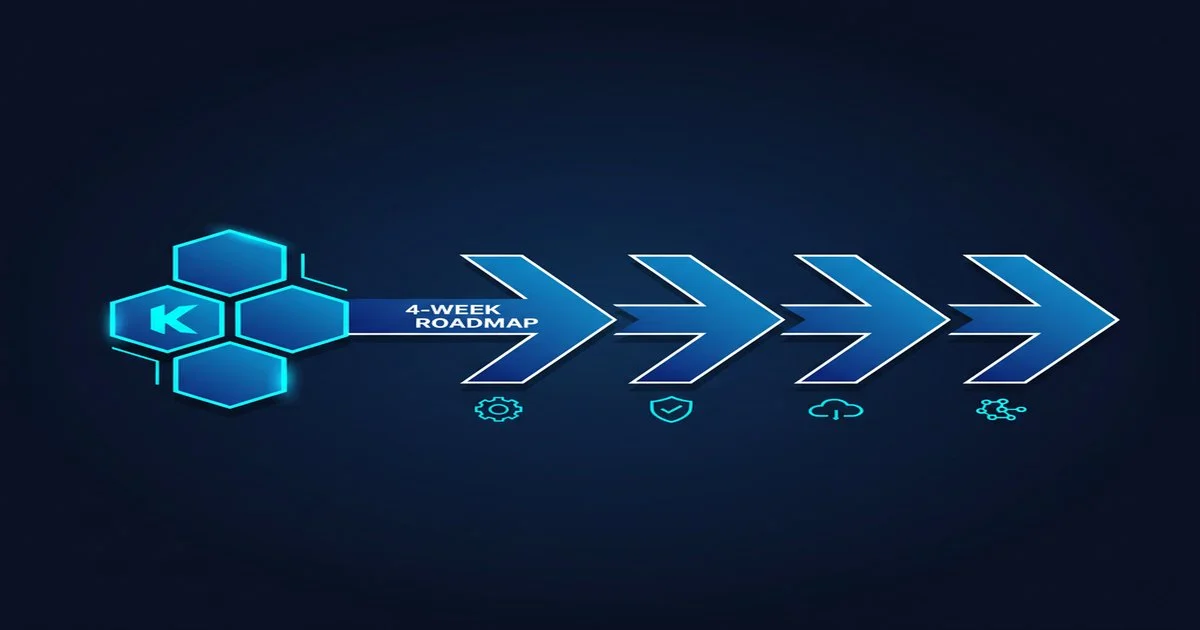
Table of Contents
The Kubernetes and Cloud Native Associate (KCNA) is the CNCF's foundational certification — the entry point into a credential family that includes CKAD, CKA, and CKS. It is the only Kubernetes cert with no hands-on terminal exam, no prerequisite, and a price tag below $300. For absolute beginners, career switchers, and recent grads who need a structured way to learn cloud native without drowning in YAML, KCNA is the right first move.
Tip: KCNA is a breadth-first cert. You will be tested on Prometheus, GitOps, service mesh, and serverless — not just core Kubernetes. Plan study time across the full CNCF landscape, not just kubectl.
Why KCNA Is the Perfect First Kubernetes Cert
KCNA was launched by the CNCF and the Linux Foundation in late 2021 specifically to fix a market gap: aspiring cloud-native engineers had no foundational cert and were being told to jump straight into CKAD or CKA. Those exams are performance-based, hands-on, and unforgiving of beginners. KCNA is the polar opposite — it validates conceptual understanding of the cloud-native ecosystem before you commit to the harder hands-on tracks.
Three reasons KCNA is uniquely beginner-friendly. First, it is multiple choice, not hands-on. You do not need a working Kubernetes cluster, a comfortable shell, or fast kubectl reflexes — you need conceptual clarity. Second, there are no prerequisites. You can sit it on day one of your Kubernetes journey. Third, at $250 USD (with a free retake), KCNA is dramatically cheaper than CKAD or CKA ($445 each). For students and career-switchers paying out of pocket, the cost difference matters.
KCNA is also legitimately recognized. It is issued by the CNCF — the same body that governs Kubernetes, Prometheus, Envoy, and the open-source cloud-native ecosystem. Recruiters and hiring managers in cloud-native roles know what KCNA is, even if they will not hire you on KCNA alone. It opens the door, demonstrates commitment, and gives you the vocabulary to interview for junior cloud-native roles.
KCNA Exam Format
KCNA is a 90-minute, 60-question multiple-choice exam delivered online via the PSI proctoring platform. You need 75% to pass. Unlike CKAD, CKA, and CKS — which drop you into a live terminal with broken clusters — KCNA never requires you to touch a shell. Every question is multiple choice or multi-select. This single design choice makes KCNA an order of magnitude easier to prepare for and pass than its hands-on siblings.
The exam is delivered remotely from your home or office. PSI's proctoring software requires a webcam, a quiet room, a desk cleared of all materials, and a government ID. You will be observed live for the full 90 minutes. Expect a 20-minute room-scan and ID-check process before the timer starts — budget your time accordingly.
Each KCNA registration includes one free retake within 12 months if you fail. The certification is valid for two years, after which you must recertify by passing the current version of the exam. The Linux Foundation periodically updates the curriculum — check the official KCNA page for the latest exam outline before you book.
Compared to the other CNCF certs, KCNA's MCQ-only format means time pressure is much lower. You get an average of 90 seconds per question, with a "flag for review" button so you can skip hard questions and return at the end. Most candidates finish with 15-20 minutes to spare.
The 5 KCNA Domains, Weighted
The KCNA curriculum is split into five domains. The weightings below match the current Linux Foundation exam outline. The first domain is huge — nearly half the exam — so prioritize accordingly.
1. Kubernetes Fundamentals — 46%
The dominant domain. Tests core Kubernetes concepts: resources (Pods, Deployments, Services, ConfigMaps, Secrets), control plane architecture (API server, scheduler, controller manager, etcd, kubelet, kube-proxy), the Kubernetes API model (declarative manifests, reconciliation loops), container basics (images, registries, container runtimes), and scheduling (node selectors, taints, tolerations, affinity at a conceptual level). Master this domain and you are halfway to passing.
2. Container Orchestration — 22%
Covers container runtime interface (CRI — containerd, CRI-O), networking concepts (CNI, kube-proxy, network policy, basic service mesh terminology like Istio and Linkerd), storage (CSI, persistent volumes, storage classes at concept level), and security primitives (RBAC, service accounts, pod security, supply-chain basics).
3. Cloud Native Architecture — 16%
Conceptual breadth: autoscaling (HPA, VPA, Cluster Autoscaler, KEDA at concept level), serverless on Kubernetes (Knative, OpenFaaS), CNCF community and governance (graduation levels, TOC, SIGs), and open standards (OCI, CNI, CSI, CRI). Expect questions on the CNCF Landscape map and project maturity tiers.
4. Cloud Native Observability — 8%
The three pillars (metrics, logs, traces), Prometheus basics (pull model, exporters, PromQL at a conceptual level), OpenTelemetry as the vendor-neutral standard, FinOps and cost-management concepts for Kubernetes workloads.
5. Cloud Native Application Delivery — 8%
GitOps fundamentals (Git as the source of truth, ArgoCD and Flux as reference implementations), CI/CD pipeline basics, progressive delivery (canary, blue/green at concept level), and the role of pipeline tooling in cloud-native shops.
The 4-Week Beginner Study Plan
This plan assumes ~1 hour per day, five days a week, plus a weekend mock exam. Adjust based on your background — engineers with prior IT experience can compress to 2-3 weeks; complete beginners should plan for 6 weeks.
Week 1 — Kubernetes Fundamentals (the 46% domain)
Spend most of your first week here. Start with the official Kubernetes documentation "Concepts" section: Cluster Architecture, Workloads (Pods, Deployments, ReplicaSets, StatefulSets, DaemonSets, Jobs), Services and Networking, Configuration (ConfigMaps, Secrets). Install Docker Desktop or kind locally and run through the official "Hello Minikube" tutorial. Learn kubectl basics: get, describe, apply, delete. You do not need terminal speed for KCNA — but reading and writing simple YAML helps with comprehension.
Week 2 — Container Orchestration + Cloud Native Architecture
Read the CNCF documentation on CRI, CNI, CSI, OCI. Learn the concept of a service mesh: read the Istio "What is a Service Mesh?" page and the Linkerd intro. Cover network policy at the concept level. Then move to cloud-native architecture: read about HPA, VPA, Cluster Autoscaler, KEDA. Browse the CNCF Landscape (landscape.cncf.io) and learn the graduation levels (Sandbox, Incubating, Graduated). This is also the week to skim Knative docs to understand serverless on Kubernetes.
Week 3 — Observability + Application Delivery
Read the OpenTelemetry overview, the Prometheus "Getting Started", and the FinOps Foundation Kubernetes cost-management intro. Then pivot to delivery: the OpenGitOps principles (gitops.tech), ArgoCD and Flux landing pages, the difference between continuous integration and continuous deployment, progressive delivery strategies (canary, blue/green).
Week 4 — Mock exams + weak-area review
Take a full 60-question timed mock exam on Saturday morning. Review every wrong answer — not just to memorize, but to understand why the right answer is right. Spend the rest of the week re-reading documentation for your two weakest domains. Take a second mock exam the night before the real thing. If you score above 80% on a fresh mock, you are ready.
Best Free KCNA Study Resources
You do not need a paid bootcamp to pass KCNA. The free ecosystem is excellent.
- Linux Foundation LFS158x — "Introduction to Kubernetes" on edX. Free to audit. Created by the cert vendor themselves. The single best free resource for the Kubernetes Fundamentals domain.
- Official Kubernetes documentation tutorials at kubernetes.io/docs/tutorials/. The "Kubernetes Basics" interactive tutorial covers the core concepts and is free.
- KodeKloud free tier — offers a free KCNA learning path with practice labs. Some content is paywalled but the foundational lectures are accessible.
- ExamCert free KCNA practice questions — free MCQ sets generated to match the actual KCNA exam style, weighted by the official domain breakdown.
- The CNCF Landscape map (landscape.cncf.io). Browse it for 30 minutes per week of study. You will be tested on which projects are CNCF-graduated and which solve which problem.
- CNCF YouTube channel — free KubeCon talks. Watch one "Kubernetes 101" and one "Service Mesh 101" talk per week as passive learning.
KCNA Exam-Day Tips
Read every question fully before answering. KCNA questions are short but precise. Look for qualifiers like "always", "primarily", "best", "least". Multi-select questions tell you how many answers to pick — do not under-pick.
Use the flag-for-review button generously. If you are not 90% sure on a question, flag it and move on. Come back to flagged questions only after you have completed all 60. You will often find the answer hinted at by a later question.
Manage your pace. 90 minutes / 60 questions = 90 seconds per question. After the first 30 questions, check the clock. If you are behind, speed up by trusting your gut on questions you are 80% sure about and flagging the rest.
Trust your prep. If you have done LFS158x plus mock exams above 80%, you know the material. Second-guessing your initial answer is the most common way to lose points on MCQ exams. Change an answer only if you have a concrete reason from the question itself.
Pre-exam environment check. Run the PSI system check 24 hours in advance, not 10 minutes before. Clear your desk, close all background apps, restart your machine, and have your government ID ready. Online proctored exams are stressful enough without surprise tech issues.
What Comes After KCNA?
KCNA is the foundation, not the destination. Your next move depends on the job you want.
If you are a developer — you write code that runs on Kubernetes — take the Certified Kubernetes Application Developer (CKAD) next. CKAD is hands-on and tests your ability to build, deploy, and configure cloud-native applications in a live cluster. It is the most popular follow-on to KCNA for software engineers, backend developers, and DevOps engineers moving toward an app-focused role.
If you are a sysadmin or infra engineer — you operate the cluster — take the Certified Kubernetes Administrator (CKA) next. CKA tests cluster bootstrapping, upgrades, troubleshooting, networking, and storage configuration. It is the foundational cert for platform engineering, SRE, and cloud-ops roles.
If you are aiming long-term at security or platform engineering, the path is KCNA → CKA → CKS (Certified Kubernetes Security Specialist). CKS requires CKA as a prerequisite. CKS is the highest-paying Kubernetes cert in 2026, signalling deep production-grade Kubernetes security expertise.
A common, smart sequence: KCNA in month 1, CKAD or CKA in months 2-4, CKS optional in months 5-7. Compare paths side by side with our KCNA vs CKAD decision guide.
Start Practicing KCNA with Free AI Questions
Free KCNA practice questions weighted by the official CNCF domain breakdown.
Try KCNA Practice ExamFrequently Asked Questions
Do I need experience for KCNA?
No. KCNA is the foundational CNCF cert designed for newcomers. Basic Linux and container familiarity helps but isn't required.
How long should I study for KCNA?
4-6 weeks with 1 hour/day for beginners. Engineers with prior IT background can pass in 2-3 weeks.
Is KCNA easier than CKAD?
Yes, significantly. KCNA is multiple-choice and tests breadth of concepts. CKAD is performance-based hands-on and tests depth + speed.
How much does KCNA cost in 2026?
$250 USD via Linux Foundation including one free retake within 12 months — the cheapest CNCF Kubernetes cert.
Is KCNA worth it for my career?
KCNA alone is foundational and won't dramatically change salary, but it's the perfect stepping stone to CKAD/CKA which command $115k-$170k US salaries. Strong choice for career switchers and recent grads.
Plan Your Kubernetes Cert Path
Free tools to plan study time and compare KCNA / CKAD / CKA.