How to Renew Your CISSP Certification
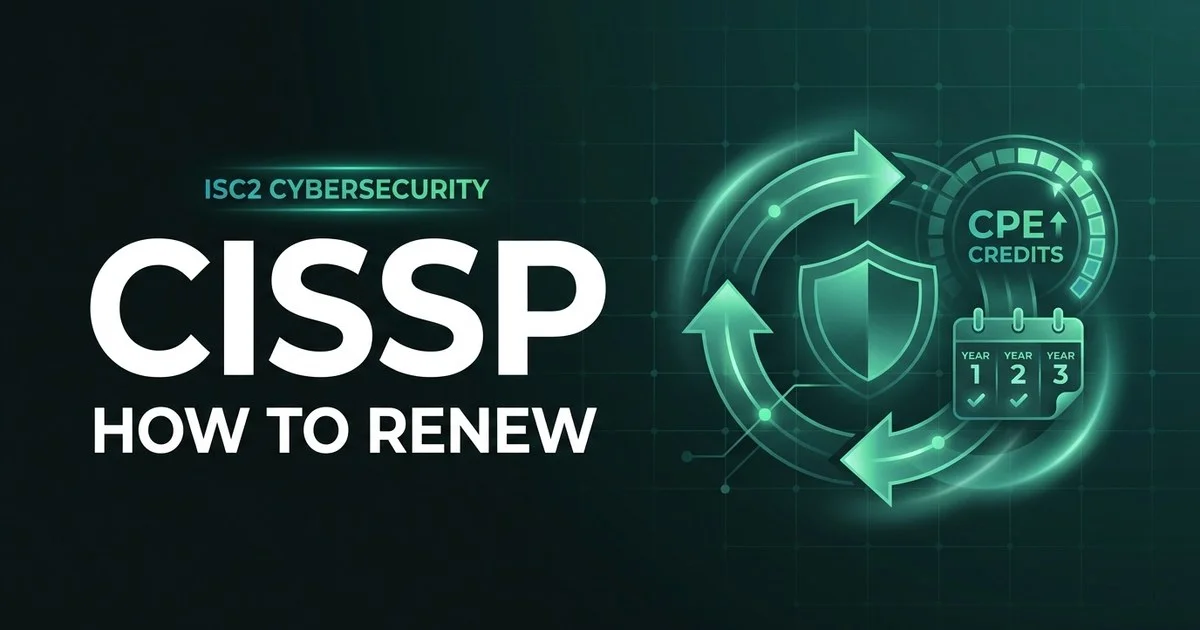
Your CISSP is valid for three years. To keep it, you earn 120 CPE credits and pay a small annual fee — no re-exam required. Here is exactly how the CPE cycle works, the fastest ways to earn credits, and what happens if you let it lapse.
01 The short answer
The mistake people make is treating renewal as a one-time event. It is not: CPEs accrue continuously and ISC2 expects steady progress, recommending at least 40 CPEs per year so you do not arrive at year three needing to scramble for 120. The annual fee is due every year on your certification anniversary, independent of where you are in the CPE cycle.
02 The CPE requirement, in detail
The 120 credits are not interchangeable — ISC2 splits them into two groups, and most of your credits must come from the technical, domain-related group.
| Requirement | Amount | What counts |
|---|---|---|
| Total CPEs / cycle | 120 over 3 years | Everything below, combined |
| Group A (required) | At least 90 | Activities tied to the eight CISSP domains — training, conferences, reading security material, teaching |
| Group B (optional) | Up to 30 | General professional development — project management, presentation skills, other non-security learning |
| Annual posting target | 40 / year | ISC2's recommended pace so you never fall behind |
03 The fastest ways to earn CPE credits
You do not need to spend money to hit 120. A mix of free and paid activities — many of which you already do at work — gets you there comfortably.
Read & watch security content
Webinars, vendor whitepapers, security podcasts, and books. ISC2's own member webinars and the on-demand library are free and auto-post credits.
Do your job & document it
Unique work projects, writing security policy, or first-time tasks can count. One substantial project can be worth several Group A CPEs.
Attend a conference or course
A multi-day security conference or training course can earn 20–40 CPEs in one go — often the single fastest way to clear a cycle.
Teach, present, or write
Delivering training, speaking at a meetup, or publishing an article earns CPEs at a premium rate (and the first instance of new material counts more).
Online courses & labs
MOOCs, hands-on labs, and structured self-study count as Group A when they map to the CISSP domains. Keep the completion certificate.
Professional development
Non-security learning — leadership, communication, project management — fills your 30 Group B credits without needing more technical study.
04 The renewal cycle, step by step
↻ Repeats every 3 years
Earn CPEs
Accumulate credits year-round from training, reading, work, and events — aim for 40 a year.
Log them
Record each activity in your ISC2 member portal and keep your supporting evidence in case of audit.
Pay the AMF
Pay the $135 annual maintenance fee on your certification anniversary — every year, not just at renewal.
Stay certified
Hit 120 CPEs by the end of the 3-year cycle and the certification renews automatically — no re-exam.
05 What happens if your CISSP lapses
Missing the requirements is recoverable if you act fast, but expensive if you ignore it. Here is the sequence.
06 FAQ
How many CPE credits does CISSP renewal require?
You must earn 120 CPE credits over each three-year cycle, about 40 per year. Of those 120, at least 90 must be Group A (directly related to the eight CISSP domains) and up to 30 can be Group B (general professional development). ISC2 recommends posting at least 40 CPEs each year so you do not fall behind.
How much does it cost to maintain a CISSP?
ISC2 charges a single Annual Maintenance Fee (AMF) of $135, due each year on the anniversary of your certification. The single fee covers you even if you hold more than one ISC2 certification, and it is separate from the cost of any activities you use to earn CPEs.
What happens if my CISSP expires?
If you miss the CPE or AMF requirements, ISC2 gives a 90-day grace period to catch up. Miss that and your certification is suspended, then ultimately revoked. Once revoked, you generally have to sit and pass the CISSP exam again to regain it — so it is far cheaper to stay current.
Can I renew CISSP without retaking the exam?
Yes. The normal path is recertification by CPE: earn 120 CPE credits across three years and pay the annual maintenance fee, and you never retake the exam. Retaking is only required if you let the certification lapse and it is revoked.