How to Renew Your CEH Certification
Your CEH is valid for three years. To keep it, you earn 120 ECE credits and pay a small annual EC-Council membership fee — no re-exam required. Here is exactly how the ECE cycle works, the fastest ways to earn credits, and what happens if you let it lapse.
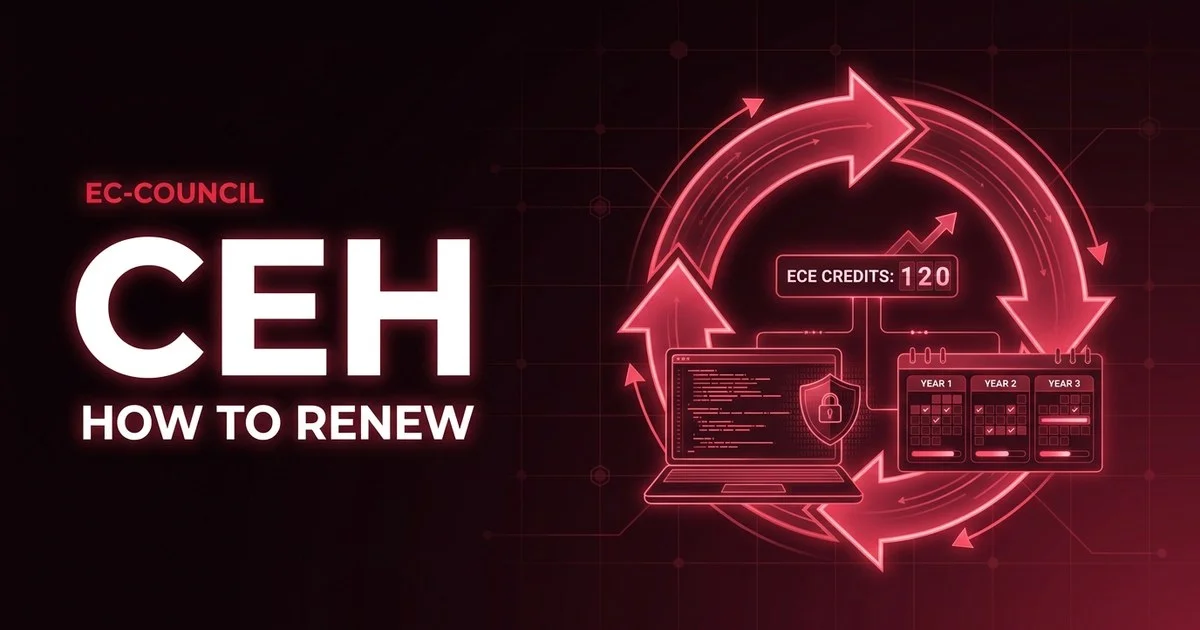
01 The short answer
The mistake people make is treating renewal as a single event near the deadline. It is not: ECE credits accrue continuously, and EC-Council expects steady progress — a recommended pace of around 40 credits per year, with a soft floor of roughly 20 in any single year so you do not arrive at year three needing to scramble for the full 120. The membership fee is also annual: it is the mechanism that actually lets you submit your earned credits, so skipping it stalls your recertification even if your credit total is fine.
It is worth being precise about the two moving parts, because they are independent. The ECE credits measure your continuing education over the cycle, and the membership fee keeps your account in good standing so those credits can be filed. You can be fully paid up on the fee and still fall short on credits, or have a wall of credits you cannot submit because the membership has lapsed. Recertification only happens when both are satisfied at the same time, which is why treating them as a single annual habit — pay the fee, log the quarter's credits — is the lowest-stress way to stay certified.
02 The ECE requirement, in detail
The headline number is simple — 120 credits in three years — but the detail around the annual fee, what qualifies, and the audit risk is where people trip up. Here is the full picture.
Unlike some vendor programmes, CEH does not split its credits into rigid technical and non-technical buckets — the 120 simply need to come from approved continuing-education activities relevant to your field. That flexibility is helpful, but it places the burden on you to confirm that each activity actually qualifies and to record the correct credit value. The table below summarises the parts that matter most.
| Requirement | Amount | What it means |
|---|---|---|
| Total ECE credits / cycle | 120 over 3 years | The full recertification requirement; everything below feeds into it |
| Recommended annual pace | ~40 / year | EC-Council's suggested rhythm; a minimum of around 20 in any year keeps you on track |
| Annual membership fee | $80 / year | Paid through the ASPEN/EC-Council portal; required to submit your ECE credits |
| What qualifies | Many activities | Training, conferences, webinars, articles and books, teaching, other certifications, and relevant work — each carries a set credit value |
| Audit risk | Random review | EC-Council audits a share of members and asks for proof; unverifiable credits can be struck off |
03 The fastest ways to earn ECE credits
You do not need to spend a fortune to reach 120. A mix of free and paid activities — several of which you already do at work — gets you there comfortably. Each activity carries a set ECE value; the figures below are typical guides, so always check the current EC-Council scheme before relying on a specific number, as the per-activity awards and any annual caps are set by EC-Council and can change between cycles.
EC-Council or vendor training
Completing an approved IT-security course is one of the biggest single sources of credits — a full course can be worth a large batch toward your cycle in one go.
Attend a security conference
Multi-day events such as Black Hat, DEF CON, or regional security cons earn credits per day attended — often the quickest way to clear a chunk of a cycle.
Write articles or books
Publishing a security article, whitepaper, or book chapter earns credits at a premium — authoring original material is one of the best-rewarded activities.
Teach or present
Delivering training, lecturing, or speaking at a meetup or conference earns ECE credits per hour, with first-time delivery of new material counting for more.
Earn another certification
Passing a new, relevant security certification — or a newer version of an EC-Council credential — earns a sizeable block of ECE credits at once.
Webinars & relevant work
Attending EC-Council or vendor webinars, plus unique security work projects and reading approved material, all count toward your total at roughly an hour-for-credit rate.
A practical way to think about it: one approved training course plus a single multi-day conference can, between them, cover a large share of an entire cycle, leaving webinars and reading to top up the rest. If your employer sends you to events or funds courses, your day job may already be earning most of your credits — the work is simply to log them properly and keep the paperwork. The professionals who get caught out are usually the ones who do plenty of qualifying activity but never record it, then discover at deadline that none of it is on file.
04 The renewal cycle, step by step
↻ Repeats every 3 years
Earn ECE credits
Accumulate credits year-round from training, conferences, webinars, writing, and work — aim for around 40 a year.
Submit them
Log each activity in the ASPEN/EC-Council member portal and keep your supporting evidence ready in case of audit.
Pay the fee
Pay the $80 annual EC-Council membership fee through the portal — it is what enables you to submit your credits.
Recertified
Hit 120 credits by the end of the 3-year cycle and your CEH recertifies for another three years — no re-exam.
05 What happens if your CEH lapses
Falling short is recoverable if you act early, but costly if you ignore it. There are two ways to slip — a membership-fee lapse and an ECE-credit shortfall — and they often compound. Understanding which one you are facing matters, because the fixes differ: a lapsed membership is usually a matter of paying to bring the account current, whereas a genuine credit shortfall means actually completing more qualifying activity before the deadline closes.
06 FAQ
How many ECE credits does CEH renewal require?
You must earn 120 ECE credits over each three-year cycle, about 40 per year. EC-Council recommends a steady pace and sets a soft expectation of a minimum of around 20 ECE credits in any single year so you do not arrive at year three needing to scramble for the full 120. Credits come from training, conferences, webinars, writing, teaching, earning other certifications, and relevant work.
How much does it cost to maintain a CEH?
EC-Council charges an annual membership fee of $80, paid through the ASPEN/EC-Council member portal, which works out to roughly $240 across a three-year cycle. Paying this membership fee is what lets you submit your earned ECE credits, so it is effectively mandatory for recertification, and it is separate from the cost of any activities you use to earn credits.
What happens if my CEH expires?
If you fail to earn 120 ECE credits in the three-year cycle or stop paying the annual membership fee, EC-Council can suspend and ultimately revoke your CEH. A revoked certification means you lose member benefits and may no longer use the CEH logo or claim the credential. Depending on how long it has lapsed, the route back can require re-earning credits or, in the worst case, re-sitting the CEH exam.
Can I renew CEH without retaking the exam?
Yes. The normal path is recertification through the EC-Council Continuing Education (ECE) programme: earn 120 ECE credits across three years, log them in the ASPEN portal, and pay the annual membership fee. Do that and you never retake the exam. Re-sitting the exam only becomes necessary if you let the certification lapse and it is revoked.
