How to Get Into AI With No Experience
You can move into AI without a degree or a tech job behind you — but be honest about the door you walk through. A pure ML engineer role is rarely a first job. You enter via AI-adjacent roles, prove AI literacy with a starter cert, and build toward machine learning. Here is the realistic zero-to-hired roadmap.
01 Can you really break into AI with no experience?
The good news is that demand is genuinely strong and the field is expanding fast. The US Bureau of Labor Statistics projects data-science and related roles to grow far faster than the average occupation through the mid-2030s, and a rising share of job postings now ask for some AI skill. That means employers are increasingly open to people who can show what they know rather than only those with the pedigree — but you still have to show it. The myths below are what trip people up; none of them survive contact with reality.
✗ Myth
You must have a PhD or be a math genius to touch AI.
✓ Reality
Entry work needs solid fundamentals — not a doctorate. Working stats, clean data handling, and a few real projects matter far more than advanced theory at the start.
✗ Myth
“Machine learning engineer” is an entry-level job you apply for cold.
✓ Reality
It almost never is. You enter through adjacent roles first — data analyst, AI ops, junior data work — then move toward ML once you have Python and a portfolio.
✗ Myth
Using ChatGPT a lot makes you an AI professional.
✓ Reality
Prompting tools is useful, but employers hire on data skills, understanding of how models work, and projects you can defend — not chat history.
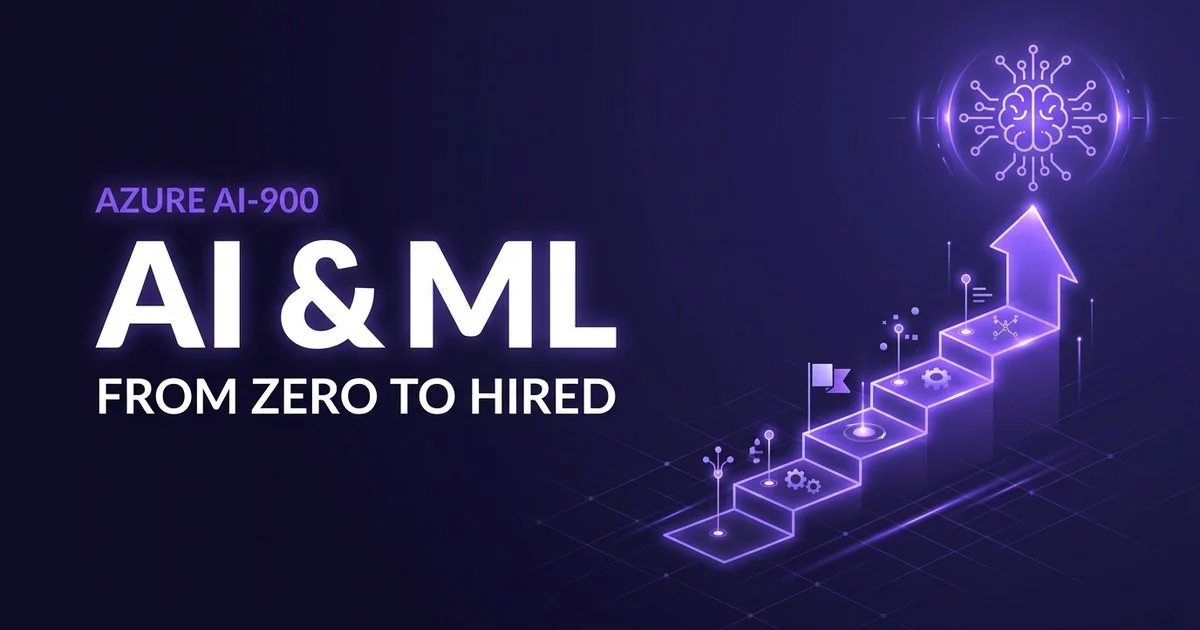
02 The zero-to-hired roadmap
There is no single route into AI, but this sequence works most reliably for career-changers. Expect roughly nine to eighteen months of consistent part-time effort from a standing start — AI takes longer than a single IT cert because you are building real, defensible skills, not just passing one exam.
Start where you are You are here
List transferable strengths — spreadsheets and analysis, attention to detail, domain knowledge from your current field. Anyone who already works with data has a head start; put that on your resume now.
Learn the fundamentals Month 1–6
Build a base in Python, working math and statistics (averages, distributions, probability, basic linear algebra), and core AI/ML concepts — what a model is, training vs inference, supervised vs unsupervised. Free material covers all of it; aim for fluency, not perfection.
Earn the entry certification Month 3–6
Microsoft Azure AI Fundamentals (AI-900) is the standard starter: no prerequisites and no coding on the exam. It teaches the vocabulary of AI and proves AI literacy to a recruiter — a starting signal, not a job guarantee.
Build projects (your portfolio) Ongoing
This is the real differentiator. Build small projects with Python ML libraries (scikit-learn, pandas) and cloud AI services, push them to GitHub, and write up what you did. Three honest projects beat any number of certificates alone.
Land an AI-adjacent role & grow Get hired
Target data analyst (AI track), AI operations/support, or AI/prompt specialist — not senior ML postings. Get in, do the work, keep building, and move toward an ML/AI engineer role from there over a year or two.
03 The skills employers actually want
You do not need all of these on day one, but the “core” items separate a hireable junior from a hopeful applicant. Build them as you study and bake each one into a project you can point to.
Python
The default language of AI. You need enough to load, clean, and explore data and to use ML libraries — not deep software engineering on day one.
CoreMath & statistics
Working stats and probability, plus basic linear algebra. Enough to understand what a model is doing and why it works — not research-level theory.
CoreAI / ML concepts
Training vs inference, supervised vs unsupervised, overfitting, evaluation metrics — exactly the literacy AI-900 covers.
CoreData handling
Cleaning, joining, and shaping messy real-world data. Most AI work is data wrangling, and it is where juniors prove their value first.
CoreA cloud AI service
Hands-on time with Azure AI, AWS, or Google Cloud AI services. Increasingly expected and a strong differentiator for a junior.
Nice to haveA notebook / ML library
Jupyter plus scikit-learn or pandas to actually train and test a model. The tooling that turns “I read about it” into “I built it.”
Nice to have04 The certification that opens the door
With no work history, a certification does two jobs: it teaches you the baseline vocabulary, and it gives a recruiter a reason to call. For AI, Microsoft Azure AI Fundamentals (AI-900) is the near-universal first choice — beginner-friendly, no prerequisites, and crucially no coding on the exam. It proves you understand core AI and ML concepts and common Azure AI services. Treat it as a starting signal of AI literacy, not a guarantee of a job — the projects you build around it are what make it count.
| Stage | What to do |
|---|---|
| Prove AI literacy first | AI-900 (Azure AI Fundamentals) — the standard, code-free starting point |
| Then build real skills | Learn Python and ship a small portfolio of ML projects |
| Lean toward data analysis | Add a data path — e.g. DP-900 and SQL — and target a data analyst role |
| Grow toward ML later | Role-specific or associate AI/ML certs once you have projects and a job |
05 Your first roles & what they pay
Aim at genuine entry points, not senior ML postings dressed up as “junior.” These are the roles that realistically hire people without an AI title yet. A note on pay: AI salaries vary enormously — by role, location, employer, and how much you can demonstrate. The figures below are rough US starting ranges drawn from public aggregators, which themselves disagree wildly; treat them as a loose guide, not a quote.
Data Analyst (AI path)
~$60k–$85k (varies)
The most reliable on-ramp. Work with real data daily, learn the business, and pivot toward AI/ML from a paid seat near the team.
Junior ML / AI Engineer
Wide range (varies a lot)
Possible but rarely a true first job — usually needs strong Python, math, and projects first. Reported ranges swing widely; aim here after an adjacent role.
AI Operations / Support
~$60k–$95k (varies)
Keep AI systems and workflows running, handle data and tooling, support the team. A practical way in that values reliability over deep theory.
AI / Prompt Specialist
~$60k–$100k+ (varies)
Design and test prompts and AI workflows for a product or team. A newer role with very wide pay; treat any single figure with caution.
06 FAQ
Can you get into AI with no experience?
Yes, with honest expectations. You typically do not start as a machine learning engineer — you enter through AI-adjacent roles like data analyst on an AI track, AI operations or support, or an AI/prompt specialist, then build toward ML. To get there, teach yourself the fundamentals, earn a credential that proves AI literacy such as Microsoft Azure AI Fundamentals (AI-900), and build a small portfolio. “No experience” means no job title yet, not no skills.
Is machine learning engineer an entry-level job?
Generally no. A pure ML engineer role usually expects strong Python, solid math and statistics, and a portfolio of real projects, so it is rarely a first job for a complete beginner. Most people reach it after a year or more in an AI-adjacent role — data analyst, AI operations, or junior data work — while they keep building skills and projects. Treat ML engineer as a target to grow toward, not the door you walk in through.
What is the first AI certification to get?
Microsoft Azure AI Fundamentals (AI-900) is one of the most recommended starters. It is beginner-friendly, has no prerequisites, and there is no coding on the exam — it proves you understand core AI and ML concepts and common Azure AI services. AI-900 is a starting signal of AI literacy, not a guarantee of a job, so pair it with hands-on projects to make it count.
What entry-level AI jobs can you get with no experience?
The most realistic entry points are a Data Analyst on an AI path, an AI Operations or AI Support role, and an AI or Prompt Specialist role. A junior ML or AI engineer role is possible but usually needs strong Python, math, and projects first. US pay varies widely — very roughly $60,000–$100,000 to start — depending heavily on the role, location, employer, and the skills you can demonstrate.