How Hard Is CISSP in 2026? An Honest Difficulty Rating
CISSP has a fearsome reputation. Here is a straight answer — a difficulty rating, the real pass-rate picture, what actually makes it tough, and who struggles most.
Ask any security professional which certification earned its reputation and the CISSP (Certified Information Systems Security Professional) is near the top of the list. But "hard" means different things — hard to understand, hard to pass, or hard to qualify for? For CISSP, it is mostly the second and third. Here is an honest breakdown.
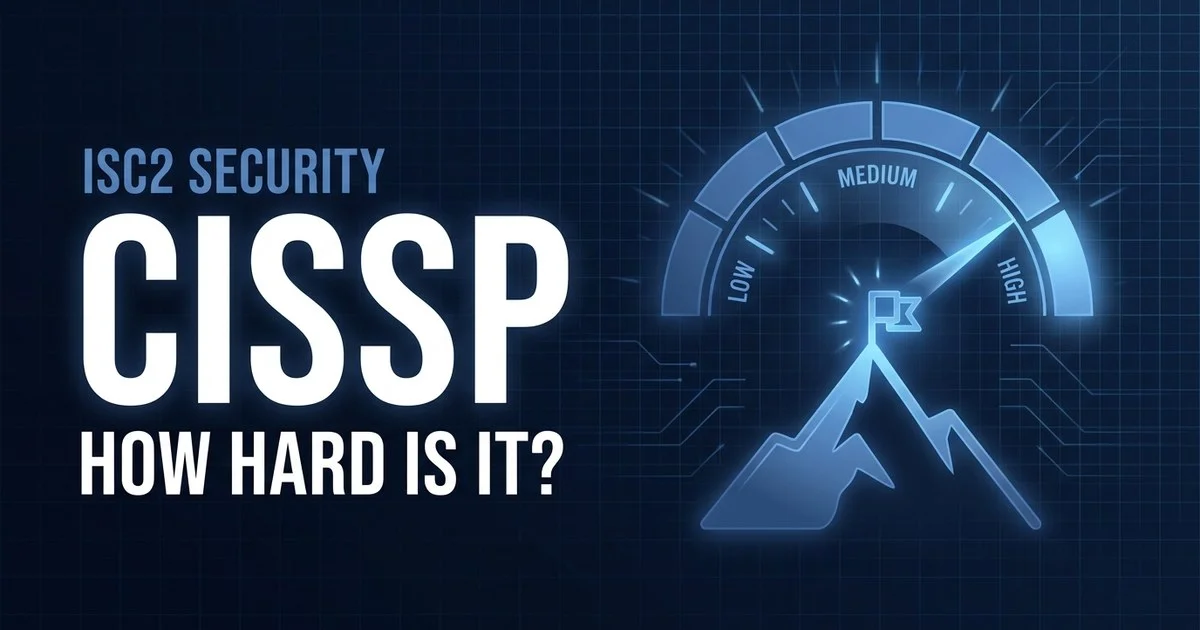
CISSP difficulty rating: 8.5 / 10
On our scale, CISSP lands firmly in "Very Hard" — above almost every associate cloud or networking exam, and just short of the most brutal hands-on labs. Here is where it sits:
What actually makes CISSP hard
Sheer breadth
HighEight domains from security architecture to software development security — a mile wide, and you cannot skip your weak areas.
"Think like a manager"
HighQuestions reward the best risk-based, governance-first answer — not the most technical one. Engineers often over-think.
Adaptive (CAT) format
MediumThe computerised adaptive test keeps serving questions near your limit, so it never feels easy and you cannot review answers.
Experience requirement
MediumFive years of paid, relevant experience (or four with a degree) is required to become certified — a barrier before you start.
Who finds CISSP hardest?
Harder for you if…
- You are a deep specialist (all your time in one domain)
- You are a hands-on engineer who dislikes governance/policy
- You over-analyse and pick the "technically correct" answer
- You have less than a few years of broad security exposure
Easier for you if…
- You have broad, cross-domain security experience
- You already think in terms of risk, policy, and business impact
- You are comfortable eliminating "almost right" options
- You have led or advised, not just implemented
CISSP vs other certifications
Difficulty is relative. Here is roughly how CISSP compares to other popular certs on our 10-point scale (estimates — your mileage varies with background):
The honest verdict
CISSP is genuinely hard — but it is beatable with the right preparation, and it is not a research-grade technical exam. The people who fail usually do so for one of two reasons: they under-estimated the breadth and left weak domains unstudied, or they answered questions like an engineer instead of a security leader.
Get comfortable across all eight domains, drill hundreds of scenario questions until the "manager mindset" clicks, and the 8.5 becomes very passable. Preparation, not raw intelligence, is what separates a pass from a fail here.
Train for the CISSP mindset
Hundreds of CISSP scenario questions with explanations and timed adaptive-style mocks in the ExamCert CISSP app — the fastest way to rewire from engineer to security manager and pass first time.
How hard is CISSP: FAQ
How hard is the CISSP exam, really?
We rate it about 8.5/10 — one of the hardest mainstream security certs. The difficulty is breadth (eight domains), the adaptive format, and a question style that rewards risk-manager thinking over hands-on technical answers, not impossible technical depth.
What is the CISSP pass rate?
ISC2 does not publish one. Community estimates commonly land around 50–70% first-attempt, so plenty of prepared professionals still fail once. Treat any exact number as an estimate.
How long should I study for CISSP?
Typically 2–4 months and 100–150 hours, though it varies with your background. Broad, experienced security pros need less; anyone new to a domain like security architecture needs more.
Is CISSP harder than Security+?
Yes, considerably. Security+ is an early-career fundamentals exam; CISSP is a management-level credential with a five-year experience requirement, more breadth, and a tougher question style.
ExamCert Team — we build exam-prep apps and study resources for 90+ certifications. Difficulty ratings and pass-rate estimates are our informed opinion from candidate reports and public data, not official figures.
Related: CISSP exam guide · CISSP practice questions · Free practice tests