How Hard Is CCNA in 2026? An Honest Difficulty Rating
The CCNA is many people's first real networking cert — and it has a reputation for being a grind. Here is a straight answer: a difficulty rating, the pass-rate picture, what actually makes it tough, and who struggles most.
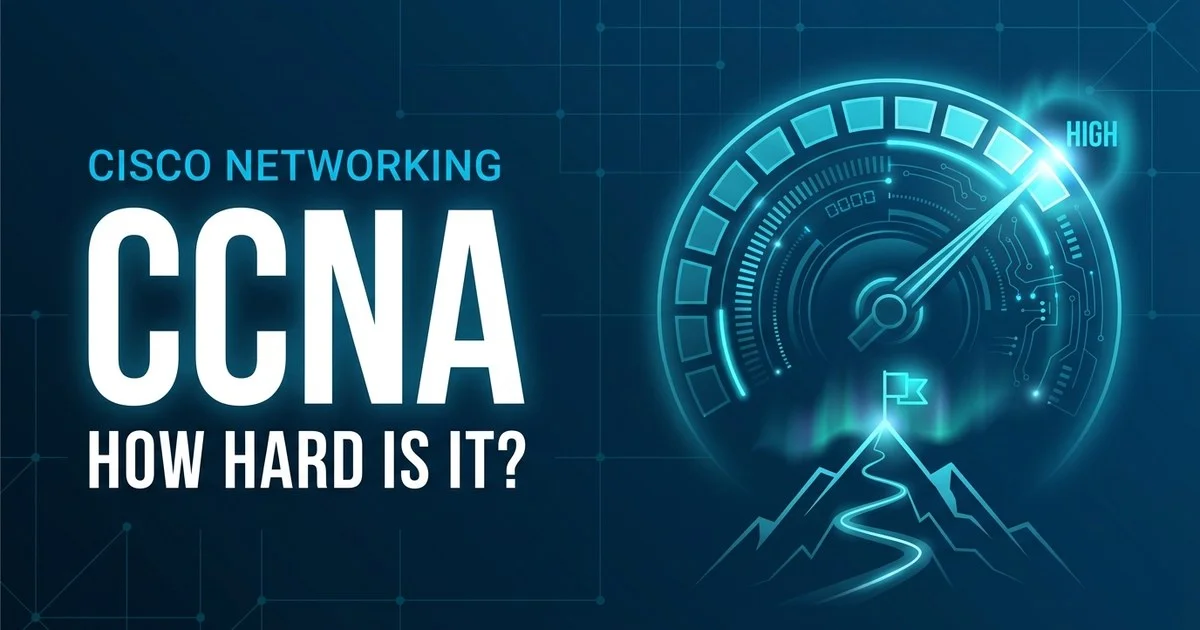
The CCNA (Cisco Certified Network Associate, exam 200-301) is the on-ramp to a networking career, and for a lot of people it is the first genuinely challenging certification they attempt. So is it actually hard? Yes — but in a very specific way. It is not brutal theory or a five-year experience gate; it is a broad blueprint, a fast clock, and hands-on tasks that punish anyone who only memorised slides. Here is an honest breakdown.
CCNA difficulty rating: 6.5 / 10
On our scale, the CCNA lands in the "Hard" band — noticeably tougher than an entry fundamentals exam like Security+, roughly level with an associate cloud cert, but well below the pro-level and expert Cisco tracks. It is hard for a first cert, not hard in absolute terms. Here is where it sits:
What actually makes the CCNA hard
Subnetting under the clock
HighIP and subnetting math shows up throughout, and on a 120-minute clock you cannot work each one out on paper. It has to be automatic — the top place candidates lose time and confidence.
Hands-on simulations
HighSim and simlet items make you configure real VLANs, OSPF, or ACLs from memory. They are weighted heavily, eat 5–10 minutes each, and once you move on you cannot return to fix them.
Very broad blueprint
MediumSix domains — network fundamentals, access/switching, IP connectivity/routing, IP services, security fundamentals, and automation. You cannot skip a weak area; every topic is fair game.
Time pressure, no going back
MediumThe exam is linear: no flagging or reviewing answered questions. One slow simulation early can starve the rest of the paper of time, which is why so many first-timers run out of clock.
Who finds the CCNA hardest?
Harder for you if…
- You are brand new to networking with no IT background
- You still work out subnets with long-hand arithmetic
- You studied videos and notes but rarely touched a CLI
- You struggle under a strict clock with no answer review
Easier for you if…
- You already work in IT, support, or help-desk roles
- Subnetting and the "magic number" trick are second nature
- You have logged real hours in Packet Tracer or on live gear
- You are comfortable configuring VLANs, OSPF, and ACLs from memory
CCNA vs other certifications
Difficulty is relative. Here is roughly how the CCNA compares to other popular certs on our 10-point scale (estimates — your mileage varies with background):
The honest verdict
The CCNA is genuinely hard for a first certification, but it is squarely beatable with the right preparation. The people who fail rarely do so because the material is beyond them — they fail because their subnetting was slow, they panicked on a simulation, or they mismanaged the clock and left questions unanswered. All three are preparation problems, not intelligence problems.
Make subnetting automatic, spend real hours configuring VLANs, OSPF, and ACLs until the commands come without thinking, and rehearse under a timer so the linear format holds no surprises. Do that and the 6.5 becomes very passable, often on the first attempt with no prior networking experience.
Train for the CCNA the smart way
Hundreds of CCNA 200-301 practice questions with explanations, subnetting drills, and timed mocks in the ExamCert CCNA app — build the speed and CLI reflexes the real exam rewards and pass first time.
How hard is the CCNA: FAQ
How hard is the CCNA exam, really?
We rate the CCNA 200-301 about 6.5/10 — genuinely hard for a first certification, but very beatable with steady preparation. The difficulty is not deep theory; it is the combination of fast subnetting under a ticking clock, hands-on simulation questions where you type real IOS commands and cannot go back, and a broad blueprint that spans network fundamentals, switching, routing, security, and automation.
What is the CCNA pass rate?
Cisco does not publish an official pass rate for the CCNA, so any specific percentage you see online is an estimate rather than a confirmed figure. What is clear from candidate reports is that a meaningful share of first-time takers fail, most often because of weak subnetting speed, simulation panic, or poor time management rather than a lack of overall knowledge.
How long should I study for the CCNA?
Most candidates spend roughly 150 to 250 hours over three to five months, though it varies with your background. People already working in IT can often be ready in around 80 to 120 hours, while complete beginners to networking usually need 200 hours or more of structured study plus consistent lab time in Packet Tracer or real gear.
Do I need experience to take the CCNA?
No. There is no formal prerequisite or work-experience requirement to sit the CCNA 200-301. Cisco recommends about a year of hands-on networking experience as a guideline, but plenty of people pass with no prior background by studying the blueprint and drilling labs. That open door is a big part of why the CCNA is such a popular first cert.
ExamCert Team — we build exam-prep apps and study resources for 90+ certifications. Difficulty ratings and pass-rate estimates are our informed opinion from candidate reports and public data, not official figures.
Related: CCNA exam guide · CCNA exam topics · Free practice tests