CISSP Common Mistakes: Why People Fail (and How to Pass)
Roughly half of first-time CISSP candidates fail — and most of them already work in security. They fail because they answer like a technician when ISC2 is testing whether you think like a manager. Here are the 8 mistakes that actually sink people, why each one happens, and the exact fix.
01 The real numbers
ISC2 has never published an official CISSP pass rate, so treat every figure you read as an estimate, not gospel. With that caveat firmly in place: training providers and community data have long pointed to a first-time pass rate somewhere around 50% — meaning roughly half of candidates fail their first attempt. What makes that number sting is who fails. These are not beginners; CISSP requires five years of paid security experience, so almost everyone in the room is a working professional. They fail because of how they answer, not because they lack knowledge.
The exam is scored on a scaled 0–1000 range and you need 700 to pass. It is not a straight percentage — difficulty is normalised across the item bank, so you cannot simply count correct answers. It is delivered as Computerised Adaptive Testing (CAT): between 100 and 150 questions in a maximum of 3 hours, with 25 unscored pretest items mixed in that you cannot identify. The engine adapts to you, decides when it has enough evidence, and may end your exam at question 100 or run you to 150.
02 The 8 reasons people fail
Answering as a technician instead of a manager
The mistake: picking the most technically clever control when the question rewards a policy, training, or risk-acceptance response.
Why it happens: the candidate is a strong engineer. Years of hands-on instinct say "fix it at the firewall", and that instinct is exactly what ISC2 is screening out.
The fix: default to people, policy, and process before technology. Ask "what would a CISO do first?" — usually understand the risk, get management buy-in, write the policy — then choose.
Underestimating the exam because you're experienced
The mistake: assuming a decade of security work means you can sit the CISSP after a couple of weekends of skimming.
Why it happens: the experience requirement breeds overconfidence. Real-world depth in two or three domains feels like it should cover all eight.
The fix: respect the breadth. Budget 8–12 weeks of structured study even if you are senior; your job experience is depth, and CISSP rewards even coverage.
Cramming facts instead of understanding concepts
The mistake: memorising port numbers, encryption key sizes, and acronym lists, expecting recall questions.
Why it happens: facts are easy to drill and feel like measurable progress. Most other IT exams reward exactly this.
The fix: learn why a control exists and when you would choose it. CISSP asks you to apply concepts to a scenario, not to regurgitate a number you memorised last night.
Going narrow when the exam spans all 8 domains
The mistake: over-studying your day-job domain (often Security Operations or Network Security) and skimming Asset Security or Software Development Security.
Why it happens: people study what is comfortable, and the CAT engine will happily probe your weakest domain until it finds the floor.
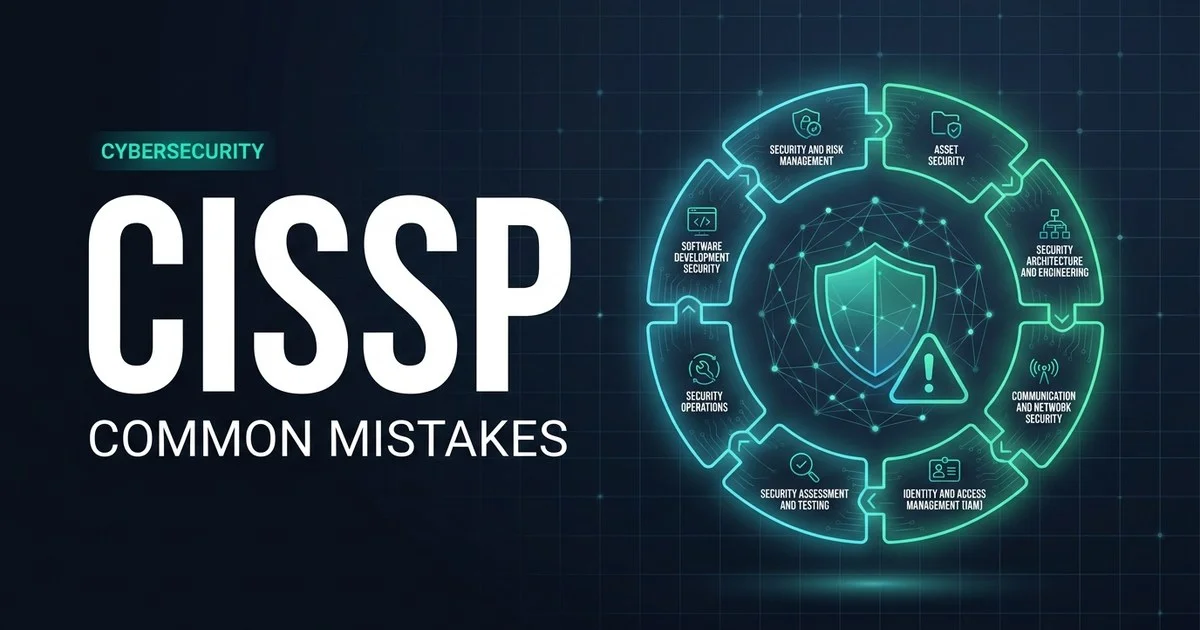
The fix: weight by the blueprint — Security & Risk Management is 16%, the single heaviest domain, and Domains 3–7 sit at 12–13% each. No domain can be a black hole.
Neglecting Security and Risk Management (Domain 1)
The mistake: treating risk, governance, law, and ethics as soft "fluff" and rushing past them to the technical domains.
Why it happens: engineers find risk frameworks abstract and dull next to crypto and networking. So they under-invest in the largest domain.
The fix: master Domain 1 cold — risk treatment, the (ISC)² Code of Ethics, due care vs due diligence, BCP/DR priorities. It is 16% of the exam and shapes the "manager" mindset everywhere else.
Not practising ISC2-style "best answer" questions
The mistake: drilling questions where one option is obviously right, so you never train the skill of separating two correct answers.
Why it happens: cheap question banks ask "what does X do?" instead of "what should you do first/ best / most". The real exam almost never works that way.
The fix: use questions that force a choice between plausible options, and practise reasoning to the best answer — the one a security leader would defend — not merely a true one.
Forgetting the CAT format won't let you go back
The mistake: planning to "flag and review" questions, then realising mid-exam that CAT has no skip, no flag, and no going back.
Why it happens: candidates train on linear practice tests with review screens, so they never rehearse committing to an answer once and moving on.
The fix: practise a one-and-done rhythm. Read carefully, reason to the best answer, commit, move on. Build the discipline before exam day, not during it.
Ignoring mental stamina and exam-day fatigue
The mistake: never sitting a long, uninterrupted session, then fading after 80 dense management-judgement questions.
Why it happens: short practice sets are painless; nobody enjoys a 3-hour grind, so focus and decision quality go untested under fatigue.
The fix: rehearse full-length, timed sessions of 100+ questions so concentration in hour three is a trained habit, not a gamble. Fatigue is where late questions get lost.
03 Study habits that backfire vs. work
Same hours, wildly different outcomes. On the CISSP the difference is almost entirely about training judgement rather than collecting facts.
| What fails | What works instead |
|---|---|
| Memorising ports, key sizes and acronyms | Understanding why a control exists and when a manager would choose it |
| Answering from your engineer's instinct | Asking "what would a CISO do first?" — risk, people, policy, then tech |
| Re-reading the official study guide cover to cover | Active recall — answer best-answer questions, then look up what you missed |
| Easy banks where one option is clearly right | ISC2-style questions that force a choice between two plausible answers |
| Studying only your strongest domains | Weighting by blueprint — lead with Domain 1 (16%), cover all eight evenly |
04 Exam-day mistakes that cost passes
Plenty of well-prepared people lose the CISSP in the room, not in the books — usually by fighting the CAT format or letting fatigue erode their judgement.
05 Are you actually ready? A pre-exam check
If you cannot honestly tick every box below, you are in the band where people fail. Fix the gaps before you book.
- You instinctively answer like a manager — risk, people, policy and governance before technology.
- You score a repeatable 80%+ on fresh, full-length, ISC2-style best-answer question sets.
- Security & Risk Management (Domain 1, 16%) is one of your strongest domains, not your weakest.
- No single domain is a black hole — your weakest domain is still above 70%.
- You can reason to the best answer when two options are both technically correct.
- You have rehearsed the CAT rhythm — commit to each answer, no going back, no flagging.
- You have sat a full-length, fatiguing session and your judgement held in hour three.
06 FAQ
What is the CISSP pass rate?
ISC2 does not publish official CISSP pass rates, so every figure is an estimate. Community and training-provider estimates commonly put the first-time pass rate somewhere around 50%, meaning roughly half of candidates fail their first attempt. The exam uses a scaled 0–1000 score and you need 700 to pass.
Why do so many people fail the CISSP?
The single biggest reason is answering like a technician instead of a manager. The CISSP tests judgement at the level of a security manager or CISO, so the best answer is usually the one that addresses policy, people, risk, and governance before reaching for a technical control. Experienced engineers who pick the hands-on fix repeatedly choose a correct-but-not-best answer and fail.
How long do you have to wait to retake the CISSP?
If you fail, ISC2 makes you wait 30 days before a second attempt, 90 days before a third, and 180 days before any further attempt, with a maximum of four attempts in any rolling 12-month period. You pay the full exam fee (commonly around $749) each time, which is why it pays to be genuinely ready before booking.
Can you go back and change answers on the CISSP CAT exam?
No. The CISSP is delivered as Computerised Adaptive Testing (CAT). Once you submit an answer the engine adapts the next question to it, so you cannot skip, flag, or return to a previous question. You must commit to each answer before moving on, which is why careful first reads and managing mental stamina matter so much.