AZ DP-100 Complete Guide 2026: Master Data Scientist Associate
Complete guide covering AZ Machine Learning, Python SDK, ML pipelines, and model deployment to pass your Data Scientist certification.
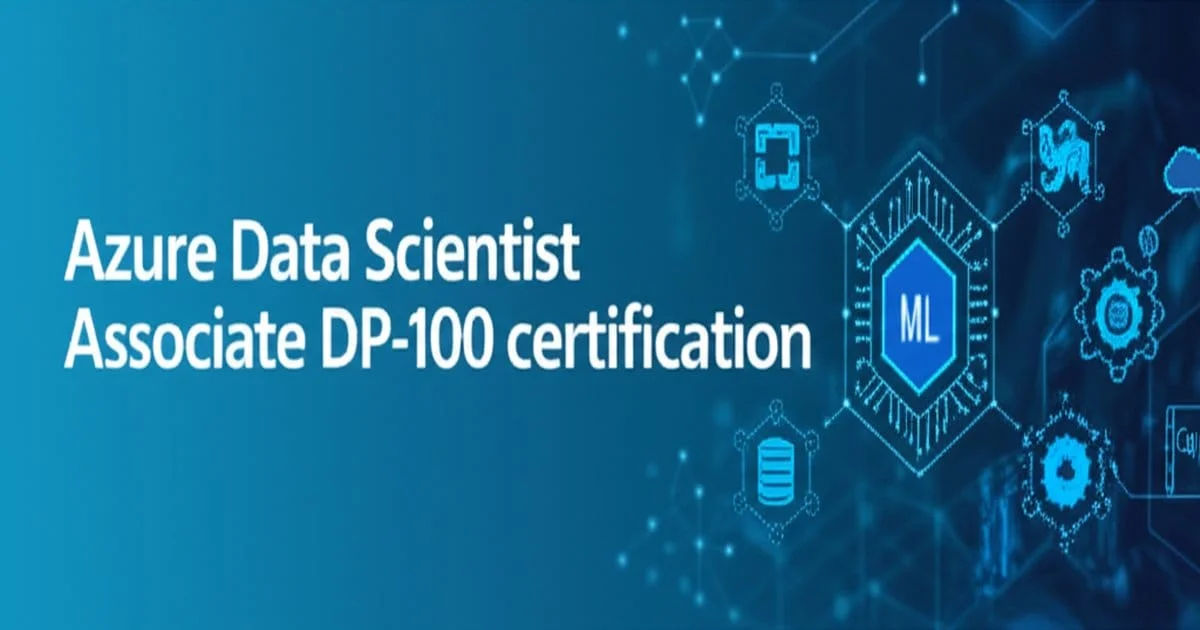
Table of Contents
What is AZ DP-100?
The Microsoft AZ Data Scientist Associate (DP-100) certification validates your expertise in applying data science and machine learning to implement and run machine learning workloads on AZ. It's the premier certification for data scientists working with AZ Machine Learning.
DP-100 focuses on the end-to-end machine learning lifecycle - from data preparation and model training to deployment and monitoring. You'll demonstrate proficiency with AZ Machine Learning workspace, Python SDK v2, automated ML, and responsible AI practices.
Target Audience: Data scientists, ML engineers, AI practitioners, and developers who design and implement machine learning solutions using AZ Machine Learning, Python, and popular ML frameworks like scikit-learn, PyTorch, and TensorFlow.
Exam Format & Details
Question Types
The DP-100 exam includes several question formats:
- Multiple Choice: Select ONE correct answer from options
- Multiple Response: Select ALL answers that apply
- Drag and Drop: Arrange steps or match items correctly
- Case Studies: Scenario-based questions requiring analysis
- Code Completion: Fill in Python code snippets for ML tasks
Python-Heavy Exam: Expect to see Python code throughout the exam. Know the AZ ML Python SDK v2, pandas, scikit-learn, and common ML patterns. Understanding code is essential, not optional!
Exam Domains Breakdown
The DP-100 exam covers four main domains. Focus your study time according to these weights.
Design ML solutions for business requirements, select compute specifications, create AZ ML workspace, manage data assets and datastores, configure environments and compute targets.
Explore and preprocess data with pandas, perform feature engineering, train and evaluate models using automated ML and custom training scripts, tune hyperparameters with sweep jobs.
Register models, create and run ML pipelines, implement MLflow for experiment tracking, manage model versions, apply responsible AI practices and model interpretability.
Deploy models to managed online endpoints and batch endpoints, configure autoscaling, monitor model performance, implement data drift detection, set up retraining triggers.
Key Services to Master
AZ Machine Learning Workspace
- Workspace: Central resource for all ML assets and experiments
- Datastores: Connect to AZ Blob, Data Lake, SQL databases
- Data Assets: URIs, folders, and MLTable for data versioning
- Compute Targets: Compute instances, clusters, and serverless compute
- Environments: Curated and custom Docker environments
Automated ML (AutoML)
- Task Types: Classification, regression, forecasting, computer vision, NLP
- Featurization: Automatic feature engineering and selection
- Model Selection: Algorithm screening and hyperparameter tuning
- Guardrails: Data quality checks and validation splits
- Explainability: Feature importance and model explanations
AZ ML Designer
- Visual Pipelines: Drag-and-drop interface for ML workflows
- Built-in Components: Pre-built modules for common ML tasks
- Custom Components: Create reusable pipeline components
- Real-time Inference: Deploy pipelines as web services
- Batch Inference: Score large datasets efficiently
MLflow Integration
- Experiment Tracking: Log metrics, parameters, and artifacts
- Model Registry: Version and manage models centrally
- Model Packaging: MLflow model format for deployment
- Autologging: Automatic logging for popular frameworks
- Comparison: Compare runs across experiments
Responsible AI
- Fairness: Assess and mitigate model bias across groups
- Interpretability: Explain model predictions with SHAP values
- Error Analysis: Identify and understand error patterns
- Data Explorer: Analyze dataset characteristics
- Responsible AI Dashboard: Comprehensive model assessment tool
Prerequisites
Before diving into DP-100, ensure you have foundational knowledge in these areas:
Python Programming
- Proficiency with Python syntax, functions, and classes
- Experience with pandas for data manipulation
- Familiarity with NumPy for numerical computing
- Understanding of Jupyter notebooks workflow
Statistics & Mathematics
- Descriptive statistics (mean, median, standard deviation)
- Probability distributions and hypothesis testing
- Linear algebra basics (matrices, vectors)
- Calculus fundamentals for understanding optimization
Machine Learning Fundamentals
- Supervised learning: classification and regression
- Unsupervised learning: clustering, dimensionality reduction
- Model evaluation metrics (accuracy, precision, recall, F1, AUC)
- Train/validation/test splits and cross-validation
- Overfitting, underfitting, and regularization concepts
AZ Basics: While not required, familiarity with AZ portal, resource groups, and basic AZ services (Storage, Virtual Networks) will help you navigate the exam scenarios more easily.
Recommended Study Strategy
Phase 1: Foundation (Weeks 1-3)
- Complete Microsoft Learn path: "AZ Data Scientist Associate"
- Set up AZ ML workspace and explore the studio interface
- Run sample notebooks to understand SDK v2 patterns
- Practice creating compute instances and clusters
- Focus on: Workspace setup, data assets, environments
Phase 2: Core Skills (Weeks 4-6)
- Deep dive into AutoML: run classification and regression experiments
- Build custom training scripts with command jobs
- Implement hyperparameter tuning with sweep jobs
- Practice MLflow integration for experiment tracking
- Focus on: Training workflows, evaluation, MLflow
Phase 3: Deployment & Advanced (Weeks 7-10)
- Build and run ML pipelines with components
- Deploy models to managed online endpoints
- Configure batch endpoints for large-scale scoring
- Explore Responsible AI dashboard and interpretability
- Take full practice exams, target 85%+ before real exam
Ready to Start Practicing?
Get access to 1000+ DP-100 practice questions covering all exam domains
Start Practicing NowPlan Your Study Journey
Use our free tools to optimize your preparation
Hands-On Practice Tips
Build ML Pipelines
Create end-to-end pipelines that demonstrate the full ML lifecycle:
# AZ ML Pipeline Example (SDK v2)
from azure.ai.ml import MLClient, command, Input, Output
from azure.ai.ml.dsl import pipeline

@pipeline()
def training_pipeline(input_data):
    # Data preparation step
    prep_step = prep_component(raw_data=input_data)

    # Training step
    train_step = train_component(
        training_data=prep_step.outputs.processed_data,
        learning_rate=0.01,
        epochs=10
    )

    # Evaluation step
    eval_step = eval_component(
        model=train_step.outputs.model,
        test_data=prep_step.outputs.test_data
    )

    return {"trained_model": train_step.outputs.model}

# Submit pipeline
pipeline_job = ml_client.jobs.create_or_update(
    training_pipeline(input_data=Input(type="uri_folder", path="..."))
)
Train and Evaluate Models
# AutoML Classification Job
from azure.ai.ml import automl

classification_job = automl.classification(
    compute="cpu-cluster",
    experiment_name="bank-marketing-classification",
    training_data=training_data,
    target_column_name="y",
    primary_metric="AUC_weighted",
    n_cross_validations=5,
    enable_model_explainability=True
)

# Set limits
classification_job.set_limits(
    timeout_minutes=60,
    trial_timeout_minutes=20,
    max_trials=20,
    enable_early_termination=True
)

# Submit job
returned_job = ml_client.jobs.create_or_update(classification_job)
Deploy Models to Endpoints
# Create managed online endpoint
from azure.ai.ml.entities import ManagedOnlineEndpoint, ManagedOnlineDeployment

endpoint = ManagedOnlineEndpoint(
    name="my-model-endpoint",
    description="Endpoint for credit scoring model",
    auth_mode="key"
)
ml_client.online_endpoints.begin_create_or_update(endpoint).result()

# Create deployment
deployment = ManagedOnlineDeployment(
    name="blue",
    endpoint_name="my-model-endpoint",
    model=registered_model,
    instance_type="Standard_DS3_v2",
    instance_count=1
)
ml_client.online_deployments.begin_create_or_update(deployment).result()

# Route traffic
endpoint.traffic = {"blue": 100}
ml_client.online_endpoints.begin_create_or_update(endpoint).result()
Implement MLflow Tracking
import mlflow
from sklearn.ensemble import RandomForestClassifier
from sklearn.metrics import accuracy_score, f1_score

# Start MLflow run
with mlflow.start_run():
    # Log parameters
    mlflow.log_param("n_estimators", 100)
    mlflow.log_param("max_depth", 10)

    # Train model
    model = RandomForestClassifier(n_estimators=100, max_depth=10)
    model.fit(X_train, y_train)

    # Evaluate and log metrics
    predictions = model.predict(X_test)
    mlflow.log_metric("accuracy", accuracy_score(y_test, predictions))
    mlflow.log_metric("f1_score", f1_score(y_test, predictions))

    # Log model
    mlflow.sklearn.log_model(model, "model")
Exam Day Tips
- Read Carefully: Pay attention to keywords like "MUST", "SHOULD", "minimize cost", "reduce latency"
- Know SDK Patterns: Understand MLClient methods, job types, and deployment configurations
- AutoML Settings: Know primary metrics for classification (AUC, F1) vs regression (RMSE, R2)
- Compute Selection: Match compute type to workload - GPU for deep learning, CPU for traditional ML
- Responsible AI: Understand when to use fairness assessment, interpretability tools
- Time Management: Allocate ~2 minutes per question, flag difficult ones for review
- Deployment Choices: Online endpoints for real-time, batch endpoints for large-scale scoring
Common Pitfalls: Don't confuse SDK v1 patterns with SDK v2. The exam focuses on SDK v2 (azure-ai-ml package). Know the difference between compute instances, compute clusters, and serverless compute.
Frequently Asked Questions
What is the passing score for AZ DP-100?
The passing score is 700 out of 1000. Questions are weighted differently, so focus on understanding concepts rather than counting questions.
What programming language is required for DP-100?
Python is the primary language. You should be comfortable with Python, pandas, scikit-learn, and the AZ Machine Learning Python SDK v2. R is not tested on this exam.
Do I need AI-900 before taking DP-100?
No, AI-900 is not a prerequisite. However, if you're new to AI concepts, AI-900 provides a good foundation. DP-100 is more hands-on and assumes you understand ML fundamentals already.
How long should I study for DP-100?
Most candidates need 8-10 weeks of dedicated study, assuming you have Python and basic ML knowledge. If you're new to machine learning, add 4-6 weeks for foundational concepts and hands-on practice.
Is DP-100 harder than AZ-204 or AZ-104?
DP-100 requires specialized data science knowledge. If you have ML experience, it may feel more natural than AZ admin tasks. If you're primarily a developer without ML background, expect a steeper learning curve.
What AZ ML features should I focus on?
Prioritize: AZ ML workspace setup, AutoML, Python SDK v2 (command jobs, sweep jobs, pipelines), MLflow integration, managed endpoints, and Responsible AI dashboard. These cover the majority of exam content.
Start Your Data Scientist Journey Today
Join thousands who passed with ExamCert. 500–1,000+ practice questions and 100% money-back guarantee.