AWS SAA-C03 Exam Format: What to Expect
The AWS Certified Solutions Architect – Associate exam is 65 questions in 130 minutes, all multiple-choice and multiple-response — no hands-on labs. Here is exactly what the exam looks like on screen, the question types, what exam day feels like, and how scoring works.
01 The format in one minute
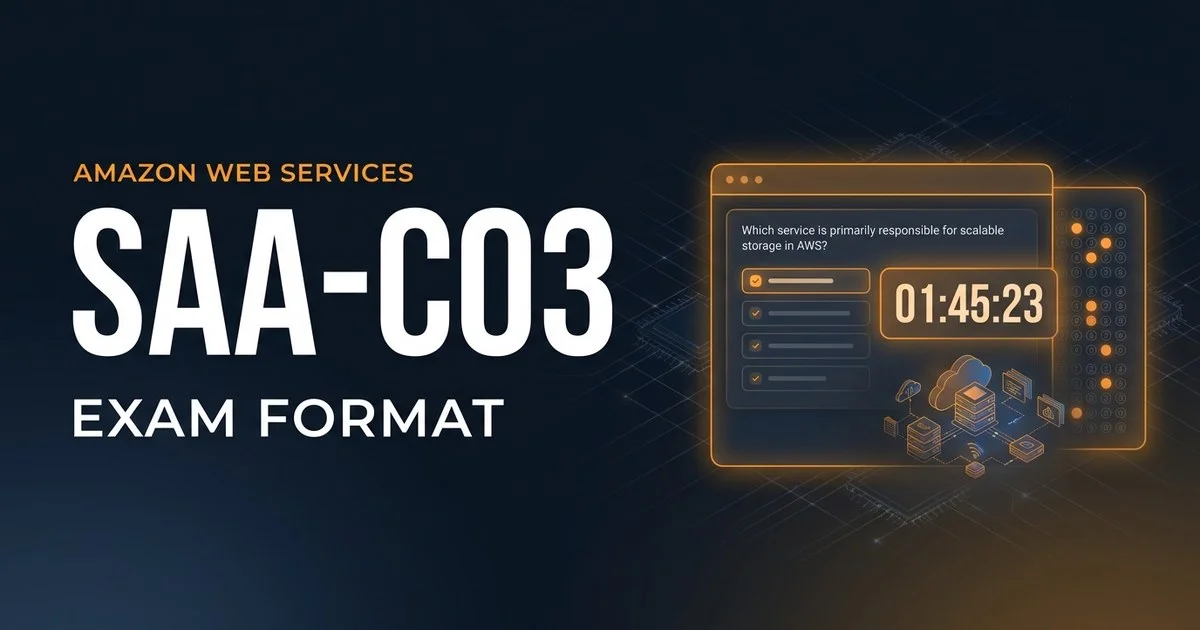
Below is a close approximation of what a single question looks like in the Pearson VUE test engine. The header shows your position and the countdown clock; the footer holds the flag-for-review toggle and navigation:
A company runs a stateless web tier on EC2 behind an Application Load Balancer. Traffic is highly variable and the team wants to minimise cost while staying highly available across two Availability Zones. Which approach best meets these requirements?
Illustration of the test-engine layout — not an actual exam question.
That single screen captures most of what makes SAA-C03 tick: long, real-world scenario stems, four plausible options where more than one “works” but only one is best, and a clock that gives you about 120 seconds to decide. Get comfortable reading and eliminating under that pace and the format stops being a surprise.
02 Question types you'll face
AWS keeps the SAA-C03 deliberately simple in form — the difficulty is in the scenarios, not in exotic interactions. There are only two scored question types, and knowing how each is marked changes how you answer.
Multiple choice
Four options, exactly one correct. The other three are distractors that are technically valid but worse on cost, resilience, or operational overhead. The majority of the exam.
Most questionsMultiple response
Five or more options; the stem states how many to pick (“choose TWO”). You must select every correct option and no wrong ones — partial credit is not awarded.
A handfulScenario stems
Not a separate type, but the defining trait: most questions wrap a mini case study around the choice — requirements like “most cost-effective” or “least operational overhead” are the deciding words.
ThroughoutLabs & simulations
None. Unlike some Azure or CompTIA exams, the SAA-C03 has no performance-based tasks, no console work, and no drag-and-drop. Every answer is a click.
Not on this exam03 Timing, structure & domain weighting
You have 130 minutes for 65 questions. Only 50 are scored — the other 15 are unscored pilot items AWS is trialling for future exams. They are mixed in invisibly, so treat all 65 as real. Your score is compensatory: there is one overall pass mark and no requirement to pass each domain individually.
| Domain | Weight | What it covers |
|---|---|---|
| 1. Design Secure Architectures | 30% | IAM, data protection, secure network design |
| 2. Design Resilient Architectures | 26% | Decoupling, multi-AZ/region, fault tolerance |
| 3. Design High-Performing Architectures | 24% | Storage, compute, network & database performance |
| 4. Design Cost-Optimized Architectures | 20% | Right-sizing, pricing models, cost-effective storage |
04 What exam day actually looks like
You can sit the SAA-C03 two ways: at a Pearson VUE test centre, or online with a remote proctor from home. The exam itself is identical; the check-in is what differs. Here is the typical flow for an online-proctored sitting.
Log in and launch early
Open the OnVUE software, run the system test, and start check-in up to 30 minutes ahead. Late arrivals can be refused.
ID & room scan
Photograph your government ID and your workspace from four angles. Your desk must be clear — no notes, phone, second monitor, or drinks unless explicitly allowed.
Short walkthrough
A brief, untimed tutorial of the test engine. The 130-minute clock does not start until you begin the actual exam.
The exam
65 questions, your clock counting down. Flag, skip, and revisit freely. A proctor monitors by webcam — looking away or speaking can trigger a warning.
Submit & short survey
Submit when done or when time expires. An optional survey follows; it does not affect your score.
Provisional result
A pass/fail message appears on screen. The official scored report lands in your AWS Certification (CertMetrics) account, usually within about five business days.
Allowed
- A valid, unexpired government photo ID
- An on-screen scratchpad (no physical paper online)
- Flagging and reviewing questions before you submit
- Requesting a different language at booking time
Not allowed
- Phones, smartwatches, headphones, or second screens
- Notes, books, or scratch paper (online proctoring)
- Other people entering or talking in the room
- Leaving your seat without proctor permission
05 How scoring & results work
SAA-C03 is reported on a scaled range of 100–1000, and you need 720 to pass. Because the score is scaled and compensatory, a strong showing in one domain can offset a weaker one — you do not have to clear a bar in each domain, only overall.
You will see an immediate provisional pass/fail on screen, but the full score report — including a per-domain “meets / needs improvement” breakdown — arrives in CertMetrics within about five business days. If you do not pass, AWS requires a 14-day wait before you re-sit, and you pay the $150 fee again each attempt.
06 FAQ
How many questions are on the AWS SAA-C03 exam?
65 questions. Only 50 are scored — the other 15 are unscored pilot questions AWS uses to trial future items, and you cannot tell which is which, so answer all 65 as if they count.
How long is the AWS Solutions Architect Associate exam?
130 minutes for all 65 questions — about two minutes per question. Candidates testing in a non-native language can request an extra 30 minutes through the accommodation process before booking.
What types of questions are on the SAA-C03?
Two types: multiple choice (one correct answer of four) and multiple response (two or more correct, where the stem tells you how many to pick). There are no hands-on labs or performance-based questions — every question is scenario text with selectable options.
Can you go back and change answers on the AWS SAA-C03?
Yes. The exam is fully navigable — you can move forward and backward, flag any question for review, and revisit flagged questions before submitting. There is no penalty for wrong answers, so never leave one blank.